Big Data in Insurance: A 2026 Game-Changer for Growth and Efficiency
Technology has revolutionized how we use data, making it more critical than ever. Companies across various sectors, including sports, healthcare, and insurance, are leveraging data insights to enhance their operations. The U.S. insurance sector, known for its innovation, is increasingly relying on Big Data. This technology empowers insurers to acquire, analyze, and interpret vast amounts of information with unprecedented speed and efficiency.
Firms that have embraced big data technologies are already seeing remarkable results. They report up to 30% greater efficiency, cost savings ranging from 40% to 70%, and a 60% increase in fraud detection rates. Furthermore, big data enables insurance companies to target potential clients with much greater precision.
The Synergy of Insurance and Big Data
Data analytics has long been a cornerstone of the insurance industry, primarily for client targeting and risk assessment. Insurers have traditionally used accident statistics, policyholder information, and third-party data to define risk categories. This data-driven approach also aids in minimizing fraud and optimizing operational costs. With the digital transformation, the volume and variety of data on customer behavior and market segmentation have exploded. Insurance companies now harness both structured and unstructured data to refine their pricing, marketing strategies, and claims processing.
Fraud is a significant challenge in the insurance industry. Research indicates that every day, there are hundreds of fraudulent claims and thousands of dishonest applications. Big data analytics can identify anomalies, analyze social media sentiment, and cross-reference information to combat this issue effectively. Insurers possess a wealth of data, and the goal is to utilize this asset to develop innovative insurance products in collaboration with carrier partners.
Here are a few examples of how data is being used to identify and manage risks:
- Health and Wellness Data: Access to a customer’s medical information has become more streamlined and insightful. Wearable fitness trackers that monitor heart rate, activity levels, and even calorie intake provide a continuous stream of data. This information helps in understanding how an individual’s current health status might impact their future well-being and longevity.
- Consumer Behavior and Financial Data: By analyzing a person’s purchasing habits and financial stability, insurers can forecast their behavior and lifestyle choices, leading to more accurate risk assessments.
- Telematics and Vehicle Data: Modern vehicles are equipped with sensors that provide constant and instantaneous data about their location, speed, and driver actions. This telematics data is invaluable for auto insurers.
- Natural Catastrophe Data: Information such as flood hazard mapping allows for a better understanding of the locations and potential intensity of future catastrophic events, enabling more accurate risk modeling.
- Smart Home and Office Data: Data from internet-connected appliances, like water usage monitors or smoke detectors, can provide early warnings of potential risks.
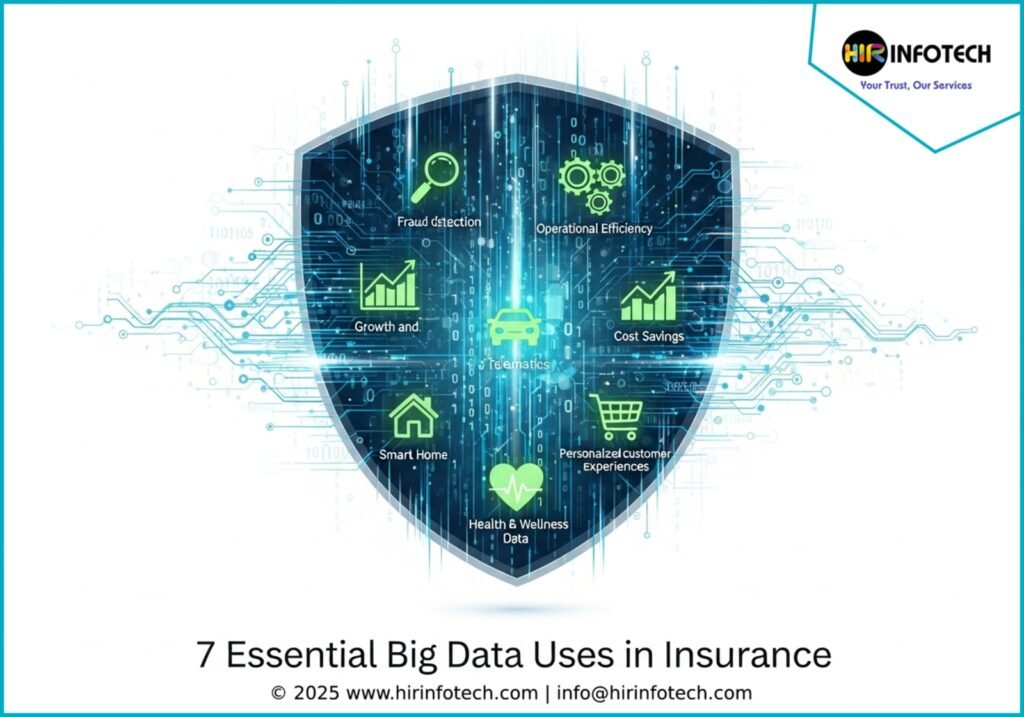
7 Powerful Applications of Big Data in the Insurance Sector
1. Acquiring New Clients
A steady stream of customers is the lifeblood of any business. Understanding what motivates your target market makes client acquisition significantly easier. In today’s social media-driven world, massive amounts of unstructured data are generated daily. Insurance companies can analyze this big data to create highly personalized and effective advertising campaigns. This approach is often more accurate and insightful than traditional methods like surveys and questionnaires.
2. Enhancing Customer Retention
Retaining existing customers is just as crucial as acquiring new ones. Companies that excel at customer retention are better positioned to thrive. For instance, studies have shown that a small percentage of loyal customers can account for a significant portion of a company’s profits. Big data can help you understand why a customer might leave your service. By identifying the root causes of customer churn, you can take proactive steps to improve your offerings and address their concerns, ultimately boosting loyalty.
3. Advanced Risk Analysis
The entire insurance model is built upon the concept of risk assessment and management. Insurers constantly evaluate risks and verify the information provided by their customers. Policyholders are then segmented into different groups based on their risk profiles. Big data revolutionizes this process by enabling more accurate risk identification and prediction. For example, an athlete with a healthy lifestyle presents a lower health risk compared to an individual with a history of poor dietary habits. By analyzing lifestyle and health data, companies can more accurately classify individuals into appropriate risk categories.
4. Proactive Fraud Detection and Prevention
Insurance fraud is a multi-billion dollar problem. In the United States, non-health insurance fraud costs the nation over $40 billion annually. This translates to an increased financial burden on the average American family, with premiums rising by $400 to $700 per year. Big data analytics provides a powerful defense against such fraudulent activities. By employing predictive modeling, insurers can compare an individual’s data against established profiles of fraudulent claims, flagging suspicious cases for further investigation.
5. Significant Cost Savings
Technological advancements have consistently driven cost-saving measures, and big data is no exception. By automating routine tasks and manual processes, insurance companies can significantly improve efficiency and reduce operational expenses. This automation in areas like claims handling and administration saves a substantial amount of time and effort. These savings can then be passed on to the customers in the form of lower premiums, which in turn promotes customer retention.
6. Personalized Pricing and Services
Every customer appreciates being treated as an individual. The demand for personalized experiences is on the rise, and businesses are taking note. To maintain a competitive edge, insurers are moving towards dynamic pricing models. With detailed information about a customer’s specific needs and risk profile, you can create a tailored insurance plan that meets their requirements. This data-driven approach allows for pricing that is both profitable for the company and affordable for the client.
7. Optimizing Internal Operations
The integration of big data tools can dramatically boost the efficiency of internal operations. By automating various processes, from researching customer histories and categorizing them into risk groups to streamlining claims processing, this technology allows for more effective workflows. Automated claims processing, for example, has been shown to reduce manual labor by as much as 80% while significantly increasing accuracy.
For expert assistance in harnessing the power of your data, explore the comprehensive data extraction services offered by Hir Infotech.
Frequently Asked Questions (FAQs)
1. What is the primary role of big data in the insurance industry?
Big data analytics helps insurers to better classify customers, manage risks more effectively, and gain a deeper understanding of customer trends and behaviors. The core function of an insurance company is to accurately price policies, and big data provides the sophisticated risk assessment tools to do so.
2. How is the insurance sector leveraging big data analytics?
The use of big data analytics is rapidly growing within the insurance industry. Companies that have invested in these technologies have seen significant returns, including a 60% improvement in fraud detection, a 30% increase in overall efficiency, and cost reductions of 40% to 70%.
3. How does data analytics improve fraud detection in insurance?
Data analytics plays a crucial role in identifying and preventing insurance fraud. By analyzing historical data and identifying patterns associated with fraudulent cases, insurance companies can flag new claims that fit these patterns for further review, thus accelerating and improving the accuracy of fraud detection.
4. What are the challenges of implementing big data in the insurance industry?
Implementing big data strategies can be complex. Challenges include dealing with legacy systems, ensuring data quality and consistency, having the necessary technical expertise, managing costs, and adhering to regulatory requirements. Partnering with an experienced data solutions provider can help overcome these hurdles.
5. How does big data contribute to a more personalized customer experience?
Big data allows insurers to move beyond generic offerings and create hyper-personalized policies. By analyzing a wide range of data, from driving habits via telematics to health metrics from wearables, insurers can tailor coverage and pricing to an individual’s specific needs and risk profile, leading to greater customer satisfaction and loyalty.
6. What is the future of big data and AI in the insurance sector?
The future will see even greater integration of big data and artificial intelligence in insurance. Emerging trends include more dynamic and real-time pricing models, the use of blockchain for enhanced data security, and more sophisticated predictive analytics for proactive risk management. This will lead to more innovative, customer-centric insurance solutions.
7. How is the Internet of Things (IoT) impacting big data in insurance?
The Internet of Things (IoT) is a major source of big data for the insurance industry. Connected devices like vehicle telematics, smart home sensors, and wearable fitness trackers provide a constant stream of real-time data. This data allows for more accurate risk assessment, personalized pricing, and proactive risk prevention.
Transform Your Business with Expert Data Solutions
Ready to unlock the full potential of your data and gain a competitive edge in the insurance industry? Hir Infotech offers a comprehensive suite of data solutions, including web scraping, data extraction, and advanced analytics. Our team of experts can help you navigate the complexities of big data and turn your information into actionable insights.
Contact Hir Infotech today to learn how our tailored data solutions can drive efficiency, reduce costs, and foster growth for your business.
#BigData #InsuranceIndustry #DataAnalytics #Insurtech #RiskManagement #FraudDetection #CustomerRetention #DataSolutions #HirInfotech