
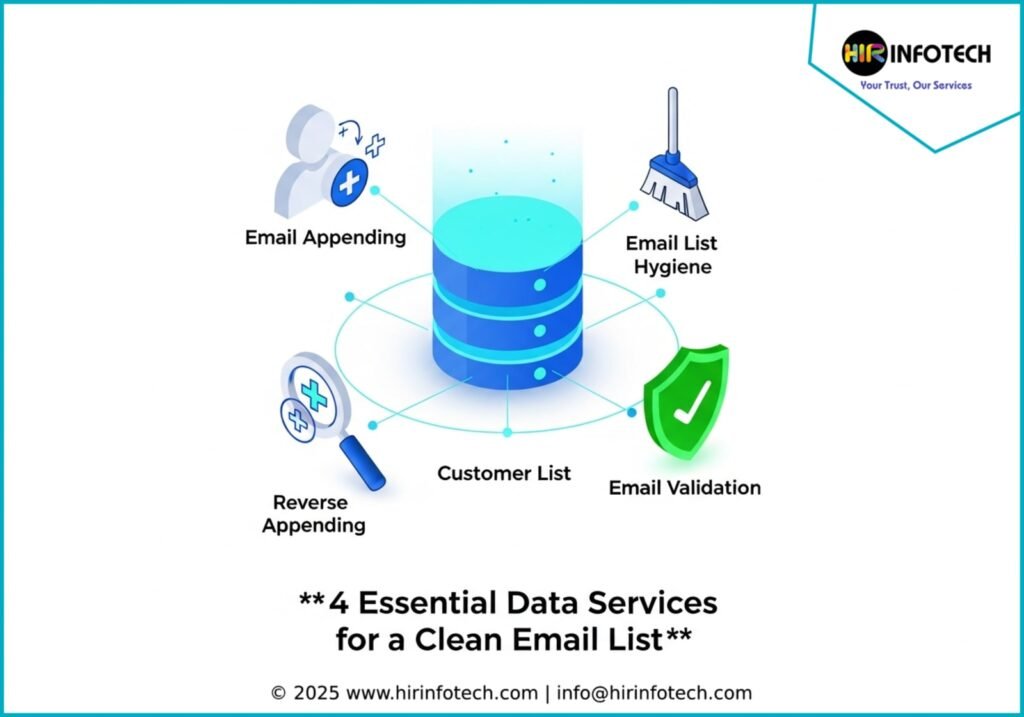
Unlock the Full Potential of Your Customer Data: Essential Data Services for a High-Caliber Email List in 2026
In the competitive landscape of digital marketing, the adage “quality over quantity” has never been more relevant, especially when it comes to your email list. While the temptation to grow your subscriber count is strong, a high-quality, engaged list is the true engine of successful email marketing. Low-quality data can lead to dismal click-through rates, soaring bounce rates, and a damaged sender reputation, making it increasingly difficult for your messages to even reach your audience’s inboxes.
As we look towards 2026, the importance of a pristine email list is paramount. The digital space is becoming more crowded, and inbox providers are employing smarter, more stringent filtering mechanisms. A staggering percentage of emails never even reach their intended destination due to poor data quality. For mid-to-large companies that rely on web scraping, data extraction, and other data-related services, maintaining the integrity of your email database is not just a best practice—it’s a critical component of your marketing infrastructure and overall business success.
This comprehensive guide will explore the essential data services that can transform your email list from a simple collection of contacts into a powerful asset for engagement and growth. We will delve into the latest trends and strategies for 2026, providing actionable insights to help you build a robust, high-performing email marketing program.
The Bedrock of Success: Why a Clean Email List Matters More Than Ever
Before we explore the solutions, let’s underscore the significance of a clean email list. Think of your email list as the foundation of a house. If the foundation is weak, cracked, or built with substandard materials, the entire structure is at risk. Similarly, a list cluttered with invalid, inactive, or irrelevant email addresses will undermine all your email marketing efforts.
The tangible benefits of a clean email list are numerous:
- Improved Deliverability: Internet Service Providers (ISPs) and mailbox providers are the gatekeepers of the inbox. They closely monitor sender reputation, which is heavily influenced by bounce rates and spam complaints. A clean list minimizes these negative signals, significantly increasing the likelihood that your emails will land in the inbox rather than the spam folder.
- Enhanced Engagement Rates: When you’re sending emails to people who are genuinely interested in your brand, you’ll naturally see higher open and click-through rates. This positive engagement further signals to ISPs that your content is valuable, creating a virtuous cycle of improved deliverability.
- Increased ROI: A clean and targeted email list means you’re not wasting resources sending messages to non-existent or uninterested contacts. This leads to more efficient campaigns and a higher return on investment for your email marketing spend.
- Better Insights and Analytics: With a clean list, your campaign metrics will provide a much more accurate picture of your performance. You’ll be able to make better-informed decisions about your content, offers, and overall strategy based on reliable data.
- Protection of Your Brand Reputation: Consistently sending emails that bounce or are marked as spam can damage your brand’s reputation not only with ISPs but also with your audience. A clean list demonstrates professionalism and respect for your subscribers’ inboxes.
Now, let’s dive into the four crucial data services that will empower you to build and maintain a high-caliber email list in 2026.
1. Email Appending: Filling in the Gaps for a Complete Customer View
Email appending is the process of adding missing email addresses to your existing customer database. You may have a wealth of customer information, such as names and postal addresses, but without a valid email address, you’re missing a vital channel for communication and engagement.
In its most effective form, email appending allows businesses to reconnect with customers and prospects, ensuring that their database remains a valuable asset. The process involves matching your known customer data against a reputable vendor’s database to identify and append accurate, deliverable email addresses.
Looking ahead to 2026, the strategic application of email appending will be more critical than ever. As customer data becomes increasingly fragmented across various touchpoints, the ability to create a unified and complete customer profile is a significant competitive advantage.
Key Benefits of Email Appending:
- Expanded Reach: Instantly grow your marketable email list by adding valid email addresses for a larger portion of your customer base.
- Improved Customer Relationships: Re-engage with customers who may have fallen off your radar due to a lack of email contact information.
- Increased Revenue Opportunities: A larger, more complete email list opens up new avenues for targeted marketing campaigns and sales promotions.
- Enhanced Data Quality: A professional email appending service will not only add missing emails but also verify the accuracy of existing data, correcting typos and outdated information.
The process is straightforward and carries minimal risk when you partner with a trusted provider. You provide your customer data, and the service provider returns an enriched list with newly appended and verified email addresses. For more insights into how to choose the right data provider, consider this comprehensive guide from Forbes Advisor on Data as a Service.
2. Email List Hygiene: The Ongoing Practice of a Healthy Database
Email list hygiene is the regular practice of identifying and removing inactive, invalid, and problematic contacts from your email list. Just as you would regularly maintain a high-performance vehicle, your email list requires ongoing care to ensure it operates at peak efficiency. Neglecting email list hygiene can lead to a host of problems, including a tarnished sender reputation and diminished campaign effectiveness.
By 2026, advanced email hygiene practices will incorporate AI-powered tools to proactively identify and flag potentially harmful email addresses in real-time. This evolution moves beyond simple reactive cleaning to a more predictive and preventative approach.
A robust email list hygiene process involves several key components:
- Removal of Invalid and Non-Deliverable Emails: This includes deleting emails with syntax errors, invalid top-level domains (TLDs), and those associated with parked or non-existent domains.
- Elimination of Duplicate Addresses: Ensure that each contact on your list is unique to avoid sending redundant messages and skewing your analytics.
- Identification and Removal of Spam Traps: Spam traps are email addresses used by ISPs and anti-spam organizations to identify senders with poor data practices. Hitting a spam trap can have severe consequences for your sender reputation.
- Segmentation of Inactive Subscribers: Subscribers who haven’t engaged with your emails in a significant period (e.g., 6-12 months) can be segmented for a re-engagement campaign or, if that fails, removed from your active sending list.
- Deletion of Departmental or Role-Based Addresses: Emails like “info@,” “support@,” or “sales@” often have low engagement and can be more likely to generate spam complaints.
Regularly cleaning your email list, ideally on a quarterly basis, will help you maintain a strong sender reputation and ensure that your messages are reaching an engaged and receptive audience.
3. Reverse Appending: Unlocking the Power of Multichannel Marketing
Reverse appending is a powerful data enrichment technique that works in the opposite direction of traditional email appending. With reverse appending, you start with an email address and add missing data points such as names, postal addresses, and even demographic information.
This process is invaluable for creating a more holistic view of your prospects and customers, enabling you to execute sophisticated multichannel marketing campaigns. For example, you can use the postal addresses obtained through reverse appending for a direct mail campaign to complement your email marketing efforts.
In 2026, the integration of data from various channels will be a key differentiator for successful marketing strategies. Reverse appending provides the crucial data needed to connect with your audience across multiple touchpoints, creating a more seamless and personalized customer journey.
The primary advantages of reverse appending include:
- A Comprehensive Customer Profile: Transform a simple email address into a rich customer profile with multiple points of contact.
- Enhanced Personalization: With more data at your disposal, you can create highly personalized marketing messages that resonate with your audience on a deeper level.
- Improved Targeting: The additional data allows for more granular segmentation and targeting, ensuring that your campaigns are reaching the most relevant audience.
- Increased Campaign Effectiveness: By leveraging multiple marketing channels, you can reinforce your message and increase the overall impact of your campaigns.
A reputable reverse append service provider can deliver high match rates, providing you with a clean and accurate data file that is ready for your marketing initiatives.
4. Email Validation: Your First Line of Defense Against Bad Data
Email validation is the process of verifying whether an email address is valid and deliverable. This is a critical first step in maintaining a clean email list and should be implemented at the point of data capture, such as on your website’s sign-up forms.
Real-time email validation can prevent invalid email addresses from ever entering your database. This proactive approach is far more effective than periodically cleaning your list after the bad data has already been collected.
As we move into 2026, email validation services are becoming increasingly sophisticated, utilizing AI and machine learning to detect not only syntactical errors but also to identify potentially risky or fraudulent email addresses.
The core functions of email validation include:
- Syntax and Formatting Checks: Ensuring that the email address follows the correct format (e.g., name@domain.com).
- Domain and Mail Server Verification: Confirming that the domain is valid and that the mail server is configured to receive emails.
- Mailbox Existence Check: Verifying that the specific mailbox exists and can accept incoming mail.
- Identification of Disposable Email Addresses: Flagging temporary email addresses that are often used to receive an initial offer and then abandoned.
By implementing a robust email validation process, you can significantly improve the accuracy of your database from the outset, leading to better deliverability and campaign performance down the line. To learn more about the top email verification tools, check out this insightful article from TechRadar on the best email validation services.
Building a Foundation for Lasting Relationships
Ultimately, the goal of every marketer should be to cultivate a high-quality email list that serves as a foundation for building lasting relationships with prospects and customers. By leveraging the power of data services like email appending, email list hygiene, reverse appending, and email validation, you can shift your focus from list growth to meaningful engagement.
These services empower you to connect with the right people, at the right time, with the right message. The result is a more effective, efficient, and profitable email marketing program that drives sustainable growth for your business.
Frequently Asked Questions (FAQs)
1. What are data services in the context of email marketing?
Data services for email marketing are specialized solutions designed to enhance the quality, accuracy, and completeness of your email list. These services include processes like email appending (adding missing emails), email hygiene (cleaning your list), reverse appending (adding other data points from an email), and email validation (verifying email addresses).
2. How often should I clean my email list?
It is generally recommended to perform a thorough cleaning of your email list at least once every quarter. However, the ideal frequency may vary depending on the size of your list and the rate at which you acquire new subscribers. Implementing real-time email validation at the point of capture can also significantly reduce the need for frequent, large-scale cleanings.
3. What is the difference between email validation and email list hygiene?
Email validation is a proactive measure that typically occurs at the point of data entry to verify if an email address is valid and deliverable. Email list hygiene, on the other hand, is a more comprehensive and ongoing process of cleaning and maintaining your entire email database by removing inactive, invalid, and other problematic contacts.
4. Can email appending services guarantee a 100% match rate?
No email appending service can guarantee a 100% match rate. The success of the appending process depends on the quality and completeness of your existing customer data and the breadth of the provider’s reference database. However, a reputable provider will be transparent about their average match rates and work to maximize the number of valid email addresses they can append to your list.
5. How does a clean email list impact my sender reputation?
A clean email list has a direct and positive impact on your sender reputation. By minimizing hard bounces (emails sent to non-existent addresses) and spam complaints, you send strong positive signals to ISPs that you are a responsible and legitimate sender. This, in turn, improves your email deliverability, ensuring more of your messages reach the inbox.
6. What are the risks of using a low-quality data service provider?
Partnering with a low-quality data service provider can have serious negative consequences. These can include receiving inaccurate or outdated data, experiencing low match rates, and potentially violating data privacy regulations. It’s crucial to vet potential providers thoroughly, looking for a proven track record, transparent processes, and a commitment to data quality and compliance.
7. How can I measure the ROI of investing in data services for my email list?
You can measure the ROI of data services by tracking key performance indicators (KPIs) before and after implementing these services. Look for improvements in email deliverability rates, open and click-through rates, and conversion rates. Additionally, you can calculate the cost savings from reduced email marketing waste and the increased revenue generated from a more engaged and responsive email list.
Take Your Data to the Next Level with Hir Infotech
Ready to unlock the full potential of your customer data and elevate your email marketing to new heights? Hir Infotech offers a comprehensive suite of data solutions, including web scraping, data extraction, and data processing services, tailored to the needs of mid-to-large companies. Our team of experts is dedicated to providing high-quality, accurate, and actionable data that will empower you to make smarter marketing decisions and achieve your business objectives.
Contact Hir Infotech today to learn how our data solutions can help you build a high-caliber email list and drive exceptional results in 2026 and beyond.
#DataServices #EmailMarketing #DataQuality #EmailListHygiene #EmailAppending #ReverseAppending #EmailValidation #LeadGeneration #MarketingStrategy #SEO #HirInfotech