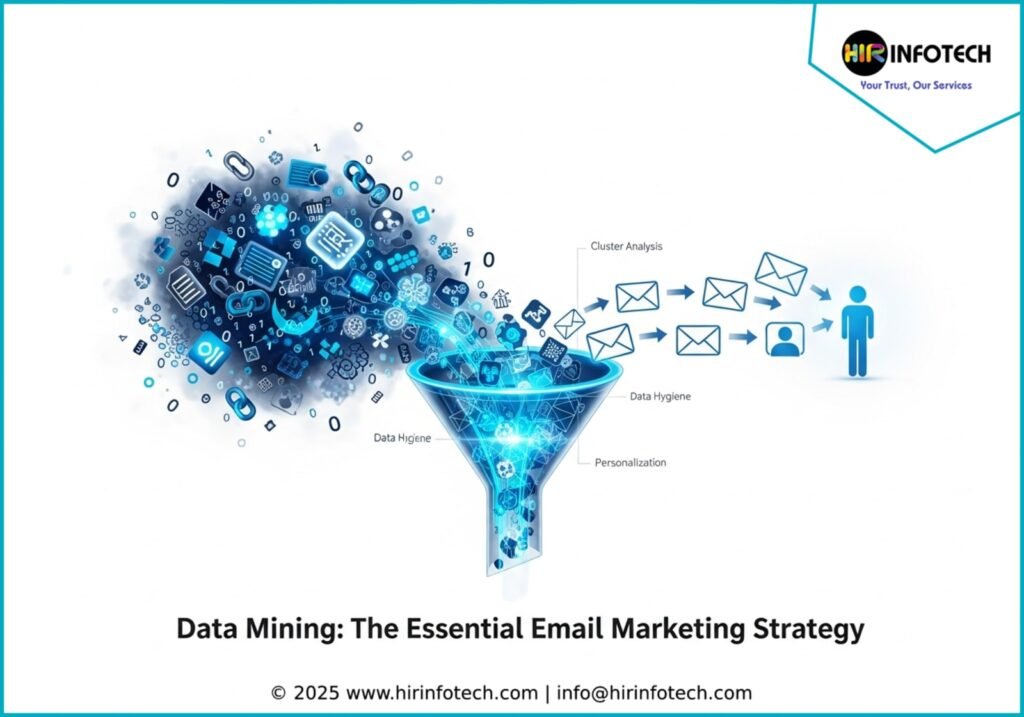
The Power of Data: How Data Mining is Revolutionizing Email Marketing in 2026
In the competitive digital landscape of 2026, creating a personalized customer experience is paramount. Email marketing remains a powerful tool for engaging with your target audience, but its effectiveness hinges on the quality of your data. Underlying issues within your email data can lead to a host of problems, including uninterested audiences, high bounce rates from faulty email addresses, and the wasted effort of incorrect IDs. This is where data mining services become essential, transforming raw data into actionable insights that drive powerful marketing strategies.
For mid-to-large companies that frequently handle web scraping, data extraction, and other data-related tasks, understanding the value of data mining is the first step toward unlocking its potential. This blog post will demystify the process of data mining, explore its methods, and highlight its crucial role in building successful email marketing campaigns.
What is Data Mining? A Clear Definition
At its core, data mining is the process of discovering patterns and other valuable information from large datasets. It’s a key component of data analytics and is widely used across various industries for everything from information-based advertising and credit risk assessment to fraud detection and spam email filtering. In the context of email marketing, data mining allows businesses to understand customer behavior and preferences on a deeper level.
The journey from raw data to actionable knowledge typically involves five key stages:
- Data Collection: The initial step is to gather and consolidate data from various sources into a data warehouse.
- Storage and Management: This data is then stored and managed, either through on-premise servers or, more commonly, via cloud-based solutions.
- Data Access and Organization: Business specialists, managers, and IT professionals collaborate to access and organize the data in a meaningful way.
- Analysis and Sorting: Sophisticated application software sorts and analyzes the data based on user-defined parameters to identify patterns and anomalies.
- Presentation: Finally, the end-user presents the refined data in an easily digestible format, such as a graph or report, to be shared with stakeholders.
A classic example of data mining in action can be seen in supermarkets. Many retailers offer loyalty cards that provide customers with exclusive discounts. These cards also allow the store to track purchasing habits, enabling them to offer personalized coupons and optimize product pricing and placement. This same principle of understanding customer behavior through data is what makes data mining so powerful for email marketing.
Building a High-Quality Email List: Data Mining Methods
For businesses venturing into email marketing, one of the first hurdles is building a robust list of interested, potential customers. It’s not just about collecting email addresses; it’s about identifying an audience that is receptive to your messaging. Data mining provides the tools to do this effectively.
There are two primary methods for data mining in this context:
- Online Data Mining: This method harnesses the power of the internet to gather new email addresses. It involves leveraging digital resources like blogs, websites, and social media platforms to identify potential leads. By analyzing publicly available information, such as posts and updates, businesses can gauge a user’s interest in their products or services.
- Offline Data Mining: While more traditional, offline data mining still plays a role. This can include collecting email addresses through in-person events, surveys, or direct mail campaigns. Modern iterations often involve tools that capture emails provided by customers on a company’s website.
Engaging top-notch list management services can significantly streamline this process, saving time and resources while efficiently converting prospects into customers.
The Critical Role of Data Mining in Email Marketing Success
A well-executed data mining strategy can deliver practical and pertinent information that directly addresses common roadblocks in email marketing. Here’s a look at how data mining tackles the most frequent issues:
- Duplicate IDs: Improper database merging can lead to multiple accounts with similar IDs. Data mining helps to identify and consolidate these duplicates, ensuring a clean and accurate database.
- Dead IDs: These are email addresses that are no longer in use. Sending emails to these addresses can harm your sender reputation. Data mining tools can identify and remove these inactive addresses.
- Erroneous IDs: Typographical or spacing errors can render an email address invalid. Data mining techniques can flag these errors for correction.
- Wrong IDs: These may be email addresses with improper formatting. Data mining helps to standardize and correct these entries.
By addressing these data quality issues, you lay the foundation for a more effective and efficient email marketing program.
Unlocking Deeper Insights with Cluster Analysis
Cluster analysis is a powerful data mining technique that allows businesses to segment their customer base into distinct groups based on shared characteristics. These characteristics can include demographic data like age and location, as well as behavioral data such as purchase history and website interactions.
This level of segmentation is invaluable for marketing. It enables companies to tailor their emails, messages, and promotions to specific audience segments, ensuring that the right message reaches the right person at the right time. The flexibility of cluster analysis allows for as much precision as needed, with no limit to the combination of variables that can be used to define a segment.
Enhancing Security with Intrusion Detection
In today’s digital world, system security is a top priority. A corrupted database can have severe consequences for a business. Marketing systems can be vulnerable to hacking or viruses that can compromise data through a Direct Email Marketing (DEM) campaign. Data mining plays a crucial role in system security by detecting intruders and potential database contamination in real-time, preventing significant damage. This demonstrates how data mining not only improves marketing effectiveness but also enhances the overall security of your systems.
For more insights into data security best practices, this article from Cisco provides a comprehensive overview of cybersecurity.
Frequently Asked Questions (FAQs)
1. Why is data mining so important for modern marketing?
Data mining allows businesses to access and analyze customer data, often with the help of artificial intelligence. This enables them to develop more effective marketing strategies and campaigns by understanding customer behavior and preferences on a deeper level. The insights gained from big data are what drive successful marketing data mining.
2. What are the primary benefits of data mining for a business?
Beyond marketing, data mining is crucial for a variety of business functions, including fraud detection, risk management, and cybersecurity planning. Its applications extend to numerous other fields such as government, science, mathematics, and even sports.
3. What makes email marketing so effective?
Email marketing allows for the creation of customized and targeted messages. This makes it easier to build lasting relationships with your customers, which in turn can increase the response rates of your direct marketing campaigns. However, it’s important to use email marketing judiciously to avoid overwhelming your audience.
4. How does data mining improve email personalization?
Data mining provides the granular data needed for true personalization. By analyzing customer data, you can go beyond simply using a customer’s name and tailor content, product recommendations, and offers to their specific interests and past behaviors. As of 2026, AI-powered personalization is becoming the standard, allowing for dynamic content that adapts to each individual recipient.
5. What is data hygiene and why is it essential for email marketing?
Data hygiene is the process of ensuring the data in your marketing database is clean, accurate, and up-to-date. This is critical for email marketing because it improves deliverability, reduces bounce rates, and ensures your messages are reaching the right people. Poor data hygiene can lead to wasted resources and damage to your sender reputation.
6. How is AI impacting data mining and email marketing in 2026?
Artificial intelligence is transforming data mining by enabling more sophisticated analysis of vast datasets. In email marketing, AI is being used for predictive analytics to anticipate customer behavior, automate personalized content, and optimize send times for individual subscribers. This leads to more effective and efficient campaigns with a higher return on investment.
7. What are some of the biggest challenges in data mining?
Some of the main challenges in data mining include dealing with incomplete or inconsistent data, ensuring data quality, and addressing security and privacy concerns. The complexity of the data and the algorithms used can also make it difficult to interpret the results accurately.
Take Your Data Strategy to the Next Level with Hir Infotech
In the data-driven world of 2026, the success of your email marketing efforts is directly tied to the quality of your data. By leveraging the power of data mining, you can gain a deeper understanding of your customers, deliver highly personalized experiences, and ultimately, drive business growth. From data extraction and web scraping to comprehensive list management, having a trusted partner can make all the difference.
At Hir Infotech, we specialize in providing cutting-edge data solutions to help businesses like yours unlock the full potential of their data. Our team of experts is ready to assist you with all your data-related needs, ensuring that you have the clean, accurate, and actionable data required to succeed.
Contact us today to learn more about how our data solutions can revolutionize your email marketing strategy.
#DataMining #EmailMarketing #DataSolutions #BigData #MarketingStrategy #LeadGeneration #BusinessGrowth #DigitalMarketing #HirInfotech #DataAnalytics #Personalization