Why Proxies Are Your Secret Weapon for Large-Scale Web Scraping in 2026
In the data-driven landscape of 2026, web scraping is no longer a niche technique but a cornerstone of business intelligence for mid-to-large-sized companies. From competitive price monitoring to sentiment analysis, the ability to gather vast amounts of web data is critical. But as you scale your data extraction efforts, you’ll quickly encounter a significant roadblock: getting blocked. This is where proxies become an indispensable part of your data strategy. This post will demystify proxies, explain their vital role in web scraping, and provide actionable insights for your business.
What Exactly Is a Proxy in the World of Web Scraping?
Think of a proxy server as an intermediary between your computer and the internet. When you browse the web, your device has a unique identifier called an IP address, which reveals your general location and internet service provider (ISP). Websites use this IP address to deliver content, but they also use it to monitor and control traffic.
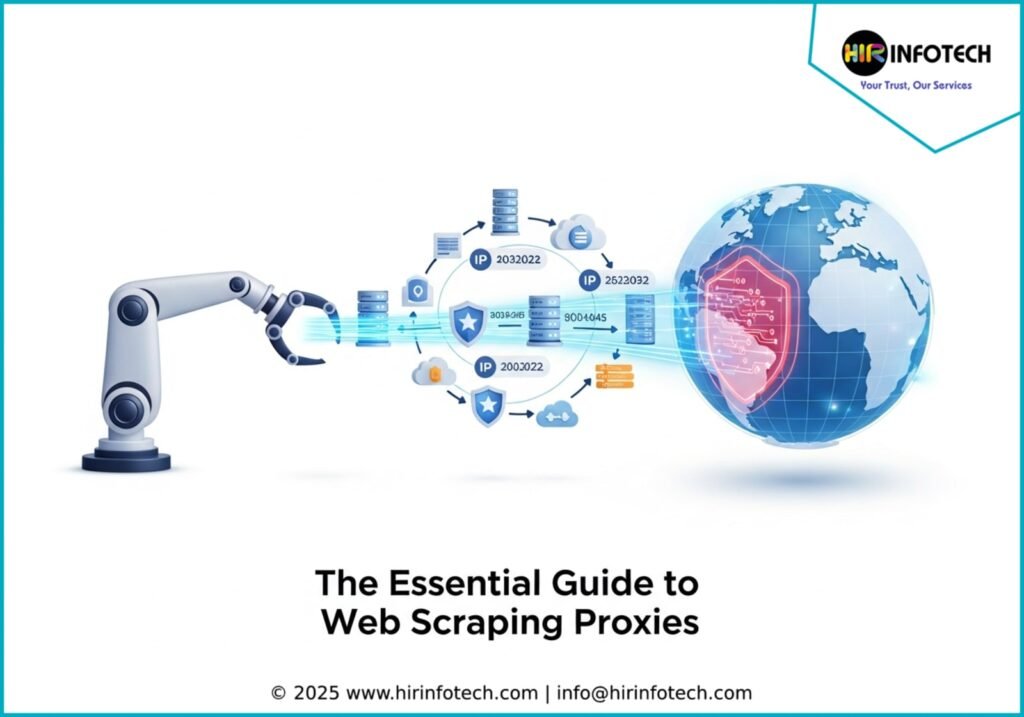
A proxy acts like an invisibility cloak for your IP address. When you send a request to a website through a proxy, the website sees the proxy’s IP address, not yours. This simple yet powerful mechanism is the key to anonymous and uninterrupted web scraping. Your internet traffic is routed through the proxy server, effectively masking your true digital identity and location.
Why Are Proxies Non-Negotiable for Serious Web Scraping?
Attempting to scrape a modern, well-protected website at a moderate to large scale without proxies is a recipe for frustration. Web servers are designed to detect and block automated activity to protect their data and prevent server overload. Here are the most common reasons you’ll get blocked and how proxies provide the solution:
- IP Rate Limiting: Most websites have limits on how many requests a single IP address can make within a certain timeframe. If you exceed this limit—which is easy to do with an automated scraper—your IP will be temporarily or even permanently banned. Proxies solve this by allowing you to rotate through a pool of different IP addresses. This distributes your requests, making your traffic appear as if it’s coming from many different users, thus avoiding rate limits.
- Geolocation Restrictions: Many websites display different content or restrict access based on the visitor’s geographic location. For businesses conducting international market research or tracking global product launches, this is a major hurdle. Proxies allow you to route your traffic through servers in specific countries, giving you access to localized data as if you were physically there.
- IP Bans and Blocks: Once a website identifies your scraper’s IP address, it can block it entirely. Without proxies, your entire operation comes to a halt. With a proxy network, if one IP gets blocked, you can simply switch to another and continue your data extraction without interruption.
Key Takeaway: The Power of Proxy Rotation
The core strategy for successful, large-scale web scraping is IP rotation. By using a pool of proxies and assigning a new IP address to each request (or a small batch of requests), you mimic natural human browsing behavior. This makes it incredibly difficult for a website’s anti-bot measures to detect and block your scraping activities. This is why a robust proxy infrastructure is essential for any serious data extraction project.
Navigating the Different Types of Proxies for Optimal Results
Not all proxies are created equal. The type of proxy you choose will depend on your specific scraping target and budget. The landscape of proxy solutions has evolved, with AI-powered management and specialized proxy types becoming the norm in 2026.
Datacenter Proxies
These are the most common and affordable type of proxies. They are generated from servers in data centers and offer high speeds and reliability. While effective for many targets, they are also the easiest for websites to detect because their IP addresses are commercially registered and not associated with a residential ISP.
- Best for: High-volume scraping of less protected websites, speed-sensitive tasks.
Residential Proxies
Residential proxies use IP addresses assigned by ISPs to real homeowners. This makes them appear as genuine, human users to websites, resulting in a much lower block rate. They are the go-to choice for scraping sophisticated targets that employ advanced anti-bot technologies.
- Best for: Scraping protected e-commerce sites, social media platforms, and other high-security targets.
ISP Proxies (Static Residential Proxies)
A hybrid solution gaining popularity, ISP proxies are registered with ISPs but hosted on fast data center servers. They offer the high speed and stability of datacenter proxies with the legitimacy and low detection rate of residential proxies. They are ideal for tasks that require a stable IP for a longer session.
- Best for: Managing social media accounts, scraping sites that require a consistent user session.
Mobile Proxies
These proxies route your traffic through mobile devices connected to 3G, 4G, or 5G networks. Since websites are highly trusting of mobile traffic, these proxies have the highest success rates but are also the most expensive. They are essential for scraping mobile-first websites and apps.
- Best for: Targeting mobile-centric platforms, accessing data that is only available to mobile users.
The Legal and Ethical Compass of Web Scraping
Using proxies and engaging in web scraping is legal in itself, but it’s crucial to operate within ethical and legal boundaries. The key is to focus on scraping publicly available data and to respect the website’s terms of service. Always check a website’s `robots.txt` file, which outlines the rules for bots. Responsible scraping means not overwhelming a website’s servers with an excessive number of requests. The goal is to gather data without disrupting the website’s service for other users.
To ensure your data scraping operations are compliant:
- Scrape only public data: Avoid attempting to access any information that requires a login or is not publicly visible.
- Respect `robots.txt`: This file is a clear directive from the website owner on what they permit to be crawled.
- Be gentle: Limit your request rate to avoid putting an unnecessary load on the website’s servers.
- Be transparent: Use a clear user agent in your scraper’s requests to identify the purpose of your scraping activity.
For more detailed insights into the legal framework, you can refer to resources like the Electronic Frontier Foundation (EFF), which often covers topics related to digital rights and data access.
Scaling Up: Should You Build or Buy Your Proxy Solution?
For mid-to-large companies, managing a large pool of proxies, ensuring they are healthy, and handling rotation logic can become a significant operational burden. This is where managed proxy solutions and web scraping APIs come into play. By 2026, many leading proxy providers offer intelligent, AI-driven proxy management that automatically handles IP rotation, retries, user-agent switching, and CAPTCHA solving.
Partnering with a service like Hir Infotech allows your team to offload the complexities of proxy management and focus on what truly matters: extracting and analyzing the data to drive business decisions. A managed solution can significantly reduce development time, improve success rates, and provide the scalability needed for large-scale projects.
For a deeper dive into how to effectively manage proxies for web scraping, check out this comprehensive guide on proxy servers from Zyte.
Frequently Asked Questions (FAQs)
1. What is the main advantage of using rotating proxies for web scraping?
Rotating proxies automatically switch the IP address for each request or after a set interval. This makes your scraper appear as multiple, distinct users, which is the most effective way to avoid IP-based blocking and rate limiting when scraping at scale.
2. How many proxies do I need for my web scraping project?
The number of proxies required depends on the target website’s sensitivity, the volume of data you need, and the speed at which you need to scrape. A general rule of thumb is to start with a small pool and scale up as needed based on your success and block rates. For large-scale projects, a managed rotating proxy service with access to a large pool of IPs is often the most practical solution.
3. Are residential proxies better than datacenter proxies?
For scraping heavily protected websites, residential proxies are significantly more effective because they appear as real users and have a much lower chance of being blocked. However, datacenter proxies are faster and more cost-effective for scraping websites with less stringent anti-bot measures. The best choice depends on your target and budget.
4. Can a website detect that I am using a proxy?
While it is possible for a website to detect the use of some proxies (especially low-quality or public ones), high-quality residential and ISP proxies are very difficult to distinguish from genuine user traffic. Advanced proxy services also rotate other request headers to further mimic human browsing behavior.
5. What is the difference between a proxy and a VPN?
While both proxies and VPNs route your traffic through an intermediary server, they serve different primary purposes. A VPN is designed to encrypt all your internet traffic for security and privacy. A proxy, in the context of web scraping, is primarily used to mask your IP address and manage multiple identities to facilitate large-scale data collection. Proxies typically operate on an application level, whereas a VPN encrypts all traffic from your device.
6. What are the risks of using free public proxies?
Free public proxies are often unreliable, slow, and insecure. They are frequently overused and already blocked by many websites. More importantly, they pose a significant security risk as the provider could monitor or alter your traffic. For any business application, it is strongly recommended to use a reputable, paid proxy provider.
7. How does a proxy help with accessing geo-blocked content?
A proxy server allows you to choose an IP address from a specific geographic location. When you send a request to a website through that proxy, the website sees the IP address from that chosen location. This tricks the website into serving you the content that is specific to that region, effectively bypassing any geo-restrictions.
Unlock the Power of Data with Hir Infotech
In 2026, the competitive edge belongs to companies that can effectively harness web data. Don’t let IP blocks and rate limits hinder your ability to gather the critical business intelligence you need. A robust proxy strategy is the key to unlocking scalable, reliable, and efficient web scraping.
At Hir Infotech, we specialize in providing comprehensive data solutions, from web scraping services to managed proxy infrastructure. We handle the technical complexities so you can focus on leveraging data to grow your business. Ready to take your data extraction to the next level?
Contact Hir Infotech today to discuss your web scraping and data solution needs. Let us help you turn the web into your most valuable source of actionable insights.
#WebScraping #DataExtraction #ProxyServers #DataSolutions #BigData #BusinessIntelligence #MarketResearch #LeadGeneration