Unlocking Your Data’s True Potential: Web Scraping for Seamless Data Transformation
Ever felt like you’re trying to solve a puzzle with pieces from different boxes? That’s what handling multiple, structurally distinct data sets can feel like. In a world driven by “big data,” companies are inundated with vast amounts of information daily. The challenge? Most of this raw data is unstructured and varied, making it nearly impossible to compare, manage, or integrate effectively.
Imagine trying to analyze your company’s overall sales performance by combining reports from different branches, each with its own unique format. The process would be painstakingly slow and prone to errors. This is where the critical process of data transformation comes into play, and web scraping is a powerful ally in this endeavor.
This blog post will demystify data transformation, explore how web scraping revolutionizes this process, and provide actionable insights for mid-to-large companies to harness the full power of their data. We’ll delve into the latest trends for 2026, offering a fresh perspective on optimizing your data strategy for the future.
What is Data Transformation and Why is it Crucial for Your Business?
Data transformation is the process of converting data from one format or structure to another. The goal is to make disparate data sets compatible for easier analysis and integration. Think of it as creating a universal language for your data to communicate effectively. For businesses with multiple databases tied to various organizational structures, this process isn’t just beneficial—it’s essential.
In today’s global marketplace, accurate data fuels modern and dynamic business analysis. However, when information is extracted, its quality and consistency can be compromised by non-standard characters, outdated information, or inconsistent formatting. Disorganized databases are a significant burden, slowing down operations and leading to flawed decision-making. High-quality, consistent data is the bedrock of reliable business intelligence.
The High Cost of Poor Data Quality
Inaccurate or inconsistent data can have severe consequences for businesses. According to some estimates, poor data quality can cost organizations millions annually. These costs manifest in several ways:
- Flawed Decision-Making: Inaccurate data leads to misguided strategies, potentially resulting in missed opportunities and financial losses.
- Decreased Productivity: Employees waste valuable time grappling with data inconsistencies and errors instead of focusing on value-added tasks.
- Damaged Reputation: Incorrect information can harm customer relationships and erode brand trust.
- Compliance Risks: Incomplete or inaccurate data can lead to regulatory violations and significant penalties.
By implementing robust data transformation processes, businesses can proactively identify and rectify data inaccuracies, mitigating these risks and ensuring that their decisions are based on reliable, high-quality information.
The Data Transformation Process: A Closer Look
Data transformation involves a series of operations to reshape raw data into a structured, usable format. These operations often include:
- Filtering: Removing irrelevant data to focus on the information that matters.
- Enriching: Adding new information to the existing data to make it more valuable.
- Merging & Joining: Combining data from multiple sources to create a unified view.
- Summarizing & Aggregating: Condensing large volumes of data into meaningful summaries.
- Cleaning: Correcting errors, removing duplicates, and handling missing values.
Traditionally, these processes were handled through complex, hand-written scripts in languages like SQL or Python. This approach was not only time-consuming and expensive but also required specialized technical expertise.
The Evolution of Data Transformation: From Manual to Automated
The dramatic increase in data volume has spurred the development of a wide array of tools and technologies to meet the growing demand for efficient data transformation. A significant leap in this evolution is the development of ETL (Extract, Transform, Load) processes.
Understanding ETL (Extract, Transform, Load)
ETL is a type of data integration process that involves three stages:
- Extract: Data is extracted from various source systems.
- Transform: The extracted data is then transformed into a proper format for analysis.
- Load: The transformed data is loaded into a target destination, such as a data warehouse.
ETL tools automate this process, making it more efficient and reliable than manual methods. They are particularly vital for companies with on-premises data warehouses. However, traditional ETL tools can be expensive, slow, and still often require specialized developers to implement and maintain the necessary scripts.
Web Scraping: The Game-Changer in Data Extraction and Transformation
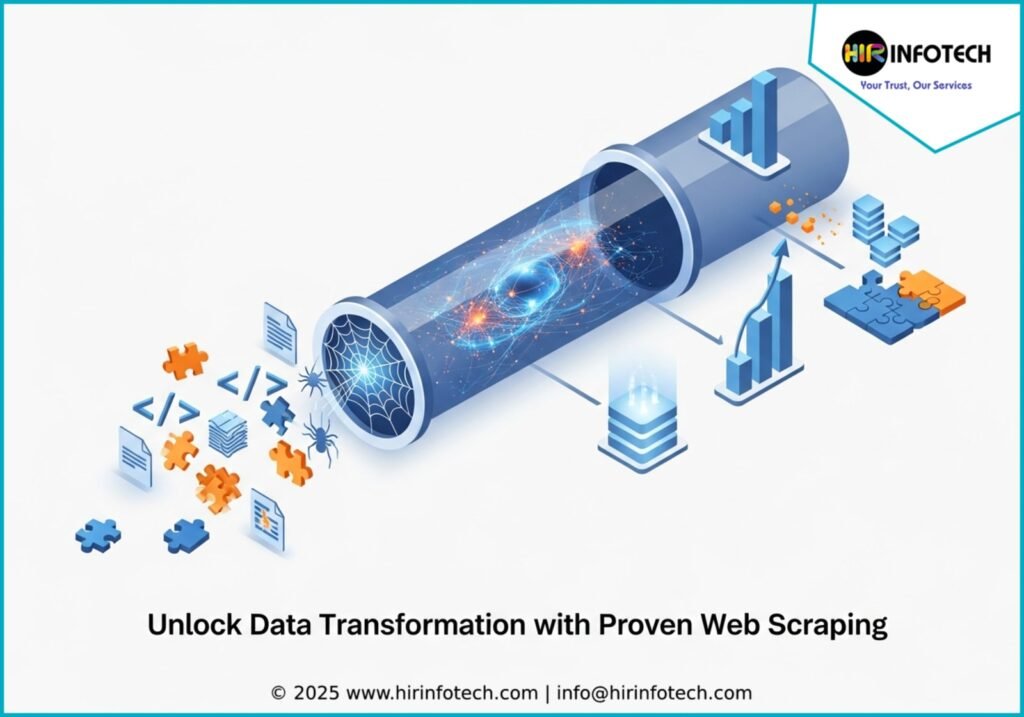
Web scraping is the automated process of extracting large amounts of data from websites. Bots or “scrapers” collect the underlying HTML code and the data stored within it, allowing for the entire webpage to be copied and stored elsewhere. This technique has emerged as a powerful tool for the “Extract” phase of the ETL process.
When you use web scraping as part of your ETL pipeline, you can extract data from websites, transform it into your desired format, and then load it into a CSV file, database, or another destination for analysis. This is particularly useful for gathering competitive intelligence, market research, and other external data that can enrich your internal datasets.
The Rise of AI-Powered Web Scraping
The future of web scraping is intelligent and adaptive, thanks to the integration of Artificial Intelligence (AI). AI-powered web scraping is revolutionizing data extraction by making it more efficient, accurate, and resilient. Here’s how:
- Adaptability to Website Changes: Traditional scrapers often break when a website’s layout changes. AI-powered scrapers can learn a webpage’s structure and adapt to changes automatically, minimizing downtime and manual intervention.
- Handling Dynamic Content: Modern websites are often dynamic, with content that loads as the user interacts with the page. AI can navigate these complex sites with ease, extracting data that would be inaccessible to simpler scrapers.
- Improved Accuracy and Reliability: AI algorithms can filter out irrelevant “noise” and identify key data points more accurately than traditional methods, leading to higher-quality data from the outset.
- Scalability and Speed: AI can extract data from thousands of websites simultaneously and at a much faster rate than manual or traditional scraping methods.
As we look towards 2026, the integration of Generative AI in data engineering will further streamline these processes. We can expect to see smart algorithms capable of autonomously cleaning and formatting data, managing ETL workflows, and even implementing security audits.
No-Code and Low-Code: Empowering Non-Technical Users
A significant trend in the data solutions industry is the rise of no-code and low-code platforms. These tools are designed to be user-friendly, allowing individuals with minimal coding experience to build and manage data pipelines. By 2025, it’s predicted that a significant percentage of new enterprise applications will be built using these platforms.
No-code ETL tools provide intuitive, drag-and-drop interfaces that empower business users to take control of their data workflows. This democratization of data integration accelerates timelines, reduces reliance on specialized IT teams, and fosters a more data-driven culture throughout the organization. For more on this topic, Forbes offers an insightful article on the rise of these platforms.
Establishing Topical Authority and E-E-A-T in Your Data Strategy
In the digital landscape, demonstrating E-E-A-T (Experience, Expertise, Authoritativeness, and Trust) is crucial for both search engine optimization and building credibility with your audience. Here’s how you can apply these principles to your data solutions content:
- Experience: Share real-world case studies and personal stories of how your company has successfully implemented data transformation and web scraping solutions.
- Expertise: Showcase the deep knowledge of your team through in-depth articles, white papers, and webinars. Collaborate with industry experts to bring diverse perspectives to your content.
- Authoritativeness: Build your brand’s reputation by consistently publishing high-quality, insightful content. Seek mentions and backlinks from other respected sites in your industry.
- Trustworthiness: Be transparent about your processes and methodologies. Encourage customer reviews and testimonials to build social proof.
By focusing on these elements, you not only improve your online visibility but also establish your company as a trusted leader in the data solutions domain. For a deeper dive into data science topics, consider exploring authoritative blogs like Data Science Central.
Actionable Insights: Getting the Most Out of Your Data
To truly leverage the power of your data, it’s essential to move beyond simple collection and focus on creating actionable insights. Here are some key takeaways:
- Prioritize Data Quality: Implement robust data quality checks throughout your data lifecycle to ensure accuracy and consistency.
- Embrace Automation: Utilize automated data transformation and web scraping tools to save time, reduce errors, and free up your team for more strategic tasks.
- Foster a Data-Driven Culture: Empower your employees with the tools and training they need to access and analyze data effectively.
- Stay Ahead of the Curve: Keep an eye on emerging trends like AI-powered scraping and no-code platforms to maintain a competitive edge.
For more information on the latest data trends, Tableau offers a curated list of excellent data science blogs to follow.
Why Choose Hir Infotech for Your Data Solutions?
At Hir Infotech, we understand that data is the lifeblood of your business. With over a decade of experience in providing cutting-edge data solutions, we have the expertise to help you navigate the complexities of data extraction, transformation, and analysis. Our commitment to innovation ensures that we are always at the forefront of the latest technologies, including AI-powered web scraping and automated data pipelines.
We pride ourselves on our client-centric approach, working closely with you to understand your unique needs and develop tailored solutions that deliver tangible results. Our team of experts is dedicated to helping you unlock the full potential of your data, driving growth and innovation for your business.
Ready to transform your data strategy? Contact Hir Infotech today for a consultation and discover how we can help you turn your data into your most valuable asset.
#DataTransformation #WebScraping #ETL #BigData #DataAnalytics #BusinessIntelligence #AI #DataSolutions #HirInfotech
Frequently Asked Questions (FAQs)
1. What is the primary purpose of data transformation?
The main goal of data transformation is to convert data from various sources into a single, consistent format. This makes it easier to analyze and integrate, leading to more accurate and reliable business insights.
2. How does web scraping fit into the ETL process?
Web scraping is a powerful method for the “Extract” phase of ETL. It allows you to gather vast amounts of data from websites, which can then be transformed and loaded into your systems for analysis.
3. Is web scraping legal?
Web scraping is legal as long as it is done ethically and responsibly. This means respecting a website’s terms of service, not scraping personal data, and not overwhelming a website’s servers with requests.
4. What are the advantages of using AI-powered web scraping?
AI-powered web scraping offers several benefits, including automatic adaptation to website changes, the ability to handle dynamic content, improved data accuracy, and enhanced scalability and speed.
5. What are no-code data transformation tools?
No-code data transformation tools are platforms that allow users to create and manage data pipelines using visual, drag-and-drop interfaces, without the need for any coding. This makes data transformation more accessible to non-technical users.
6. How can I ensure the quality of my transformed data?
To ensure data quality, it’s essential to implement validation rules, data cleaning processes, and regular audits of your data. Automated tools can help streamline this process and identify inconsistencies or errors early on.
7. How can data transformation benefit my specific industry?
Data transformation can benefit any industry by providing a clearer, more unified view of business operations. For example, in e-commerce, it can be used to analyze customer behavior across different platforms. In finance, it can help in consolidating market data for risk analysis.