
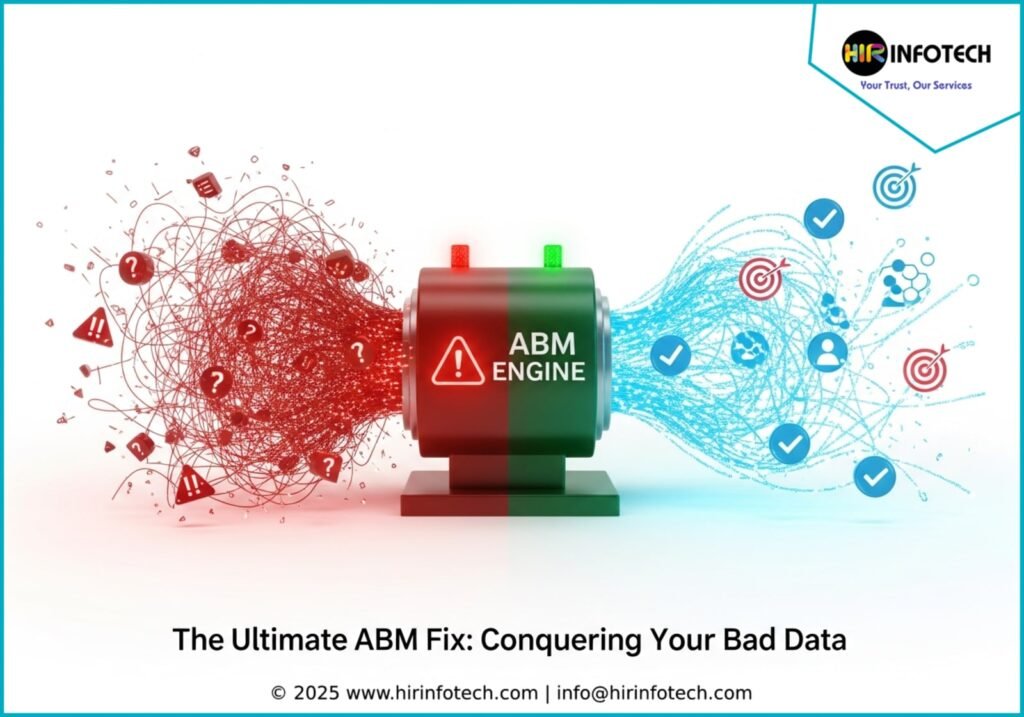
Why Your ABM Strategy Is Failing: The 2026 Guide to Conquering Bad Data
Account-Based Marketing (ABM) is no longer a niche tactic; it’s a powerhouse strategy for B2B growth. By focusing resources on high-value accounts, companies are seeing shorter sales cycles, larger deal sizes, and unprecedented alignment between marketing and sales. In fact, by 2026, the global ABM market is projected to surge, continuing its rapid expansion. But there’s a silent killer lurking in the shadows of even the most well-funded ABM campaigns: bad data.
You can have the most creative campaigns and the most talented team, but if your strategy is built on a foundation of inaccurate, incomplete, or outdated information, it’s destined to fail. This isn’t just an IT headache; it’s a multi-trillion-dollar problem that directly impacts your bottom line. For mid to large companies managing vast amounts of information, mastering data quality isn’t just important—it’s the critical difference between winning your dream accounts and wasting millions on misguided efforts.
This guide will illuminate how poor data quality is sabotaging your ABM efforts and provide an actionable blueprint to build a resilient, data-driven strategy for 2026 and beyond. At Hir Infotech, we specialize in transforming data chaos into a competitive advantage, and we’re here to show you how.
The Staggering Cost of Bad Data: A C-Suite Crisis
Before we dive into the specifics of ABM, it’s crucial to understand the sheer scale of the data quality problem. It’s not a minor inconvenience; it’s a massive financial drain on the global economy.
- The Trillion-Dollar Drain: Harvard Business Review estimates that bad data costs the U.S. economy an astonishing $3.1 trillion annually.
- The Per-Company Price Tag: Gartner’s research reveals that poor data quality costs the average organization $12.9 million every year. This is due to wasted resources, flawed decision-making, and missed opportunities.
- The Revenue Hit: Other studies show that companies can lose as much as 20% of their revenue simply due to poor data maturity.
In the high-stakes world of ABM, where every interaction is personalized and every resource is strategically allocated, these costs are amplified. You’re not just sending an email to the wrong person; you’re building an entire bespoke marketing and sales motion around a ghost. The ripple effects are felt across every department, from frustrated sales reps to disillusioned leadership.
4 Ways Poor Data Is Actively Sabotaging Your ABM Strategy
Bad data isn’t a single problem; it’s a corrosive force that degrades your ABM strategy at every stage. It undermines your foundation, cripples your execution, and distorts your results. Here’s how the damage unfolds.
1. A Flawed Ideal Customer Profile (ICP)
Your Ideal Customer Profile (ICP) is the north star of your ABM strategy. It’s a precise definition of the perfect-fit company for your product or service. This profile dictates which accounts you target, the messaging you create, and how you allocate your budget. When it’s built on bad data, you’re aiming at the wrong target from day one.
An inaccurate ICP means you’re pursuing accounts that:
- Don’t have the budget for your solution.
- Don’t have the problem your product solves.
- Are in the wrong industry or geographic location.
- Are not at the right stage of maturity to buy.
The consequences are severe:
- Wasted Marketing Spend: Your team invests heavily in creating personalized content and ad campaigns for companies that will never convert.
- Low Engagement: Outreach falls flat because the messaging doesn’t resonate with the company’s actual pain points.
- Sales Team Burnout: Sales representatives waste countless hours chasing dead-end leads, leading to frustration and plummeting morale.
- Misaligned Strategy: Leadership makes poor strategic decisions based on a skewed understanding of the market.
A well-defined ICP is integral to successful account-based marketing, guiding you to focus only on prospects that are a perfect fit for your business.
2. Inaccurate Prospect Data and Personalization Failure
ABM lives and dies by personalization. The goal is to make your target accounts feel like you’re speaking directly to them and understand their unique challenges. This is impossible without accurate data on the key decision-makers within those accounts.
Consider the phenomenon of data decay. B2B contact data decays at an alarming rate—some studies suggest as high as 70% per year. People change jobs, get promoted, switch departments, and their contact information changes. Relying on outdated data leads to embarrassing and ineffective outreach.
Common data errors that kill personalization include:
- Wrong Job Titles: You craft a perfect message for the “VP of Marketing,” but that person left the company six months ago.
- Outdated Company Information: Your pitch references a company initiative that was discontinued last year.
- Incorrect Names or Salutations: Nothing damages credibility faster than misspelling a key contact’s name.
- Irrelevant Pain Points: You’re addressing challenges that are no longer a priority for the business.
When personalization fails, you don’t just lose a lead—you can damage your brand’s reputation. The account may flag your company as spam, making future outreach nearly impossible. Effective personalization is so powerful that a staggering 86% of business buyers are more likely to make a purchase when a vendor understands their goals.
3. Hemorrhaging Sales and Marketing Resources
When your ABM strategy runs on dirty data, the financial drain is immense. Every flawed data point creates a cascade of wasted time, effort, and budget across both sales and marketing teams.
Where the money goes:
- Ineffective Ad Spend: Marketing teams pour money into digital advertising campaigns targeting outdated contacts or incorrect company profiles.
- Wasted Sales Hours: Sales reps spend an estimated 27% of their time dealing with bad leads. Instead of selling, they are stuck doing manual data verification and correction.
- Useless Content: A significant portion of B2B marketing content goes completely unused because it’s not relevant to the accounts sales is actually targeting.
- Broken Automation: Marketing automation platforms become liabilities when fed bad data, sending the wrong message to the wrong person at the wrong time.
Strong alignment between sales and marketing is a hallmark of successful ABM, and this alignment is built on a shared foundation of clean, reliable data. Companies with strong alignment achieve up to 20% annual growth, while those with poor alignment see revenues decline.
4. A Tarnished Brand Reputation and Lost Trust
In the world of high-value B2B sales, trust is everything. Your brand’s reputation is your most valuable asset. Every interaction with a target account either builds or erodes that trust. Bad data consistently leads to interactions that erode it.
Imagine a key decision-maker at a Fortune 500 company receiving an email from you with their predecessor’s name in the greeting. Or a hyper-personalized direct mail piece that references an outdated pain point. These aren’t just minor mistakes; they signal a lack of professionalism and attention to detail. They tell the prospect, “We haven’t done our homework.”
This damage is cumulative. One bad interaction might be forgiven, but a pattern of sloppy, data-driven mistakes will get you blacklisted. In an ABM model where you are nurturing a small list of high-value accounts over a long period, you can’t afford these unforced errors. Building a strong reputation is one of the key benefits of ABM, but this is only achievable with a commitment to data quality.
The 2026 Data Landscape: AI, Automation, and the Imperative of Quality
The challenges of data management are only growing more complex. The rise of AI and generative AI in marketing and sales is a double-edged sword. These technologies offer incredible potential for hyper-personalization and efficiency, but they are also powerful amplifiers. As Gartner predicts, AI will continue to be a major force, but its success hinges on the quality of the data it’s trained on. Garbage in, garbage out—but at an unprecedented scale and speed.
As we look to 2026, several trends will define the B2B data landscape:
- AI-Powered Decision-Making: AI will be used to score accounts, predict buyer intent, and even generate personalized outreach. The accuracy of these models will be entirely dependent on clean, structured data.
- Increased Data Privacy Regulations: Compliance with regulations like GDPR and CCPA will remain a top priority. Poor data governance doesn’t just hurt marketing; it creates significant legal and financial risk.
- The Centrality of First-Party Data: As third-party cookies phase out, the ability to collect, manage, and enrich your own first-party data will become a key competitive differentiator.
For more insights into data quality, the Gartner Data Quality guide offers authoritative information. This evolving landscape makes a proactive data strategy not just a best practice, but a prerequisite for survival and growth.
Your Actionable Blueprint for a Data-Driven ABM Foundation
Conquering the data quality challenge may seem daunting, but it’s achievable with a strategic, step-by-step approach. You don’t need to boil the ocean. Instead, focus on building a robust foundation that will support your ABM efforts for years to come.
Step 1: Conduct a Comprehensive Data Audit
You can’t fix a problem you don’t understand. The first step is to perform a thorough audit of your existing data. This involves assessing the health of the information in your CRM, marketing automation platform, and any other data repositories. Identify the most common issues:
- Are there high rates of duplicate records?
- What percentage of your contact data is incomplete (missing job titles, phone numbers, etc.)?
- How high are your email bounce rates for key account segments?
- Do sales and marketing have conflicting data on the same accounts?
Step 2: Implement Proactive Data Cleansing and Enrichment
Once you’ve identified the problems, it’s time for action.
- Data Cleansing: This is the process of identifying and correcting or removing inaccurate records from your database. It includes merging duplicates, correcting typos, and standardizing formats.
- Data Enrichment: This involves appending and enhancing your existing records with missing information. For example, adding firmographic data (company size, revenue, industry) or technographic data (what technologies a company uses).
This is where specialized data services become invaluable. Manual cleansing is not scalable for large organizations. Services like automated web scraping and data extraction can systematically gather and validate the accurate, up-to-date information you need to fuel your ABM engine.
Step 3: Centralize Your Data and Create a Single Source of Truth
Data silos are a primary cause of misalignment between sales and marketing. When each department works from its own separate and often conflicting dataset, collaboration breaks down. The solution is to establish a single source of truth—typically your CRM—that is integrated with all other relevant platforms.
When both teams trust and operate from the same data, they can work in harmony. Marketing can confidently build campaigns knowing they are targeting the right people, and sales can engage with prospects using consistent, accurate information. For an expert take on B2B data providers, consider insights from reports like The Forrester Wave™.
Step 4: Partner with a Data Solutions Expert
Managing data quality is a continuous, resource-intensive process. For most companies, handling it entirely in-house is inefficient and ineffective. Your teams should be focused on what they do best: marketing and selling. Partnering with a dedicated data solutions provider like Hir Infotech allows you to offload the complex work of data acquisition, cleansing, and enrichment to experts.
At Hir Infotech, we provide the clean, reliable, and actionable data that high-performing ABM strategies are built on. Our services include:
- Custom Web Scraping and Data Extraction: We gather the precise data you need from any online source to build comprehensive profiles of your target accounts.
- Data Cleansing and Verification: We transform your messy, unreliable database into a strategic asset.
- Ongoing Data Maintenance: We help you combat data decay with continuous monitoring and updates, ensuring your data remains fresh and accurate.
Frequently Asked Questions (FAQs)
1. What is the very first step in building a successful ABM strategy?
The first step is to achieve crystal-clear alignment between your sales and marketing teams to define your Ideal Customer Profile (ICP). This collaborative process ensures everyone agrees on what a high-value account looks like, which is the foundational element for all subsequent ABM activities.
2. How often should a company clean its B2B data?
Data cleaning should be an ongoing process, not a one-time event. Best practice involves continuous monitoring and automated cleansing processes. A deep, comprehensive audit should be conducted quarterly or semi-annually, while newly acquired data should be verified and cleansed upon entry.
3. What’s the main difference between ABM and traditional lead generation?
Traditional lead generation casts a wide net to capture as many individual leads as possible (a “many-to-one” approach). ABM flips the funnel, focusing marketing and sales resources on a select list of high-value accounts and the key decision-makers within them (a “one-to-few” or “one-to-one” approach). Quality over quantity is the core principle of ABM.
4. Can bad data affect our marketing automation tools like HubSpot or Marketo?
Absolutely. Bad data turns powerful automation tools into liabilities. It can cause you to send irrelevant emails, place contacts in the wrong nurture streams, and generate inaccurate lead scores. This not only leads to poor results but can also harm your sender reputation and customer relationships.
5. How is AI changing the game for data quality in 2026?
AI is transforming data quality by automating the detection of anomalies, predicting data decay, and powering intelligent data enrichment. AI-driven platforms can analyze vast datasets to identify patterns and suggest corrections far faster than humanly possible, making proactive data management more scalable and effective.
6. What kind of ROI can we realistically expect from investing in data quality?
While specific ROI varies, the returns are substantial. Companies with clean, well-managed data see higher marketing campaign conversion rates, shorter sales cycles, improved customer retention, and significantly reduced operational waste. The initial investment in data quality pays for itself many times over by preventing the multi-million-dollar losses associated with bad data.
7. Why can’t our internal team just handle data cleansing?
While internal teams can perform basic data hygiene, they often lack the specialized tools, expertise, and bandwidth to manage data quality at scale. Data management is a complex, full-time discipline. Partnering with a specialist ensures the job is done correctly and efficiently, freeing your team to focus on core revenue-generating activities.
Don’t Let Bad Data Be Your ABM Kryptonite
Account-Based Marketing holds the promise of transforming your B2B growth engine, fostering deep customer relationships, and delivering remarkable ROI. But this promise can only be realized when your strategy is built on a foundation of clean, accurate, and actionable data. In 2026, data quality is not optional—it is the essential fuel for your entire go-to-market strategy.
Stop letting bad data silently sabotage your efforts, drain your budget, and frustrate your teams. It’s time to move from a reactive to a proactive approach to data management.
Take Control of Your Data Today
Ready to fuel your ABM strategy with high-quality, actionable data? The first step is understanding the health of your current database. Contact the experts at Hir Infotech today for a free data health assessment. Let us show you the gaps and opportunities within your data and build the reliable foundation you need to win your most valuable accounts.
Don’t wait for another failed campaign. Let’s build your data-driven future together.
#ABM #AccountBasedMarketing #DataQuality #B2BMarketing #DataSolutions #LeadGeneration #SalesAndMarketing #DataStrategy #HirInfotech









