Scraping Tools vs. Scraping Services: A 2026 Guide for Modern Businesses
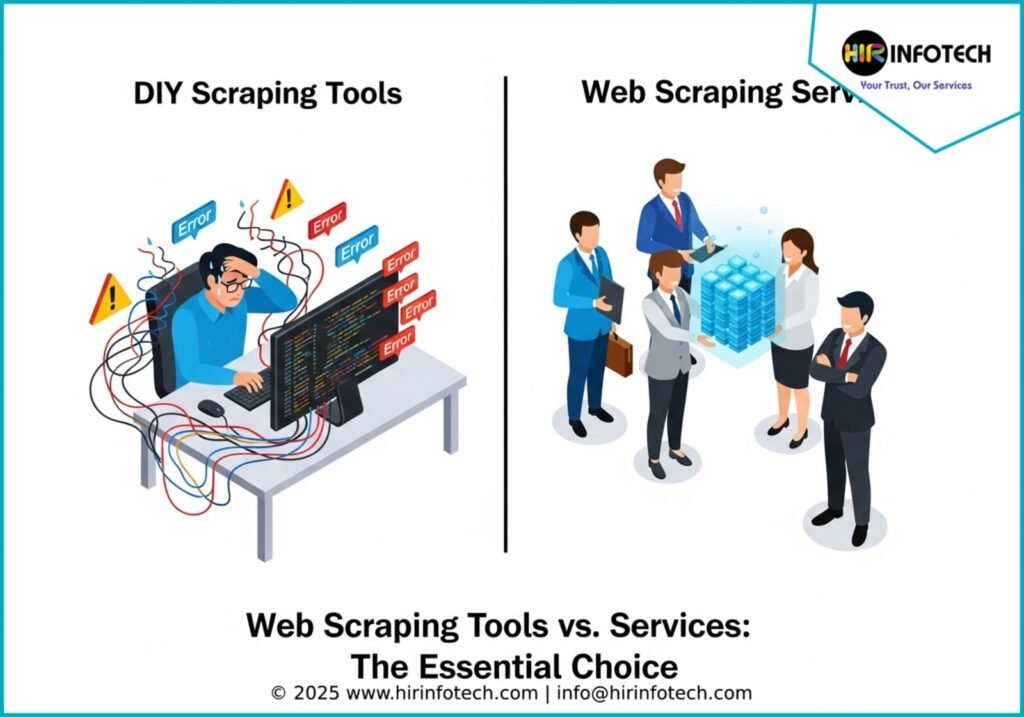
In today’s data-driven landscape, businesses across all sectors rely on web scraping to gain a competitive edge. From monitoring competitor pricing to fueling machine learning models, automated data collection has become a critical business function. As we move into 2026, the web scraping market is projected to reach multi-billion dollar valuations, with nearly half of all internet traffic generated by bots. This surge highlights a crucial decision for mid-to-large companies: should you use off-the-shelf scraping tools or partner with a dedicated web scraping service?
For non-technical audiences, navigating this choice can be daunting. This comprehensive guide will break down the differences, benefits, and costs associated with each approach, helping you make an informed decision that aligns with your business goals.
What is Web Scraping and Why Is It Essential in 2026?
Web scraping is the automated process of extracting large amounts of data from websites. Think of it as a high-speed, digital librarian that can browse thousands of pages in minutes, collecting specific information and organizing it into a structured format like a spreadsheet or database. By 2026, web scraping is no longer just a technical task but a strategic necessity. It empowers businesses to:
- Monitor market dynamics: Track competitor pricing, product catalogs, and promotional activities in real-time.
- Enhance business intelligence: Gather data for market research, lead generation, and financial analysis.
- Protect brand reputation: Monitor online reviews, news articles, and social media for mentions of your brand.
- Power AI and machine learning: Collect vast datasets to train and validate predictive models.
As the digital ecosystem evolves, so do the methods for extracting data. The rise of Artificial Intelligence (AI) is revolutionizing the field, making scraping tools smarter and services more efficient than ever before.
Understanding Web Scraping Tools: The DIY Approach
Web scraping tools are software applications designed to help users extract data from websites. They range from simple browser extensions to complex, code-based frameworks. For businesses dipping their toes into data extraction, these tools can seem like an attractive option.
Types of Web Scraping Tools
- No-Code Scraping Tools: These are designed for non-technical users and feature a visual, point-and-click interface. Tools like Octoparse and ParseHub allow you to select the data you want to extract directly on a webpage, without writing any code. They often come with pre-built templates for popular websites like Amazon or Twitter.
- Browser Extensions: Tools like Data Miner operate directly within your web browser, offering a convenient way to scrape data from the page you’re currently viewing. They are ideal for quick, small-scale data collection tasks.
- Developer-Focused Frameworks: For teams with coding expertise, open-source frameworks like Scrapy (for Python) offer maximum flexibility and control. These require programming knowledge to build and maintain custom scrapers.
The Pros of Using Web Scraping Tools
- Initial Affordability: Many tools offer free plans or are open-source, making the initial cost of entry low.
- User Control: You have direct control over the scraping process, from selecting the target data to scheduling the extraction.
- Immediate Access: You can start scraping data almost instantly, without the need for lengthy consultations.
The Cons and Hidden Costs of Web Scraping Tools
While scraping tools offer a degree of autonomy, they come with significant challenges, especially when scaling up operations:
- Technical Hurdles: Modern websites are complex. They use JavaScript to load content dynamically, employ anti-bot measures like CAPTCHAs, and frequently change their layout. A no-code tool that works today might break tomorrow, requiring constant adjustments.
- Maintenance Overhead: The responsibility of maintaining the scrapers falls entirely on your team. This includes updating code, managing IP address rotations to avoid being blocked, and troubleshooting errors. This can consume a significant amount of your developers’ time—often 15-20% of their workload.
- Scalability Issues: Scraping a few hundred pages is one thing; extracting millions of records is another. In-house scraping solutions often struggle with memory and CPU limitations, network failures, and scheduling conflicts at scale.
- Data Quality Concerns: Raw data extracted by tools is often “dirty,” containing duplicates, inconsistencies, and missing fields. Cleaning and validating this data is a tedious but essential task that requires additional time and resources.
For mid-to-large companies, these challenges can quickly outweigh the initial cost savings. The time and manpower spent on maintaining a fragile, in-house scraping setup often translate to a higher total cost of ownership in the long run.
For more insights on building robust data solutions, check out this informative article from IBM on the future of AI and data.
Web Scraping Services: The Done-For-You Solution
A web scraping service, often referred to as Data as a Service (DaaS), is a third-party provider that handles the entire data extraction process for you. You simply specify your data requirements—what information you need, from which websites, and how often—and the service delivers clean, structured data ready for analysis.
How Web Scraping Services Work
The process is straightforward:
- Consultation: You discuss your data needs with the service provider.
- Setup: The provider’s expert team builds and configures the necessary scrapers.
- Extraction and Cleaning: They manage the entire extraction process, including handling anti-bot measures and ensuring data quality.
- Delivery: You receive the data in your desired format (e.g., CSV, JSON, API) and on your schedule.
The Overwhelming Benefits of a Web Scraping Service
For companies that require frequent, large-scale, and reliable data, partnering with a service provider like Hir Infotech offers a multitude of advantages.
Significant Cost Reduction
While it may seem counterintuitive, hiring a service is often more cost-effective than building an in-house solution. Consider the costs of a DIY approach:
- Developer Salaries: A production-grade scraper can take 8-12 weeks to build, costing upwards of $80,000 in developer time.
- Infrastructure Costs: Servers, databases, and monitoring systems can cost between $2,000 and $10,000 per month.
- Proxy Services: Quality proxy services to avoid IP blocking can range from $500 to $3,000 monthly.
- Ongoing Maintenance: Annual maintenance costs can be 20-30% of the initial development cost.
A web scraping service bundles all these costs into a predictable subscription fee, often resulting in a 3-5 times better ROI.
Guaranteed Data Quality and Reliability
Data is only valuable if it’s accurate. Reputable service providers implement robust quality assurance processes to deliver clean, reliable datasets. This includes:
- Data Validation: Ensuring the extracted data adheres to predefined rules and formats.
- Deduplication: Eliminating duplicate records to prevent skewed analysis.
- Normalization: Standardizing formats for dates, currencies, and other data points.
This frees your team from the tedious task of data cleaning, allowing them to focus on analysis and strategy.
Effortless Scalability
Web scraping services are built on robust infrastructure designed to handle large volumes of data. Whether you need to scrape ten thousand pages or ten million, a service provider can scale their operations to meet your needs without any additional investment or effort on your part.
Expertise in Overcoming Technical Challenges
Service providers are experts in navigating the complexities of the modern web. They have sophisticated systems to handle:
- Anti-Scraping Technologies: Advanced techniques to bypass CAPTCHAs, IP blocks, and other bot-detection measures.
- Dynamic Websites: The ability to extract data from sites that rely heavily on JavaScript and AJAX.
- Website Structure Changes: Proactive monitoring and quick adaptation to changes in a website’s layout, ensuring uninterrupted data flow.
Focus on Your Core Business
Perhaps the most significant benefit is the time and resources you save. By outsourcing data extraction, you delegate a complex, time-consuming task to specialists. This allows your team to focus on what they do best: analyzing data to derive actionable insights and drive business growth.
To understand the complexities of data quality, explore this guide from Forbes on data quality management.
The 2026 Forecast: The Rise of AI in Web Scraping
As we look towards 2026, AI is set to further widen the gap between basic tools and professional services. AI-powered scraping is no longer a futuristic concept; it’s here, and it’s transforming the industry. AI algorithms can now:
- Intelligently Adapt: AI-driven scrapers can “see” a webpage like a human, identifying data points based on context rather than rigid HTML structures. This makes them far more resilient to website changes.
- Enhance Accuracy: AI can achieve accuracy rates of up to 99.5% on complex, dynamic websites.
- Automate Data Cleaning: Machine learning models can automatically identify and correct anomalies and inconsistencies in the data.
Leading web scraping services are at the forefront of this trend, integrating AI into their workflows to deliver faster, smarter, and more reliable data.
Making the Right Choice for Your Business
The decision between a scraping tool and a scraping service ultimately depends on your company’s specific needs, resources, and strategic goals.
Choose a web scraping tool if:
- Your data needs are small-scale and infrequent.
- You have an in-house technical team with the expertise and time to manage and maintain scrapers.
- Your budget for initial investment is extremely limited.
Choose a web scraping service if:
- You require large volumes of data on a regular basis.
- Data accuracy and reliability are critical to your business operations.
- You want to avoid the high costs and complexities of building and maintaining an in-house scraping infrastructure.
- You want your team to focus on data analysis and strategy, not data collection.
For most mid-to-large companies, the strategic advantages of partnering with a web scraping service are clear. The expertise, scalability, and guaranteed data quality offered by a professional provider far outweigh the perceived control of a DIY approach.
Learn more about leveraging data for business growth from Harvard Business Review’s collection on data and analytics.
#WebScraping #DataExtraction #BigData #BusinessIntelligence #DataAnalytics #AI #MachineLearning #DataSolutions #LeadGeneration #MarketResearch
Frequently Asked Questions (FAQs)
1. What is the primary difference between a scraping tool and a scraping service?
A scraping tool is a piece of software you use to extract data yourself, making you responsible for the entire process, including maintenance and data quality. A scraping service is a company that manages the entire data extraction process for you, delivering clean, ready-to-use data.
2. Are web scraping tools difficult for non-technical users?
While no-code tools are designed to be user-friendly, they still require a learning curve and can become complex when dealing with modern, dynamic websites. Frequent website changes can break the scrapers, requiring manual intervention.
3. How do web scraping services handle being blocked by websites?
Professional services use a variety of advanced techniques, including large pools of rotating residential IP addresses, sophisticated user-agent management, and AI-powered systems that mimic human browsing behavior to avoid detection and blocking.
4. Is web scraping legal?
Web scraping publicly available data is generally legal. However, it’s essential to adhere to ethical guidelines and respect website terms of service, privacy policies, and copyright laws. Reputable service providers have compliance experts who ensure data is collected legally and ethically.
5. How is the scraped data delivered by a service provider?
Service providers offer flexible data delivery options to fit your workflow. Common formats include CSV, Excel, JSON, and XML. Data can be delivered via email, FTP, or directly to your cloud storage or database through an API.
6. Can a scraping service extract data from websites that require a login?
Yes, many professional services can handle scraping data from behind a login wall. You would securely provide the necessary credentials, and their systems would automate the login process to access the required data.
7. What is the typical turnaround time for receiving data from a scraping service?
Turnaround time depends on the complexity and scale of the project. For ongoing projects, data is delivered on a pre-agreed schedule (e.g., daily, weekly, monthly). For one-time projects, the timeline is established during the initial consultation.
Unlock the Power of Your Data with Hir Infotech
In the competitive landscape of 2026, making data-driven decisions is no longer optional. Don’t let the complexities of data extraction hold your business back. Partner with a trusted expert who can deliver the high-quality, reliable data you need to succeed.
At Hir Infotech, we specialize in providing tailored, end-to-end data solutions for mid-to-large enterprises. Our team of experts leverages cutting-edge technology and AI-powered strategies to transform raw web data into actionable business intelligence.
Ready to elevate your data strategy? Contact Hir Infotech today for a free consultation and discover how our web scraping services can fuel your growth.