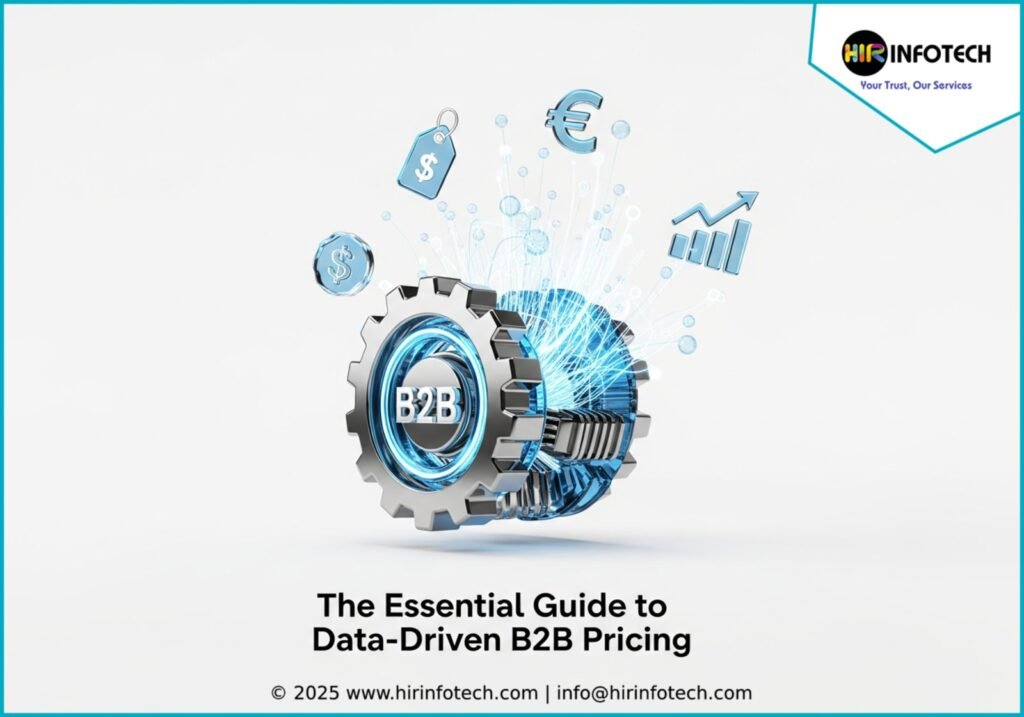
Power Your B2B Pricing with Data Analytics: A 2026 Guide for a Competitive Edge
In the fast-evolving B2B landscape, the power of big data is reshaping everything, including how companies approach pricing. As businesses are projected to increase their investment in big data analytics, a number that has already surpassed hundreds of billions, it’s clear that data-driven strategies are no longer a novelty but a necessity. For B2B companies dealing with vast amounts of data, harnessing analytics for pricing is not just an advantage—it’s the key to survival and growth.
Pricing in a B2B context is a complex puzzle. It’s a delicate balance of understanding your product’s value, your customers’ needs, and the ever-shifting market dynamics. Get it right, and you unlock significant business value. Get it wrong, and you risk leaving money on the table or alienating your customer base. This is where data analytics steps in, transforming pricing from a gut-feeling exercise into a precise, strategic discipline.
This comprehensive guide will walk you through the essential B2B pricing models and demonstrate how to infuse them with the power of data analytics. We will explore actionable techniques to help you select the optimal model for your business and showcase the tangible results of a data-informed pricing strategy. Our focus is on providing clear, non-technical insights for mid to large companies that are deeply involved in web scraping, data extraction, and other data-intensive operations.
Why Accurate B2B Pricing is a Game-Changer
Setting the right price for your B2B products or services is a powerful statement. It communicates a deep understanding of your buyer personas and their specific needs. It shows that you have a firm grasp of your value proposition and are attuned to the dynamic nature of the market, including prevailing economic conditions. By clearly articulating your pricing, you empower potential clients to make informed decisions, positioning your offerings in the context of their competitive landscape. Nailing your B2B pricing is fundamental to creating and capturing business value.
Considering the critical role of pricing, leveraging every available technological advantage is not just an option; it’s a strategic imperative. Analytics technology, in particular, offers a significant edge in this domain. By harnessing the power of data, you can move beyond intuition and make pricing decisions that are backed by concrete evidence and predictive insights.
Top B2B Pricing Models Supercharged with Analytics
To achieve pricing excellence in the B2B sector, it’s essential to consider three core elements: how your customer personas perceive the value of your product, the influence of your pricing on their purchasing journey, and your own company’s cost structure. Let’s delve into the most effective B2B pricing models and explore how data analytics can elevate each one.
Cost-Plus Pricing: The Foundation of Profitability
Often favored by smaller B2B enterprises, the cost-plus pricing model is straightforward and ensures a baseline of profitability. It involves calculating the total cost of producing a product or delivering a service and then adding a predetermined profit margin. While simple, this model can be significantly enhanced with data analytics.
Integrating Analytics:
- Granular Cost Tracking: Utilize analytical tools to meticulously track every input cost associated with your offerings. This includes direct costs like materials and labor, as well as indirect costs such as overhead and marketing expenses. This detailed view allows for more accurate pricing and margin calculations.
- Predictive Cost Modeling: Leverage predictive analytics to forecast future fluctuations in input costs. By analyzing historical data and market trends, you can anticipate price changes from your suppliers and proactively adjust your pricing to protect your profit margins.
- Dynamic Margin Adjustment: Analytics can help you move beyond a static profit margin. By analyzing sales data and customer behavior, you can identify opportunities to adjust margins on different products or for different customer segments, maximizing profitability without sacrificing competitiveness.
Value-Based Pricing: Aligning Price with Customer Outcomes
A value-based pricing strategy anchors your price to the perceived value your product or service delivers to the customer. This approach is particularly effective for startups and companies introducing high-value, innovative solutions to the market. The price is determined by the customer’s desired outcome and their budget for achieving that solution.
Integrating Analytics:
- Quantifying Customer Value: Data analytics is crucial for quantifying the value your solution provides. This can involve analyzing customer data to measure improvements in efficiency, reductions in their operational costs, or increases in their revenue. These data-backed value propositions are powerful tools in sales negotiations.
- Customer Segmentation for Targeted Pricing: Analytics allows you to segment your customer base based on the value they derive from your offerings. This enables you to create tiered pricing structures that align with the specific needs and value perceptions of different segments.
- Predicting Willingness to Pay: By analyzing historical sales data and conducting market research, predictive analytics models can help you estimate what different customer segments are willing to pay, ensuring you capture the maximum value.
For more insights into creating a robust value-based strategy, explore this comprehensive guide on value-based pricing.
Competition-Based Pricing: Navigating the Market Landscape
Both new entrants and established players in the B2B space can benefit from a competition-based pricing strategy. This model involves monitoring your competitors’ pricing and adjusting your own to maintain a profitable position in the market. A key aspect of this strategy is understanding how your pricing is perceived by customers in relation to your competitors.
Integrating Analytics:
- Automated Competitor Price Monitoring: Employ web scraping and data extraction tools to automatically track your competitors’ pricing in real-time. This continuous stream of data provides a clear picture of the competitive landscape and allows for swift adjustments to your own pricing.
- Price Elasticity Analysis: Analytics can help you understand how changes in your price, relative to your competitors, affect customer demand. This insight is vital for making strategic pricing moves that increase market share without triggering a price war.
- Feature-to-Price Comparison: Use data analytics to conduct a detailed comparison of your product’s features against those of your competitors and their corresponding prices. This helps you identify your unique value proposition and justify your pricing strategy. A variety of competitive pricing tools can assist in this process.
Dynamic Pricing: Real-Time Price Optimization
Dynamic pricing is a sophisticated strategy that adjusts prices in real-time based on a variety of factors influencing a buyer’s decision. This model can be applied to any of the previously discussed strategies and is particularly effective in markets where customer price sensitivity is high or cost structures are volatile.
Integrating Analytics:
- Real-Time Data Analysis: The foundation of dynamic pricing is the ability to analyze real-time data from multiple sources. This includes market demand, competitor pricing, inventory levels, and even external factors like economic indicators.
- Algorithmic Pricing Adjustments: Advanced analytics and machine learning algorithms can process this real-time data and automatically recommend or implement price adjustments to optimize for revenue or profit.
- Personalized Pricing Offers: For some B2B applications, dynamic pricing can be used to generate personalized price offers for individual customers based on their purchase history, perceived value, and other behavioral data.
Demonstrating E-E-A-T in Your Pricing Strategy
In the digital age, establishing Experience, Expertise, Authoritativeness, and Trust (E-E-A-T) is crucial, not just for your content but for your entire business strategy, including pricing. A well-articulated, data-driven pricing strategy demonstrates all four pillars of E-E-A-T.
- Experience: By basing your pricing on a deep understanding of your customers’ needs and pain points, you demonstrate firsthand experience in your industry.
- Expertise: The use of sophisticated data analytics and pricing models showcases your expertise in both your domain and in modern business practices.
- Authoritativeness: A clear, transparent, and justifiable pricing strategy positions you as an authority in your market. It shows that you have done your homework and are confident in the value you provide.
- Trust: Transparent pricing builds trust with your customers. When they understand the value they are receiving for the price they are paying, it fosters a stronger, more loyal relationship. For further reading on this topic, this article on E-E-A-T in SEO offers valuable parallels for business strategy.
Take Action with a Data-Driven Pricing Strategy
The message is clear: in 2026 and beyond, B2B companies that leverage data analytics for their pricing strategies will have a significant competitive advantage. By moving away from static, intuition-based pricing and embracing a dynamic, data-informed approach, you can optimize revenue, enhance customer relationships, and solidify your position as a market leader.
The journey to a fully optimized, analytics-driven pricing strategy requires expertise in data extraction, web scraping, and data analysis. This is where a partnership with a seasoned data solutions provider can be invaluable.
Frequently Asked Questions (FAQs)
1. What is pricing analytics?
Pricing analytics involves the use of metrics and technologies to analyze the profitability of different price points. It helps businesses understand the impact of pricing decisions on their overall performance and is used to optimize pricing strategies for maximum revenue and profitability.
2. What are the 4 main pricing strategies?
While there are many pricing strategies, the four most common are cost-plus pricing, competition-based pricing, value-based pricing, and dynamic pricing. Each has its own strengths and is best suited for different business contexts.
3. Which pricing model is the most effective?
Value-based pricing is widely considered one of the most effective pricing strategies, especially for B2B companies offering high-value solutions. It directly links the price of a product or service to the value it creates for the customer, ensuring that you are compensated for the outcomes you deliver.
4. How can a small B2B business start with pricing analytics?
A good starting point for a small B2B business is to begin with a simple cost-plus model and use spreadsheets to track costs and margins. As you grow, you can start incorporating competitive analysis by manually tracking competitor prices. The next step is to invest in basic analytics tools to gain deeper insights into customer behavior and sales data.
5. What are the risks of not using data analytics for pricing?
Without data analytics, you risk underpricing your products and leaving money on the table, or overpricing them and losing customers to competitors. You also miss opportunities to optimize pricing for different customer segments and market conditions, leading to suboptimal revenue and profitability.
6. How does web scraping help with competition-based pricing?
Web scraping automates the process of collecting pricing data from your competitors’ websites. This provides you with a constant stream of real-time data, allowing you to stay on top of market trends and make timely adjustments to your own pricing to remain competitive.
7. Can dynamic pricing be used in all B2B industries?
Dynamic pricing is most effective in industries where demand and costs fluctuate, or where there is a high degree of price sensitivity. However, elements of dynamic pricing, such as personalized offers or tiered pricing based on usage, can be adapted for a wide range of B2B industries.
Ready to unlock the full potential of your B2B pricing strategy?
Contact Hir Infotech today to learn how our expert data extraction and analytics solutions can provide you with the insights you need to make smarter, more profitable pricing decisions. Let us help you turn your data into a strategic asset.
#B2Bpricing #DataAnalytics #PricingStrategy #BigData #BusinessAnalytics #LeadGeneration #DataSolutions #HirInfotech