
Web Scraping vs. API: Which is the Right Choice for Your Business in 2026?
In today’s data-driven world, the success of your business hinges on your ability to gather, analyze, and act on vast amounts of information. Data extraction has become an indispensable tool for companies looking to gain a competitive edge. By harnessing the power of data, you can conduct thorough market research, understand industry trends, and anticipate market shifts. This knowledge empowers your business to adapt, minimize risks, and maximize sales in a constantly evolving marketplace.
But what is the best way to collect this crucial data? Two of the most common and effective methods are web scraping and using Application Programming Interfaces (APIs). While both can deliver the data you need, they function differently and offer distinct advantages. Understanding these differences is key to choosing the right data extraction strategy for your business.
This comprehensive guide will walk you through the nuances of web scraping and APIs. We will explore what they are, how they work, and their respective benefits. By the end, you will have a clear understanding of which method is the best fit for your company’s unique data needs, ensuring you are well-equipped to thrive in the competitive landscape of 2026 and beyond.
What’s the Difference: API vs. Web Scraping
At its core, data extraction is about retrieving information from a source. The primary distinction between using an API and web scraping lies in the method of retrieval.
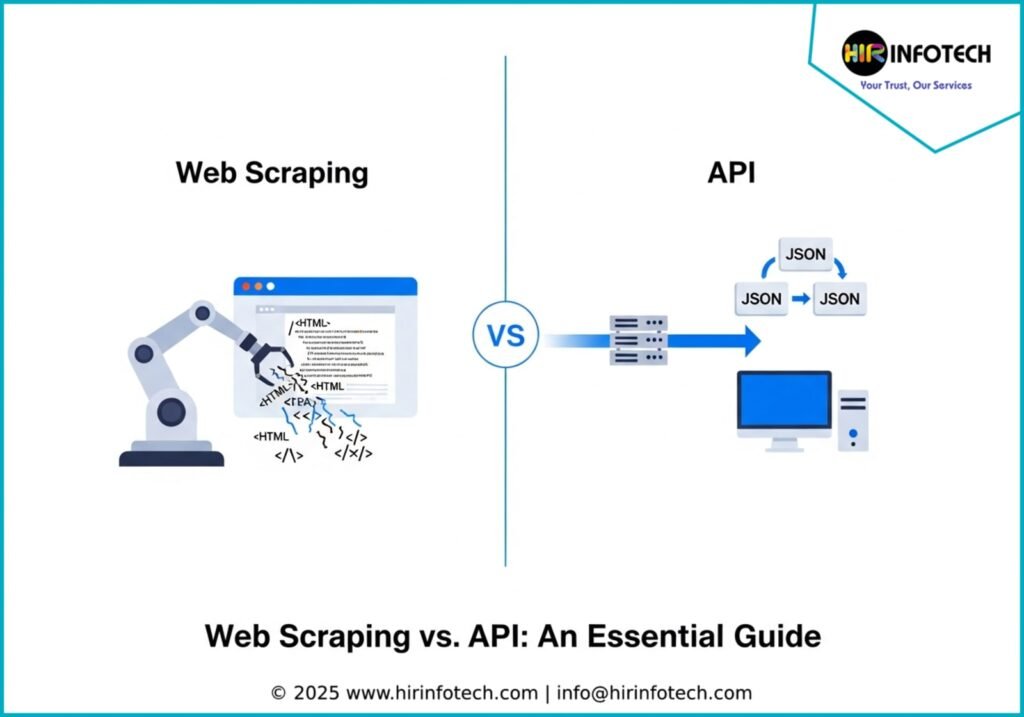
Web scraping is the process of automatically extracting large amounts of data directly from websites. Imagine a bot that visits a webpage, just like a human user, and systematically copies and pastes the information you need into a structured format, like a spreadsheet. This method is incredibly versatile, as it can be used to gather any data that is publicly visible on a website.
An Application Programming Interface (API), on the other hand, is a more structured and direct way to access data. Think of an API as a messenger that delivers data from one application to another. Websites or services with an API have created a specific channel for users to request and receive data in a clean, organized format.
To put it simply, web scraping is like reading the menu at a restaurant to see what’s available, while using an API is like having the waiter hand you a pre-printed list of today’s specials. Both get you the information you need, but the delivery is different.
The Power of APIs: A Structured Approach to Data
For many businesses, APIs are the go-to method for data extraction, and for good reason. When you need to consistently pull the same type of data from the same source, an API can be an incredibly efficient and reliable tool. Let’s delve into the key benefits of using APIs for your data needs.
Benefits of Using an API:
- Stability and Reliability: APIs are designed for machine-to-machine communication. This means the data is provided in a structured and predictable format, such as JSON or XML. This stability is a significant advantage, as you can build your applications and internal processes around a consistent data feed. You won’t have to worry about your data extraction process breaking because a website changed its layout.
- Ease of Use: For developers, working with a well-documented API is often more straightforward than building a web scraper from scratch. The provider has done the heavy lifting of organizing the data, and you simply need to make requests to the specified endpoints.
- Real-Time Data Access: APIs are often the best choice for applications that require real-time data. For example, if you are building a financial application that needs up-to-the-minute stock prices, an API from a financial data provider is the ideal solution.
- Legal and Ethical Compliance: When you use a website’s official API, you are accessing their data in a manner they have approved. This significantly reduces the legal and ethical concerns that can sometimes be associated with web scraping. You are operating within the provider’s terms of service, which can protect your business from potential legal issues.
- Efficiency and Speed: APIs are generally faster than web scraping because they provide a direct pipeline to the data. You don’t have to wait for a webpage to load and render before you can extract the information. This efficiency can be crucial for time-sensitive data collection tasks.
While APIs offer a stable and efficient way to access data, they do come with certain limitations. You are restricted to the data that the provider chooses to make available, and there may be usage limits or costs associated with accessing the API.
The Freedom of Web Scraping: Unlocking the Web’s Full Potential
While APIs are excellent for structured data access, they are not always available or sufficient for every business need. This is where web scraping truly shines. Web scraping gives you the power to extract any publicly available data from any website, offering unparalleled flexibility and control.
Key Advantages of Web Scraping:
- Access to a Wider Range of Data: The most significant advantage of web scraping is its ability to access data from websites that do not offer an API. Many websites, for various reasons, do not provide a public API. Web scraping is your only option for extracting data from these sources.
- No Rate Limiting (Technically): While many APIs impose strict limits on the number of requests you can make in a given period, web scraping does not have these inherent limitations. You can, in theory, scrape as much data as you need. However, it is crucial to be a responsible web citizen and not overload a website’s servers with too many requests in a short period. Ethical scraping practices are essential to avoid being blocked.
- Complete Customization and Control: With web scraping, you are in the driver’s seat. You have complete control over the entire data extraction process. You can choose exactly which data fields to extract, how often to collect the data, and the format in which you want to save it. This level of customization is often not possible with a rigid API structure.
- Competitive Intelligence and Market Research: Web scraping is an invaluable tool for gaining a deep understanding of your competitive landscape. You can extract data on your competitors’ pricing, product offerings, customer reviews, and marketing campaigns. This information can inform your own business strategies and help you stay ahead of the curve.
- Cost-Effectiveness: In many cases, web scraping can be a more cost-effective solution than using a paid API. While developing a custom scraper requires an initial investment of time and resources, the ongoing costs can be significantly lower than the subscription fees for a premium API. For businesses that need to extract large volumes of data on a regular basis, the long-term cost savings can be substantial. For those without the technical expertise, user-friendly tools like ParseHub and Octoparse offer no-code solutions for web scraping.
Web scraping opens up a world of possibilities for data extraction, but it also comes with its own set of challenges. Websites can change their structure, which can break your scraper. Additionally, some websites have anti-scraping measures in place that you may need to navigate.
Web Scraping vs. API: A Head-to-Head Comparison
Feature | Web Scraping | API (Application Programming Interface)
| Data Source | Any publicly available website | Websites or services with a dedicated API |
| Data Structure | Unstructured (raw HTML), requires parsing | Structured (JSON, XML), easy to process |
| Flexibility| Highly flexible, can extract any visible data | Limited to the data provided by the API endpoints |
| Stability| Can be unstable; changes in website structure can break the scraper | Highly stable and reliable; designed for consistent data access |
| Rate Limiting | No inherent rate limits, but ethical considerations are crucial | Often has rate limits to manage server load |
| Legality | Can have legal and ethical implications; must respect terms of service | Generally legally sound when used according to the provider’s terms |
| Ease of Use | Can be complex to set up and maintain, especially for dynamic websites | Generally easier for developers to work with, with clear documentation |
| Cost | Can be more cost-effective for large-scale data extraction | May involve subscription fees, especially for premium data |
The Rise of Hybrid Solutions: Web Scraping APIs
In the evolving landscape of data extraction, a powerful hybrid solution has emerged: the web scraping API. These services, offered by companies like Bright Data, combine the flexibility of web scraping with the ease of use of an API.
A web scraping API allows you to make a simple API call with a URL, and the service handles all the complexities of scraping the data for you. This includes dealing with proxies, rotating IP addresses, and solving CAPTCHAs. You get the structured data you need without having to build and maintain your own scraping infrastructure. This can be an excellent option for businesses that want the power of web scraping without the technical overhead.
Making the Right Choice for Your Business
So, is using a data API preferable to web scraping? The answer is not a simple yes or no. The best method for your business depends entirely on your specific needs and resources.
Choose an API when:
- A reliable and well-documented API is available for your target data source.
- You need real-time or near-real-time data.
- Data stability and consistency are your top priorities.
- You want a legally and ethically straightforward solution.
Choose web scraping when:
- Your target website does not have an API.
- You need to extract data that is not available through the API.
- You require a high degree of customization and control over the data extraction process.
- Cost-effectiveness for large-scale data collection is a primary concern.
In many cases, a combination of both methods may be the most effective approach. You might use an API to get the core, structured data you need, and then use web scraping to supplement that with additional information from other sources.
Future-Proofing Your Data Strategy
The world of data is constantly evolving. As we look ahead to 2026 and beyond, several key trends are shaping the future of data extraction. The rise of artificial intelligence and machine learning is making web scrapers smarter and more resilient. AI-powered tools can now intelligently adapt to changes in website structure, reducing the need for manual maintenance.
Furthermore, there is a growing emphasis on ethical and responsible data collection. Businesses that prioritize transparency and respect for website terms of service will be better positioned for long-term success.
Your Partner in Data Solutions
Navigating the complexities of data extraction can be challenging. Whether you decide that an API, web scraping, or a hybrid approach is right for your business, having a knowledgeable partner can make all the difference. At Hir Infotech, we specialize in providing custom data solutions tailored to the unique needs of your business. Our team of experts can help you develop a robust and effective data extraction strategy that will empower you to make informed decisions and drive business growth.
Ready to unlock the power of your data? Contact Hir Infotech today for a free consultation and let us help you build a data-driven future.
Frequently Asked Questions (FAQs)
1. Is web scraping legal?
The legality of web scraping is a complex issue and depends on several factors, including the type of data being scraped and the website’s terms of service. In general, scraping publicly available data is legal. However, it is crucial to be aware of and comply with relevant data privacy regulations like GDPR and CCPA. Always review a website’s terms of service and robots.txt file before scraping.
2. Can I scrape data from a website that requires a login?
Yes, it is possible to scrape data from websites that require a login. However, this adds a layer of complexity to the scraping process. Your scraper will need to be programmed to handle the login process, which may involve managing cookies and sessions. It is essential to ensure that you are not violating the website’s terms of service by scraping data from behind a login.
3. What is the difference between web scraping and web crawling?
Web crawling and web scraping are related but distinct processes. Web crawling, also known as indexing, is what search engines like Google do. It involves systematically browsing the web to discover and index new pages. Web scraping, on the other hand, is the process of extracting specific data from those pages. A crawler finds the pages, and a scraper extracts the data from them.
4. How can I prevent my IP address from being blocked when scraping?
Websites often block IP addresses that make a large number of requests in a short period. To avoid this, you can use a rotating proxy service. This will make your requests appear as if they are coming from different IP addresses, making it much harder for the website to detect and block your scraper. It is also good practice to add delays between your requests to mimic human browsing behavior.
5. Do I need to be a programmer to do web scraping?
While having programming skills is beneficial for building custom scrapers, it is not a requirement. There are many user-friendly, no-code web scraping tools available that allow you to extract data with a simple point-and-click interface. These tools are an excellent option for non-technical users who want to leverage the power of web scraping.
6. What are some common use cases for web scraping?
Web scraping has a wide range of applications across various industries. Some common use cases include competitor price monitoring, lead generation, market research, sentiment analysis of customer reviews, and gathering data for machine learning models.
7. Can an API be used for web scraping?
While the terms are often used in relation to data extraction, an API is not used for web scraping in the traditional sense. An API provides a direct, structured way to access data, while web scraping involves extracting data from the unstructured HTML of a webpage. A web scraping API is a service that uses web scraping techniques on the backend and provides the extracted data to the user through a simple API call.
#DataExtraction #WebScraping #API #DataSolutions #BigData #BusinessIntelligence #MarketResearch #CompetitiveAnalysis #DataAnalytics #HirInfotech









