Demystifying Big Data: A 2026 Guide to the Concepts Everyone Must Know
Are you looking to step into the big data industry? This guide will explain the essential technologies and terms you’ll encounter in a simple, easy-to-understand way. We’ll provide you with the foundational knowledge needed to navigate the ever-evolving world of data solutions.
In today’s tech-driven world, “big data” has become a buzzword that’s increasingly vital to understand. It refers to the use of massive datasets to analyze and uncover insights into complex patterns and trends. To truly grasp the power of big data, a basic understanding of its terminology is essential. These are the key concepts everyone should know.
Core Big Data Terms for 2026
The landscape of big data is constantly shifting, with new technologies and methodologies emerging. Staying current is key to leveraging data effectively. Here are some of the foundational and trending concepts that are shaping the industry in 2026.
Fundamental Building Blocks
- Algorithm: Think of an algorithm as a recipe that software follows to analyze data. It’s a mathematical or statistical process that runs a series of calculations to solve a problem or discover patterns automatically.
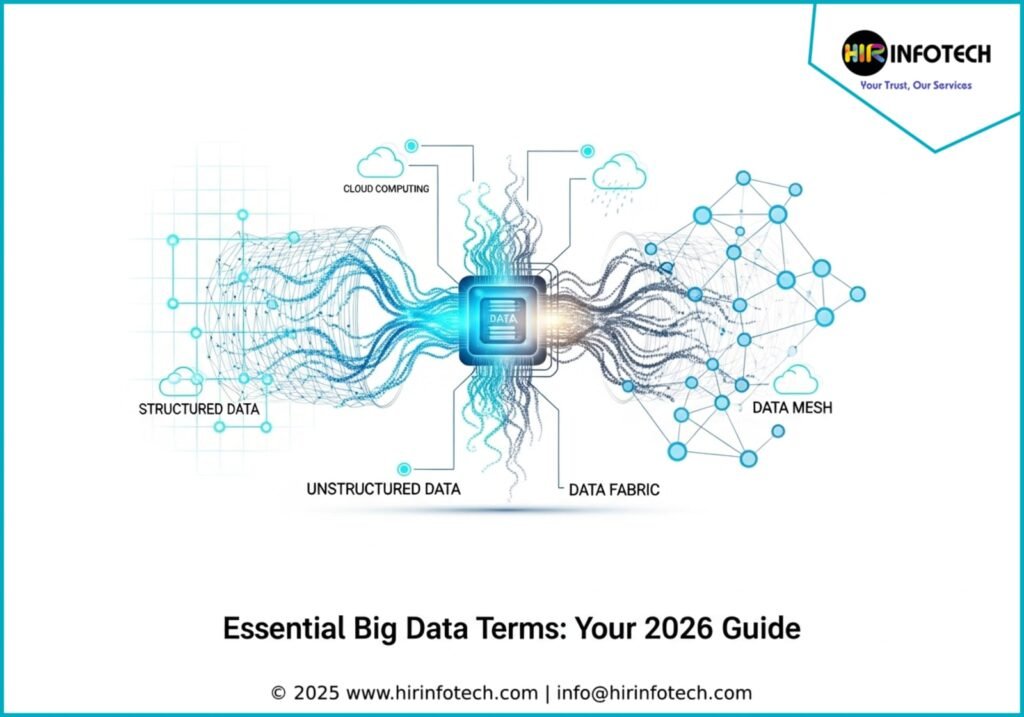
- Cloud Computing: Often referred to as “the cloud,” this is the practice of using a network of remote servers hosted on the internet to store, manage, and process data, rather than a local server or a personal computer. Data stored “in the cloud” is accessible from anywhere with an internet connection, offering immense flexibility and scalability.
- Amazon Web Services (AWS): AWS is a comprehensive suite of cloud computing services offered by Amazon. It allows businesses to conduct large-scale computing operations, including big data projects, without investing in their own physical servers and data warehouses. Companies can rent storage space, processing power, and various software services, which is often more cost-effective than building and maintaining their own infrastructure.
- Software as a Service (SaaS): This is a popular software delivery model where applications are hosted by a third-party provider and made available to customers over the internet. Instead of buying software outright, customers typically pay a subscription fee based on usage. This model is becoming the industry standard for delivering a wide range of business tools, from CRMs to data analytics platforms.
Data Professionals and Processes
- Data Scientist: A data scientist is a specialist who extracts knowledge and insights from data. This role requires a unique blend of skills, including data analytics, computer science, mathematics, and statistics, combined with business acumen, creativity, and strong communication and data visualization abilities. They are the storytellers of the data world.
- MapReduce: This is a programming model for processing large data sets with a parallel, distributed algorithm on a cluster. A MapReduce job splits the input data into smaller pieces that are processed by map tasks in parallel. The framework then sorts the outputs of the maps, which are then input to the reduce tasks. While foundational, newer technologies like Apache Spark are often preferred for their speed and versatility.
Structuring Your Data for Success
- Structured vs. Unstructured Data: Structured data is highly organized and easily searchable, typically fitting neatly into tables with rows and columns, like in a traditional database. Unstructured data, on the other hand, has no predefined format and can include things like emails, social media posts, images, and videos. An estimated 80% to 90% of all data is unstructured, holding immense potential for deep insights.
- Data Lakes: These are centralized repositories that allow you to store all your structured and unstructured data at any scale. Unlike a traditional data warehouse that requires data to be structured before it’s loaded, a data lake stores raw data in its native format until it’s needed for analysis.
The Evolution of Data Architecture in 2026
As companies mature in their data journey, more sophisticated architectural patterns are emerging to handle the complexity and scale of modern data ecosystems.
- Data Fabric: A data fabric is an architecture that uses AI and automation to create a unified, intelligent layer over disparate data sources. It automates data discovery, integration, and governance across hybrid and multi-cloud environments, making it easier to access and trust your information, no matter where it resides. This approach is technology-forward, focusing on creating a seamless and governed data landscape.
- Data Mesh: In contrast, a data mesh is a decentralized approach to data architecture. It shifts ownership of data to the business domains that create and understand it best, treating “data as a product.” This organizational paradigm promotes scalability and flexibility by distributing responsibility and enabling self-serve data infrastructure.
- The Hybrid Approach: Many successful enterprises in 2026 are not choosing one over the other but are instead blending the two. They combine the automation and unified governance of a data fabric with the domain-oriented ownership and product thinking of a data mesh to scale their analytics and AI initiatives responsibly.
The Impact of Artificial Intelligence
The integration of AI is one of the most significant trends in big data. In 2026, AI is no longer just a tool for analysis; it’s the engine driving value from massive datasets.
- AI-Driven Analytics: Modern systems now use AI to identify patterns, suggest avenues for investigation, and generate insights with a degree of autonomy. This is supercharging the ability of businesses to make faster, smarter decisions.
- Generative AI and RAG: The fusion of generative AI with retrieval-augmented generation (RAG) is a major trend. RAG grounds the outputs of generative models in verified, enterprise-specific knowledge bases, leading to more reliable and context-aware analytics.
- Agent-Ready Data: The rise of AI agents that can perform complex tasks autonomously is forcing organizations to rethink their data strategies. For these agents to be effective, data must be clean, accessible, and structured in a way they can understand, a challenge that is creating new opportunities in data management.
To learn more about how these concepts can be applied, check out these valuable resources:
Frequently Asked Questions (FAQs)
Navigating the world of big data can bring up many questions. Here are answers to some of the most common ones.
1. What are the core concepts of big data?
Big data is often defined by the “V’s.” Originally, there were three: Volume (the sheer amount of data), Velocity (the speed at which data is generated), and Variety (the different types of data). Over time, more have been added, including Veracity (the quality and accuracy of the data) and Value (the usefulness of the data).
2. Why is big data so important for businesses today?
Big data allows companies to gain deeper insights into their customers, operations, and markets. This enables them to make more informed decisions, personalize products and services, optimize processes, and identify new revenue streams. In essence, it provides a significant competitive advantage in a data-driven economy.
3. What is the difference between a data lake and a data warehouse?
A data warehouse stores processed and structured data for specific, predefined purposes. A data lake, on the other hand, stores vast amounts of raw data in its native format. Data lakes are more flexible and scalable, making them ideal for exploratory analytics and machine learning, while data warehouses are optimized for fast querying of structured data for business intelligence.
4. How is AI changing the field of big data?
AI is automating and enhancing many aspects of big data analytics. Machine learning algorithms can identify complex patterns that humans might miss, and generative AI can create new data, summarize information, and even write code for data processing. This integration is making data analytics more powerful, accessible, and efficient.
5. What skills are most in-demand for a career in big data in 2026?
Key skills include proficiency in programming languages like Python, a strong understanding of SQL for database management, and expertise in data visualization tools like Tableau or Power BI. Additionally, knowledge of cloud platforms (especially AWS), machine learning concepts, and data architecture principles like data fabric and data mesh are increasingly important. Strong communication and problem-solving skills are also crucial for translating data insights into business value.
6. Do I need to be a technical expert to understand big data?
While deep technical expertise is required for roles like data scientists and engineers, a foundational understanding of big data concepts is beneficial for professionals in many fields, including marketing, finance, and management. Being “data literate” allows you to ask the right questions, understand the potential of data-driven insights, and collaborate effectively with technical teams.
7. What are the biggest challenges in managing big data?
The primary challenges include ensuring data quality and accuracy, maintaining data security and privacy, managing the sheer volume and complexity of data, and having the right talent and tools to analyze it effectively. Emerging architectures like data fabric and data mesh aim to address many of these challenges by improving data governance, accessibility, and scalability.
Unlock the Power of Your Data with Hir Infotech
Understanding these big data concepts is the first step. The next is putting them into action. Whether you’re dealing with massive volumes of information, need to extract valuable data through web scraping, or want to build a robust data infrastructure, the right partner can make all the difference.
At Hir Infotech, we specialize in providing comprehensive data solutions tailored to the needs of mid to large-sized companies. Our expertise in data extraction, web scraping, and data management can help you transform your raw data into actionable insights that drive business growth.
Ready to take control of your data?
Contact Hir Infotech today to learn how our data solutions can empower your business to make smarter, data-driven decisions. Let us help you navigate the complexities of the big data landscape and unlock your full potential.
#BigData #DataAnalytics #BusinessIntelligence #DataScience #CloudComputing #AI #MachineLearning #DataFabric #DataMesh #SEO