Data Storage Security in 2026: Is Your Company’s Data a Ticking Time Bomb?
In the digital-first landscape of 2026, data is more than just information; it’s the lifeblood of your company. From customer details gathered through web scraping to proprietary insights from data extraction, every byte is a valuable asset. But with this value comes immense risk. Data storage security is no longer a niche IT concern—it’s a critical business priority for companies of all sizes. A single data breach can unleash devastating financial and reputational consequences. The question is no longer if you should take data security seriously, but how exposed your company is right now.
The sheer volume of data is exploding. Experts predict that the amount of data created and stored globally will continue to double every few years. For businesses that rely on large-scale data extraction and analysis, this growth presents both an opportunity and a significant threat. More data means more targets for cybercriminals. Protecting this ever-expanding digital footprint is the defining challenge for modern enterprises.
Why Data Storage Security is Non-Negotiable in 2026
Several converging trends make robust data storage security an absolute necessity. The digital world has evolved, and so have the threats. Ignoring these developments is like leaving your company’s front door wide open.
The Escalating Sophistication of Cyber-Attacks
Cyber threats are no longer limited to simple viruses or phishing scams. Today, we face a new breed of AI-powered attacks. Malicious actors are using artificial intelligence to automate vulnerability discovery, craft highly convincing phishing emails, and deploy ransomware that can cripple an entire organization in minutes. Projections estimate that the annual cost of cybercrime will reach a staggering $10.5 trillion by 2025, underscoring the scale of the threat. A proactive, multi-layered security strategy is the only effective defense.
A Stricter Regulatory and Compliance Landscape
Governments worldwide are implementing tougher data protection laws. Regulations like the GDPR in Europe and various state-level laws in the U.S. (such as those in California, Virginia, and Colorado) impose strict requirements on how companies collect, store, and process personal information. As of 2026, new privacy acts in states like Indiana, Kentucky, and Rhode Island have come into effect, adding to the complex compliance patchwork. Non-compliance can lead to crippling fines, legal battles, and a permanent loss of customer trust. For instance, global tech giants have faced multi-million dollar fines for regulatory violations, setting a clear precedent for all businesses.
The Staggering Cost of a Data Breach
The financial fallout from a data breach is immense. In 2025, the global average cost of a data breach was approximately $4.44 million. For companies in the United States, that figure was even higher, soaring to an average of $10.22 million. These costs include everything from forensic investigations and system repairs to regulatory fines and legal fees. However, the damage doesn’t stop there. The long-term harm to a company’s reputation and the resulting loss of customer trust can be even more costly, impacting revenue for years to come.
Is Your Company’s Data an Open Book? Key Vulnerabilities to Address
Effective data storage security isn’t just about buying the latest software. It’s about identifying and closing the hidden vulnerabilities in your current processes. Many companies are exposed in ways they don’t even realize. Here are the most common weak points that cybercriminals are eager to exploit.
The Encryption Gap: Are You Locking Your Digital Doors?
One of the most fundamental security measures is encryption. Encryption is the process of converting your data into a secure code to prevent unauthorized access. Failing to encrypt sensitive data, both when it’s stored (at rest) and when it’s being transmitted (in transit), is a critical error. Without it, any intercepted data is immediately readable. Modern encryption technologies are powerful tools that make stolen information useless to thieves. It is an essential layer of defense for any business serious about data protection.
Human Error: The Unseen Insider Threat
Technology can only do so much. A significant percentage of data breaches—some studies suggest over 60%—involve a human element. This can range from an employee falling for a phishing email to accidental misconfiguration of a cloud storage server. Without ongoing security awareness training, your team can become your biggest vulnerability. Educating employees about common threats and best practices is a cost-effective way to dramatically improve your security posture.
Insecure Data Deletion: The Ghosts of Data Past
When you delete a file from a hard drive or storage device, it isn’t always truly gone. Traces of the data can often be recovered by skilled individuals. Improper data deletion leaves your company vulnerable, especially when decommissioning old hardware. To prevent this, you must use secure data destruction methods. This includes techniques like overwriting the storage space multiple times or physically destroying the device to ensure the data is permanently irrecoverable.
Physical Security in a Digital World
In our focus on digital threats, it’s easy to overlook physical security. Where are your servers and data storage devices located? Who has access to them? Unrestricted access to server rooms or even individual workstations can lead to theft or tampering. Implementing physical security measures is crucial. This includes using locked server cabinets, surveillance cameras, and strict access controls that limit entry to authorized personnel only.
Third-Party and Supply Chain Risks
Your company’s security is only as strong as its weakest link, and that often includes your vendors and partners. Many recent high-profile breaches have originated from a compromise in a third-party supplier’s system. It is vital to vet the security practices of any partner who has access to your data or network. This includes cloud service providers, software vendors, and data processing partners.
Building a Fortress: Actionable Steps to Secure Your Data Storage
Protecting your company’s data requires a proactive and comprehensive approach. It’s about creating a culture of security supported by robust policies and technologies. Here are the essential steps to building your data fortress.
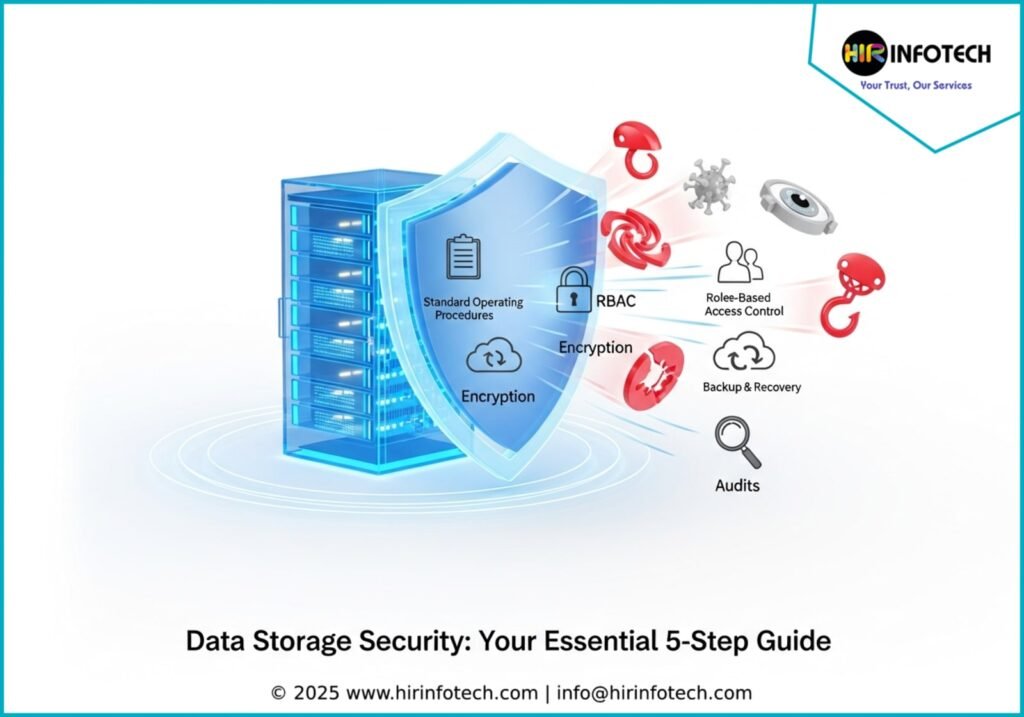
1. Create a Data Security Standard Operating Procedure (SOP)
The first step is to formalize your strategy. A written SOP acts as the blueprint for your entire data security program. It should clearly define:
- Data Classification: Categorize your data based on sensitivity (e.g., public, internal, confidential, restricted).
- Access Policies: Detail who can access what data and under which circumstances.
- Security Protocols: Outline the specific security measures required for each data classification.
- Incident Response Plan: Create a clear, step-by-step guide for what to do in the event of a security breach. This plan is critical for minimizing damage and ensuring a swift recovery.
2. Implement Role-Based Access Control (RBAC)
Not everyone in your company needs access to all data. The principle of least privilege dictates that employees should only have access to the information and systems necessary to perform their job duties. RBAC is a system that enforces this principle by assigning permissions based on an individual’s role within the organization. This simple but effective method significantly reduces the risk of both malicious and accidental data exposure.
3. Embrace End-to-End Encryption
As mentioned earlier, encryption is non-negotiable. It must be a cornerstone of your security strategy. Ensure you have high-quality encryption in place for:
- Data at Rest: All data stored on servers, databases, laptops, and other devices should be encrypted.
- Data in Transit: Any data moving across your internal network or over the internet must be protected with strong encryption protocols like TLS (Transport Layer Security).
4. Develop a Robust Backup and Disaster Recovery Plan
Data loss can happen for many reasons, including hardware failure, natural disasters, or a ransomware attack. A reliable backup and recovery plan is your ultimate safety net. Your plan should include:
- Regular Backups: Implement automated, regular backups of all critical data.
- The 3-2-1 Rule: Maintain at least three copies of your data, on two different types of media, with one copy stored off-site.
- Regular Testing: Don’t just assume your backups work. Regularly test your recovery procedures to ensure you can restore data quickly and effectively when needed. Shockingly, many organizations test their disaster recovery plans only once a year or less, which is a significant risk.
5. Conduct Regular Security Audits and Employee Training
The threat landscape is constantly changing, so your defenses must evolve as well. This requires:
- Security Audits: Regularly conduct internal and external audits to identify new vulnerabilities in your systems and processes. Frameworks like the NIST Cybersecurity Framework provide excellent guidance for managing cybersecurity risk.
- Employee Training: Your team is your first line of defense. Ongoing training programs keep employees aware of the latest threats, such as new phishing techniques, and reinforce your security policies.
The Hir Infotech Advantage: Securing Your Data Operations
For companies that depend on large-scale web scraping, data extraction, and complex data workflows, security is paramount. The data you collect is not just a business asset; it’s a liability if not handled correctly. At Hir Infotech, we understand that our services are an integral part of your data pipeline, and we build security into every step of our process.
We provide more than just data; we provide peace of mind. Our robust infrastructure and stringent security protocols ensure that your data is handled with the utmost care, from extraction to delivery. We employ advanced security measures to protect the integrity and confidentiality of your information, allowing you to focus on leveraging your data for growth, confident that it is secure.
Frequently Asked Questions (FAQs)
-
1. What is the single biggest cause of data breaches?
- While technical vulnerabilities are a factor, human error consistently ranks as a primary cause. Phishing attacks, weak passwords, and misconfigured systems—all rooted in human action—are responsible for a vast number of security incidents.
-
2. How has AI changed cybersecurity?
- AI is a double-edged sword. Attackers use it to create more sophisticated and automated attacks. However, defenders are also leveraging AI and machine learning to detect threats faster, identify anomalies in network traffic, and respond to incidents with greater speed and accuracy.
-
3. Is cloud storage less secure than on-premise storage?
- Not necessarily. Cloud security is a shared responsibility. Major cloud providers like AWS, Google Cloud, and Microsoft Azure have incredibly robust physical and network security. However, the customer is responsible for properly configuring their cloud environment and managing access controls. A misconfigured cloud server can be just as vulnerable as an unsecured on-premise server.
-
4. What is a ransomware attack?
- Ransomware is a type of malicious software that encrypts a victim’s files, making them inaccessible. The attacker then demands a ransom payment, typically in cryptocurrency, in exchange for the decryption key. Ransomware attacks can halt business operations entirely and are a major and growing threat.
-
5. What are the first steps I should take after discovering a data breach?
- Immediately activate your incident response plan. This typically involves isolating the affected systems to prevent further damage, assessing the scope of the breach, notifying relevant stakeholders (including legal counsel and law enforcement), and beginning the recovery process. The U.S. government’s Cybersecurity & Infrastructure Security Agency (CISA) offers valuable resources for incident response.
-
6. What is the “principle of least privilege”?
- This is a fundamental security concept that states users and systems should only be given the minimum levels of access—or permissions—needed to perform their job functions. By limiting access, you reduce the potential damage that can be caused by a compromised account or an insider threat.
-
7. Why is a disaster recovery plan so important if I already have backups?
- Backups are just one component of a disaster recovery (DR) plan. A complete DR plan outlines the entire process of restoring your IT operations after a major disruption. This includes not just data restoration, but also bringing servers, networks, and applications back online in a predetermined order to minimize downtime and business impact. Reputable advisory firms like Gartner provide extensive research on building resilient systems.
Secure Your Data, Secure Your Future
The factors affecting data storage security are complex and constantly evolving. In 2026, a passive approach to security is a recipe for disaster. Businesses must be proactive, vigilant, and prepared. By understanding your vulnerabilities, implementing robust security policies, and fostering a culture of security awareness, you can protect your most valuable asset and ensure the continued success and resilience of your organization.
Don’t wait for a breach to happen. Take control of your data security today.
Ready to enhance your data operations with a partner who prioritizes security? Contact Hir Infotech to learn how our secure data extraction and web scraping solutions can empower your business while safeguarding your information.
#DataSecurity #Cybersecurity #DataStorage #DataBreach #InformationSecurity #DataProtection #CloudSecurity #Ransomware #Encryption #HirInfotech