Why Your AI Strategy Is Destined to Fail Without a Big Data Revolution
Artificial intelligence (AI) is no longer the stuff of science fiction; it’s a driving force in modern business. From streamlining operations to personalizing customer experiences, AI holds immense promise. But here’s a reality check: without a solid foundation of high-quality, well-organized data, your AI initiatives are built on shaky ground. In 2026, the success of AI is inextricably linked to a revolution in how we handle big data.
For many mid to large companies, the allure of AI is powerful. The potential for data-driven decision-making, predictive analytics, and enhanced efficiency is a game-changer. Yet, a critical component is often overlooked: the sheer volume and complexity of the data that fuels these intelligent systems. We’re generating data at an unprecedented rate, but much of it is a chaotic jumble of unstructured information, unusable by machines in its raw form.
This blog post will delve into why big data is the lifeblood of AI, the challenges of wrangling this data, and how a strategic approach to data solutions can unlock the true potential of artificial intelligence for your organization.
The Data Deluge: A Double-Edged Sword
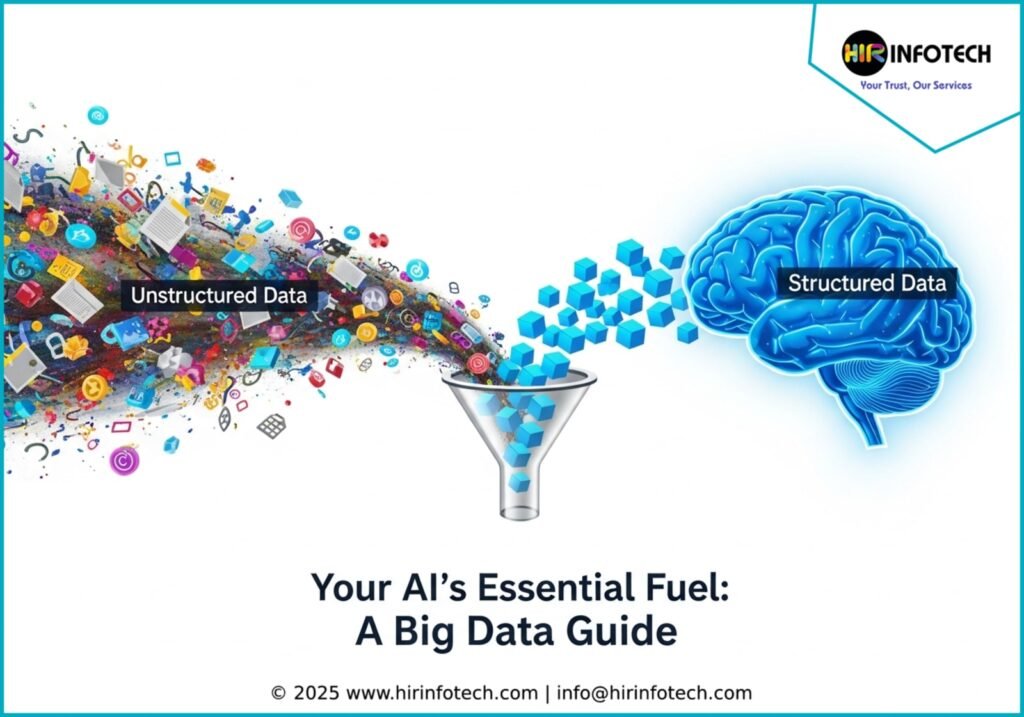
The amount of data in the digital universe is staggering and continues to grow exponentially. While this presents a golden opportunity to glean valuable insights, it also creates a significant hurdle. The vast majority of this data is unstructured – think emails, social media posts, images, and videos. This “dark data” is a treasure trove of information, but without proper organization and labeling, it’s virtually useless to AI algorithms.
Imagine trying to teach a child a new language using a library where all the books are piled in a random heap. That’s the challenge AI faces with unstructured data. For machine learning models to learn and make accurate predictions, they need clean, organized, and relevant data. Investing in data quality is not just a technical requirement; it’s a fundamental business necessity for any company serious about leveraging AI.
Structured vs. Unstructured Data: What’s the Difference?
To understand the challenge, it’s crucial to distinguish between structured and unstructured data:
- Structured Data: This is the neatly organized data that fits into spreadsheets and databases. It’s easily searchable and can be readily processed by machines. Think of customer records, sales figures, and inventory levels.
- Unstructured Data: This is the vast majority of data out there. It lacks a predefined format and includes everything from customer emails and call transcripts to social media comments and satellite imagery.
The reality is that we’re dealing with a massive imbalance. While structured data is valuable, the real gold lies in the untapped potential of unstructured data. The ability to extract, clean, and structure this data is what separates successful AI implementations from costly failures.
The Data Scientist’s Dilemma: More Janitor Than Analyst?
The demand for data scientists has skyrocketed in recent years. These highly skilled professionals are tasked with building the complex algorithms that power AI. However, a significant portion of their time is spent not on sophisticated modeling, but on the tedious and time-consuming task of “digital housekeeping.” This involves gathering, cleaning, and organizing massive datasets to make them usable for machine learning.
This isn’t just inefficient; it’s a bottleneck to innovation. The more time data scientists spend on data preparation, the less time they have for the high-value work of extracting insights and developing groundbreaking AI applications. By 2026, organizations will increasingly rely on AI-driven systems, but these systems are only as good as the data they are trained on.
Fortunately, the data solutions industry is evolving. New tools and platforms are emerging that leverage AI itself to automate many of the mundane tasks of data preparation. These solutions can intelligently identify and correct errors, remove duplicates, and standardize formats, freeing up data scientists to focus on what they do best.
AI in the Real World: From Potential to Practical Application
We’ve all seen headlines about AI achieving superhuman feats, like defeating the world’s top Go player. While impressive, these victories in highly specific and controlled environments don’t always translate to the messy, nuanced realities of the business world. For AI to be truly useful in sectors like healthcare and finance, it needs to be able to handle the complexities and ambiguities of real-world data.
Consider the challenges of applying AI in:
- Healthcare: AI has the potential to revolutionize diagnostics, treatment plans, and patient care. Imagine AI-powered systems that can analyze medical images with greater accuracy than human radiologists or predict disease outbreaks before they happen. To achieve this, AI models need access to vast amounts of high-quality, anonymized patient data, including medical records, lab results, and genomic information.
- Finance: In the financial industry, AI is being used for everything from fraud detection to algorithmic trading. Emotionally adaptive AI is even being developed to create more personalized banking experiences. However, the success of these applications hinges on the ability to process and analyze massive streams of financial data in real-time, all while adhering to strict regulatory requirements.
In both of these fields, and many others, the quality and organization of data are paramount. Inaccurate or incomplete data can lead to flawed predictions and disastrous consequences. This is where a robust data strategy, including frequent web scraping and data extraction, becomes essential.
Building a Foundation for Success: A Collaborative Approach
Advancing in the field of AI requires more than just hiring a few data scientists. It demands a collaborative effort across your entire organization, powered by the right technologies and a commitment to data quality. The future of big data solutions lies in speed, adaptability, and real-time decision-making.
Here are some key steps to building a solid data foundation for your AI initiatives:
- Invest in Data Quality Tools: Modern data cleansing tools can automate the process of identifying and fixing errors in your datasets, ensuring that your AI models are trained on accurate and reliable information.
- Embrace a Unified Data Architecture: A data fabric approach can help you connect disparate data sources and provide a unified view of your organization’s data, making it easier for your teams to access and analyze the information they need.
- Foster Collaboration: Break down silos between your technical and business teams. Financial and technology specialists need to work together to identify potential issues with data from the outset and ensure that the insights generated by AI are relevant and actionable.
- Prioritize E-E-A-T: In the world of SEO and AI, E-E-A-T (Experience, Expertise, Authoritativeness, and Trustworthiness) is crucial. This principle applies to your data as well. Ensure your data is sourced from credible locations and that your data governance practices are transparent and trustworthy.
By taking a proactive and strategic approach to your data, you can create a fertile ground for AI to flourish, driving innovation and creating a sustainable competitive advantage.
Frequently Asked Questions (FAQs)
1. Why is big data so important for AI?
AI algorithms, particularly machine learning models, require vast amounts of data to learn and make accurate predictions. The more high-quality data an AI system is exposed to, the better it becomes at identifying patterns, understanding nuances, and generating valuable insights. Big data provides the raw material that AI needs to grow and evolve.
2. What are the biggest challenges in managing big data for AI?
The primary challenges include the sheer volume of data, the high percentage of unstructured data, and issues with data quality. Ensuring data is clean, accurate, complete, and properly formatted is a significant hurdle. Data security and compliance with privacy regulations are also major concerns.
3. How does web scraping and data extraction fit into an AI strategy?
Web scraping and data extraction are critical for gathering the massive datasets needed to train AI models. Many valuable insights are locked away in unstructured web data. By systematically extracting and organizing this information, companies can create rich datasets that fuel more powerful and accurate AI applications.
4. What is the role of a data scientist in the age of AI?
While AI can automate many tasks, the role of the data scientist is evolving, not disappearing. Data scientists are still needed for their critical thinking, domain expertise, and ability to frame complex business problems in a way that AI can solve. They are increasingly focused on higher-level tasks like model interpretation, ethical considerations, and strategic decision-making.
5. How can a company get started with building a data-driven AI strategy?
Start by assessing your current data infrastructure and identifying key business problems that AI could potentially solve. It’s crucial to begin with a clear understanding of your goals. Partnering with a data solutions expert like Hir Infotech can provide the necessary expertise and tools to develop and execute a successful strategy.
6. What are some of the future trends in AI and big data?
The future will see even greater integration of AI and big data. Expect more advanced predictive analytics, hyper-personalization, and the automation of complex tasks. AI-powered data visualization will also make it easier to understand and communicate complex insights. Additionally, generative AI will play a larger role in creating synthetic data for training AI models.
7. How does E-E-A-T (Experience, Expertise, Authoritativeness, and Trustworthiness) apply to data for AI?
E-E-A-T is a concept Google uses to evaluate content quality, and it’s highly relevant to data for AI. ‘Experience’ relates to data that reflects real-world scenarios. ‘Expertise’ means the data is accurate and well-vetted. ‘Authoritativeness’ comes from using data from reputable sources. ‘Trustworthiness’ is about ensuring data security, privacy, and transparency. High-quality, E-E-A-T-compliant data leads to more reliable and trustworthy AI models.
Ready to Unleash the Power of Your Data?
The journey to successful AI implementation begins with a solid data foundation. Don’t let your AI ambitions be derailed by poor data quality and a lack of strategy. At Hir Infotech, we specialize in providing comprehensive data solutions, from web scraping and data extraction to data cleaning and organization. Our team of experts can help you transform your raw data into a valuable asset that fuels innovation and drives business growth.
Contact Hir Infotech today to learn how we can help you build the data foundation for your AI-powered future.
#AI #BigData #DataScience #DataAnalytics #MachineLearning #ArtificialIntelligence #DataSolutions #WebScraping #DataExtraction #DigitalTransformation