Unlocking a Goldmine of Business Intelligence: Overcoming the Hurdles of Scalable Text Data Solutions
In today’s digital world, businesses are drowning in a sea of unstructured data. This ever-growing mountain of information, particularly text-based data, presents both a massive challenge and a golden opportunity. For data scientists and the forward-thinking companies they support, harnessing this resource is no longer optional—it’s essential for survival and growth. While “big data” often brings to mind neat rows and columns of numbers, the reality is that unstructured text from emails, social media, customer reviews, and surveys holds a wealth of actionable insights waiting to be discovered.
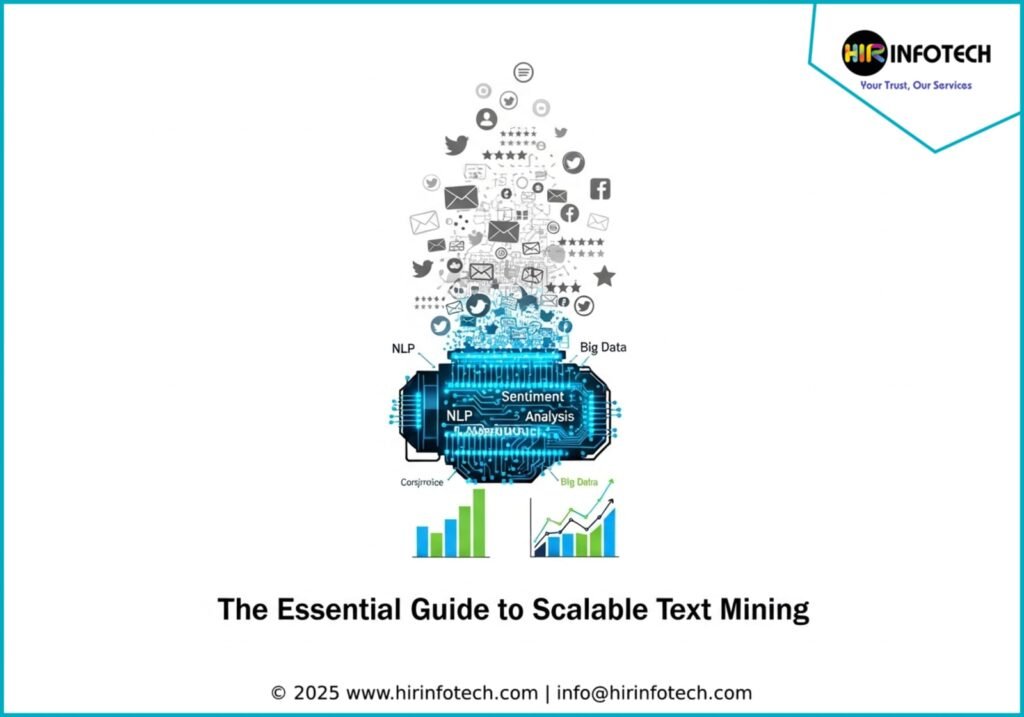
As we move further into 2026, the ability to effectively mine and analyze this text at scale is what separates market leaders from the rest of the pack. The process, known as text mining, allows organizations to cut through the noise and understand the “why” behind the numbers. It’s about transforming raw, chaotic text into structured, strategic intelligence. But how do you tackle this complex task without getting lost in the weeds? This blog post will demystify the world of scalable text mining, explore its powerful applications, and provide actionable strategies to turn your unstructured data into a competitive advantage.
Why Text Mining is a Game-Changer for Modern Businesses
Before diving into the complexities of scaling your data solutions, it’s crucial to understand why text mining has become such a critical component of business intelligence. The applications are vast and transformative, offering a direct line into the hearts and minds of your customers, competitors, and the market as a whole.
Gaining Deep Insights from Customer Feedback
Many companies have historically relied on closed-ended surveys with predefined answers. While useful for gathering quantitative data, these surveys often miss the nuances of the customer experience. They tell you *what* customers think, but not *why* they think it. This is where open-ended questions and text analysis shine.
By giving customers the freedom to express themselves in their own words, you open the door to a treasure trove of unfiltered feedback. Text mining tools can then sift through these responses to identify recurring themes, pinpoint specific pain points, and uncover suggestions for improvement you may have never considered. This qualitative data provides invaluable context to your quantitative findings, allowing you to make more informed, customer-centric decisions.
Predicting Market Trends with Social Media Analytics
Social media is a real-time pulse of public opinion and emerging trends. However, with billions of posts, comments, and messages generated daily, manually tracking this firehose of information is impossible. Scalable text mining solutions are essential for monitoring this landscape effectively.
Modern predictive analytics tools go beyond simple hashtag tracking. They analyze the unstructured text from major social media platforms to detect shifts in consumer sentiment, identify burgeoning trends, and even predict future market movements. By visualizing this data through word maps and sentiment analysis dashboards, businesses can stay ahead of the curve, adapt their strategies on the fly, and engage with their audience in a more relevant and timely manner.
Conducting In-Depth Competitive Research
Understanding your competitors is fundamental to carving out your niche in the market. Text mining offers a powerful arsenal of techniques for gathering and analyzing competitive intelligence. These methods allow you to systematically scrape and analyze data from a wide range of sources, including:
- Competitor Websites: To understand their marketing messaging, product positioning, and key value propositions.
- Customer Review Platforms (like Yelp and G2): To gauge public opinion about their products and services.
- Industry Forums and Publications: To stay informed about their latest moves and the industry’s response.
By leveraging text mining, you can automate the process of gathering this information and quickly identify your competitors’ strengths, weaknesses, pricing strategies, and overall market share. Tools like Local Business Extractor can even help you identify local competitors by mining Google Places listings, giving you a comprehensive view of the competitive landscape.
The Core Challenges of Scalable Text Mining
While the benefits of text mining are clear, implementing a scalable solution is not without its challenges. The very nature of unstructured text data—its variability, complexity, and sheer volume—presents significant hurdles that must be overcome. As the amount of data grows, these challenges become even more pronounced.
The Problem of Ambiguity in Human Language
Natural language is inherently ambiguous. The same word can have different meanings depending on the context. Sarcasm, irony, and slang further complicate the matter. A text mining algorithm must be sophisticated enough to understand these nuances to accurately interpret the sentiment and meaning behind the text. This requires advanced Natural Language Processing (NLP) techniques and machine learning models that can learn from vast amounts of data to better understand context.
Dealing with “Dirty” Data
Text data from sources like social media and online forums is often messy. It can be riddled with typos, grammatical errors, abbreviations, and emojis. Before any meaningful analysis can be performed, this data needs to be cleaned and preprocessed. This involves tasks such as:
- Tokenization: Breaking down the text into individual words or phrases.
- Stop Word Removal: Filtering out common words that don’t add much meaning (e.g., “the,” “a,” “is”).
- Stemming and Lemmatization: Reducing words to their root form to ensure consistency.
Performing these tasks at scale requires a robust and efficient data pipeline.
Ensuring Scalability and Performance
As your data volume grows, your text mining solution must be able to keep up without a significant drop in performance. Processing massive amounts of text data can be computationally expensive. A scalable architecture is crucial to handle the increasing load. This often involves leveraging cloud-based platforms and distributed computing frameworks that can allocate resources dynamically as needed. The goal is to ensure that your analysis remains timely and cost-effective, even as you scale up.
Integrating Domain-Specific Knowledge
Generic text mining models may not be effective for specialized industries. A model trained on general news articles will likely struggle to understand the nuances of legal documents or medical records. To achieve high accuracy, it’s often necessary to incorporate domain-specific knowledge into your models. This can involve creating custom dictionaries, training models on industry-specific datasets, and working with subject matter experts to validate the results.
Strategies for Building a Successful Scalable Text Mining Solution
Overcoming the challenges of text mining requires a strategic approach that combines the right technology, processes, and expertise. Here are some key strategies to consider as you build out your scalable data solution:
Adopt a Modular and Cloud-Native Architecture
A monolithic, on-premise solution will struggle to keep up with the demands of big data. A modular, cloud-native architecture provides the flexibility and scalability you need. By breaking down your text mining pipeline into smaller, independent services, you can scale each component individually based on its specific needs. Cloud platforms like AWS, Google Cloud, and Azure offer a wide range of services for data storage, processing, and machine learning that can be easily integrated to build a powerful and scalable solution.
Leverage Pre-Trained Models and Transfer Learning
Building a text mining model from scratch can be a time-consuming and resource-intensive process. Fortunately, you don’t always have to reinvent the wheel. The data science community has developed a wealth of pre-trained models that can be used as a starting point for your own projects. Techniques like transfer learning allow you to take a model that has been trained on a large, general dataset and fine-tune it for your specific needs. This can significantly reduce development time and improve model performance, especially when you have a limited amount of training data.
Implement a Robust Data Quality Framework
The quality of your analysis is only as good as the quality of your data. A robust data quality framework is essential for ensuring that your text data is clean, consistent, and ready for analysis. This should include automated processes for data cleansing, validation, and enrichment. By investing in data quality upfront, you can avoid costly errors and ensure that your insights are accurate and reliable.
Emphasize Continuous Learning and Model Improvement
The world of text data is constantly evolving. New slang, new topics, and new ways of expressing ideas are constantly emerging. Your text mining models need to be able to adapt to these changes. This requires a commitment to continuous learning and model improvement. Regularly retrain your models with new data to keep them up-to-date and monitor their performance to identify areas for improvement. A/B testing different models and algorithms can also help you find the best approach for your specific use case.
For more in-depth information on data mining techniques, check out this excellent resource from TechTarget. To explore some of the leading tools in the industry, Forbes Advisor provides a great overview.
Putting It All Together: A Vision for the Future
The ability to extract meaningful insights from unstructured text data is no longer a luxury—it’s a necessity for any business that wants to thrive in the data-driven landscape of 2026 and beyond. By understanding the challenges and implementing the right strategies, you can build a scalable text mining solution that turns your data into a powerful strategic asset. It’s about more than just technology; it’s about fostering a data-centric culture that empowers your team to make smarter, more informed decisions at every level of the organization.
#TextMining #DataAnalytics #BigData #ScalableSolutions #BusinessIntelligence #NLP #DataScience #MarketResearch #CompetitiveAnalysis #SocialMediaAnalytics
Frequently Asked Questions (FAQs)
-
1. What is text mining?
- Text mining, also known as text analytics, is the process of extracting high-quality information from text. It involves using techniques from natural language processing (NLP), machine learning, and statistics to identify patterns, trends, and insights within unstructured or semi-structured text data.
-
2. How does text mining differ from data mining?
- Data mining is a broad term that refers to the process of discovering patterns in large datasets. Text mining is a specific type of data mining that focuses on unstructured text data. While data mining often works with structured data (like numbers in a spreadsheet), text mining is designed to handle the complexities and ambiguities of human language.
-
3. What are some common applications of text mining in business?
- Businesses use text mining for a variety of purposes, including sentiment analysis of customer feedback, social media monitoring to track brand reputation and market trends, competitive intelligence gathering, fraud detection, and enhancing customer support through the analysis of support tickets and chat logs.
-
4. What are the main challenges in text mining?
- The main challenges include dealing with the ambiguity of natural language, handling large volumes of unstructured and often “dirty” data (with typos, slang, etc.), ensuring the scalability and performance of the analysis, and integrating domain-specific knowledge to improve accuracy.
-
5. What is Natural Language Processing (NLP)?
- Natural Language Processing (NLP) is a field of artificial intelligence that focuses on enabling computers to understand, interpret, and generate human language. It is a core component of text mining, providing the algorithms and techniques needed to process and analyze text data.
-
6. How can I get started with text mining for my business?
- A good starting point is to identify a specific business problem you want to solve, such as understanding customer feedback from a particular channel. You can then explore various text mining tools and platforms, from open-source libraries to comprehensive enterprise solutions. It’s often beneficial to partner with a data solutions provider who can help you develop a strategy and implement a solution tailored to your needs.
-
7. Is text mining only for large enterprises?
- Not at all. While large enterprises with massive datasets can certainly benefit from text mining, the rise of cloud-based solutions and user-friendly tools has made it more accessible to businesses of all sizes. Even small and medium-sized businesses can gain valuable insights from analyzing customer emails, social media mentions, and online reviews.
Ready to Unlock the Power of Your Text Data?
Navigating the complexities of scalable data solutions can be a daunting task. At Hir Infotech, we specialize in helping businesses like yours transform their unstructured data into a strategic advantage. Our team of experts has over 13 years of experience in delivering cutting-edge web scraping, data extraction, and AI-driven data analytics solutions. We provide the tools and expertise you need to tackle your toughest data challenges and unlock the insights that drive growth.
Don’t let your most valuable data remain untapped. Contact Hir Infotech today to learn how our scalable data solutions can help you make smarter, data-driven decisions and stay ahead of the competition.