Five Reasons Data Digitization is Imperative for Business Growth in 2026
In today’s fast-paced digital world, the question is no longer if a business should digitize its data, but how quickly it can do so. Digital transformation is the engine of modern industry, reshaping how companies operate, connect with customers, and create value. For mid-to-large-sized companies grappling with vast amounts of data, digitization isn’t just an advantage—it’s essential for survival and growth.
This blog explores the top five reasons why data digitization is crucial for your company’s success. We will delve into how converting analog information into a digital format can streamline your operations, reduce costs, and unlock new opportunities for innovation.
The Digital Shift: A New Business Reality
The world is increasingly digital. From manufacturing and healthcare to finance and agriculture, every sector is embracing digital technologies to stay competitive. A digital-first strategy is no longer optional; it’s a core component of a successful business model. Companies that harness the power of their data through digitization are better equipped to navigate market changes and meet evolving customer expectations.
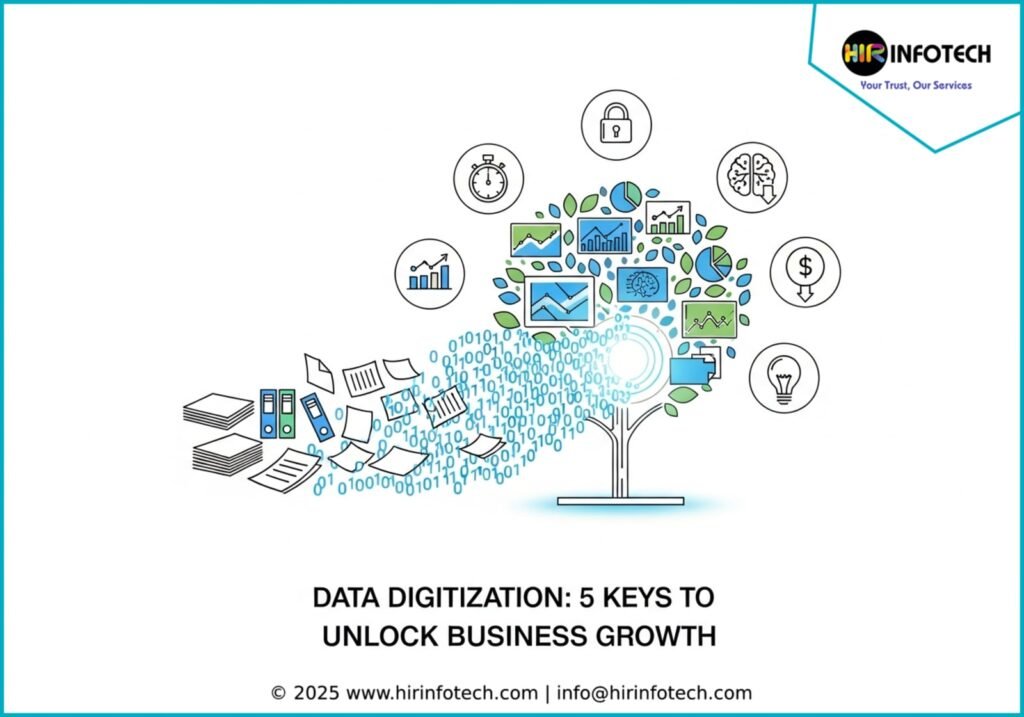
Data is the lifeblood of modern business. It provides the insights needed to understand customer behavior, optimize processes, and make informed decisions. Digitization transforms this raw data into a structured, accessible, and actionable asset. By converting paper documents, images, and other analog formats into digital files, you create a centralized repository of information that can be easily searched, analyzed, and shared across your organization.
Services like web scraping and data extraction are vital in this process. They allow businesses to gather vast amounts of information from various online sources, converting unstructured web data into structured formats ready for analysis. This capability is crucial for competitive analysis, market research, and lead generation, providing a real-time pulse on your industry landscape.
1. Massive Time Savings and Enhanced Efficiency
One of the most immediate and significant benefits of data digitization is the incredible amount of time it saves. Manual, paper-based processes are notoriously slow and inefficient. Think about the hours your employees spend printing, sorting, filing, and then later searching for physical documents. These are hours that could be dedicated to more strategic, revenue-generating activities.
Digital data storage eliminates these time-consuming tasks. With a centralized, cloud-based system, finding any piece of information is as simple as a quick search. This immediate access to data streamlines workflows and empowers your team to work more efficiently. By automating repetitive tasks like data entry and report generation, you free up your employees to focus on what they do best: innovate and solve complex problems.
Key benefits include:
- Instant Document Retrieval: No more digging through filing cabinets. Find what you need in seconds.
- Streamlined Workflows: Automate data entry, approvals, and other routine processes to accelerate operations.
- Improved Collaboration: Teams can access and work on the same documents simultaneously, from anywhere in the world.
For companies that require frequent web scraping and data extraction, digitizing this incoming data flow is paramount. It ensures that the collected information is immediately available for analysis, allowing for agile, data-driven decision-making that can give you a significant competitive edge.
2. Significant Reduction in Administrative Costs
Every business owner knows that managing costs is critical for long-term success. Data digitization offers a powerful way to reduce administrative overhead and improve your bottom line. Paper-based systems come with a host of expenses, including the cost of paper, printing, ink, and physical storage space. Over time, these costs can add up to a substantial amount.
By going paperless, you can eliminate these expenses almost entirely. Digital storage is far more cost-effective than renting or maintaining physical storage facilities. Furthermore, the efficiency gains from digitization translate directly into cost savings. When your employees spend less time on manual tasks, your operational costs decrease, and productivity increases. McKinsey estimates that digitizing information-intensive processes can cut costs by up to 90%.
Digitization reduces costs by:
- Eliminating Paper and Printing Expenses: A direct and immediate cost saving.
- Reducing Physical Storage Needs: Free up valuable office space and save on storage costs.
- Lowering Labor Costs: Automation of manual tasks reduces the need for extensive administrative staff.
3. Enhanced Data Security and Compliance
In an era of increasing cyber threats and stringent data privacy regulations, securing your company’s information is more important than ever. Physical documents are vulnerable to theft, loss, and damage from natural disasters like fires or floods. Losing critical records can be incredibly costly, both financially and in terms of your company’s reputation.
Data digitization provides a much more secure way to manage your information. Digital files can be encrypted, password-protected, and backed up in multiple locations to ensure they are safe from unauthorized access and can be recovered in the event of a disaster. Access controls can be implemented to ensure that employees only have access to the data they need for their specific roles, reducing the risk of internal data breaches.
Moreover, digitization makes it easier to comply with data protection regulations such as GDPR and CCPA. Digital systems allow you to track who has accessed data, what changes were made, and when. This audit trail is essential for demonstrating compliance and avoiding hefty fines.
Security advantages of digitization include:
- Robust Encryption: Protects sensitive data from unauthorized access.
- Regular Backups: Ensures data can be recovered in case of a disaster.
- Access Controls: Limits access to sensitive information on a need-to-know basis.
For more on data security best practices, check out this insightful article from Forbes on data security in digital transformation.
4. Improved Data-Driven Decision-Making
In today’s competitive market, making decisions based on intuition or incomplete information is a recipe for failure. Data-driven decision-making is the key to staying ahead of the curve. Data digitization provides the foundation for this approach by making high-quality, real-time data accessible to decision-makers across your organization.
When your data is digitized and centralized, you can use powerful analytics tools to uncover valuable insights into your operations, customers, and market trends. These insights can inform everything from product development and marketing strategies to supply chain management and financial planning.
Web scraping and data extraction services play a crucial role here, providing a continuous stream of external data that can be integrated with your internal data for a more comprehensive view of the business landscape. This allows you to:
- Analyze Market Trends: Identify new opportunities and potential threats.
- Understand Customer Behavior: Personalize products and services to meet customer needs.
- Optimize Operations: Identify inefficiencies and areas for improvement.
Explore the latest trends in data and analytics in this comprehensive overview from Gartner, a leading research and advisory company.
5. Fostering Innovation and Future-Readiness
Digital transformation is not a one-time project; it’s an ongoing process of adaptation and innovation. By digitizing your data and processes, you create a more agile and flexible organization that is better prepared for the future. A digital infrastructure allows you to quickly adopt new technologies like artificial intelligence (AI) and machine learning, which can further automate processes and provide even deeper insights.
AI-powered web scraping, for example, is revolutionizing how businesses gather market intelligence. These advanced tools can extract and structure data with greater speed and accuracy, enabling more sophisticated analysis and forecasting. By embracing digitization, you position your company to take advantage of these and other emerging technologies, ensuring your long-term competitiveness and growth.
Digitization is the gateway to:
- Greater Agility: Respond quickly to market changes and new opportunities.
- Scalability: Easily scale your operations as your business grows.
- Technological Adoption: Seamlessly integrate new technologies to maintain a competitive edge.
To learn more about how digital marketing can leverage your digitized data, this HubSpot article provides a great starting point.
Frequently Asked Questions (FAQs)
1. What is data digitization?
Data digitization is the process of converting information from a physical format (like paper documents, images, or audio recordings) into a digital format that can be stored, accessed, and processed by a computer.
2. How does data digitization help with business growth?
It drives growth by increasing efficiency, reducing costs, enhancing data security, enabling better decision-making through analytics, and fostering innovation. This allows businesses to operate more effectively and adapt to market changes.
3. What are web scraping and data extraction?
Web scraping and data extraction are automated techniques used to collect large amounts of data from websites. This data is then typically saved in a structured format, like a spreadsheet or database, for analysis.
4. Is data digitization secure?
Yes, when implemented correctly, data digitization is far more secure than physical data storage. Digital files can be protected with encryption, access controls, and regular backups to prevent loss, theft, or unauthorized access.
5. How can my company get started with data digitization?
Start by identifying the most critical paper-based processes in your organization. Then, develop a clear strategy for converting these documents into a digital format and storing them in a centralized system. Partnering with a data solutions expert can help streamline this process.
6. What is the ROI of data digitization?
The return on investment for data digitization can be substantial. It comes from direct cost savings on paper and storage, increased productivity from more efficient workflows, and the value of improved decision-making and business insights.
7. How does AI impact data digitization?
AI enhances data digitization by automating the extraction and classification of data, improving accuracy, and enabling advanced analytics. AI can identify patterns and insights in large datasets that would be impossible for humans to detect.
Take the Next Step in Your Digital Journey
Data digitization is no longer a luxury—it is a fundamental requirement for any business looking to thrive in the modern economy. From saving time and money to enhancing security and driving innovation, the benefits are clear and compelling.
Ready to unlock the full potential of your business data?
Contact Hir Infotech today. Our team of experts specializes in providing comprehensive data solutions, including web scraping and data extraction services, tailored to the unique needs of mid-to-large-sized companies. Let us help you transform your data into your most valuable asset and pave the way for sustainable business growth.
#DataDigitization #BusinessGrowth #DigitalTransformation #DataExtraction #WebScraping #DataSolutions #FutureOfBusiness #TechTrends2026