Unlock Growth in 2026: The Ultimate Guide to Scraping Customer Reviews
Every customer interaction leaves an impression. Think of it like a tire track in the mud—distinct, impactful, and hard to erase. This first impression quickly solidifies into an opinion, shaping how a customer perceives your brand for a long time. In today’s digital marketplace, these impressions are captured and amplified through online customer reviews. They are the digital word-of-mouth that can make or break a business.
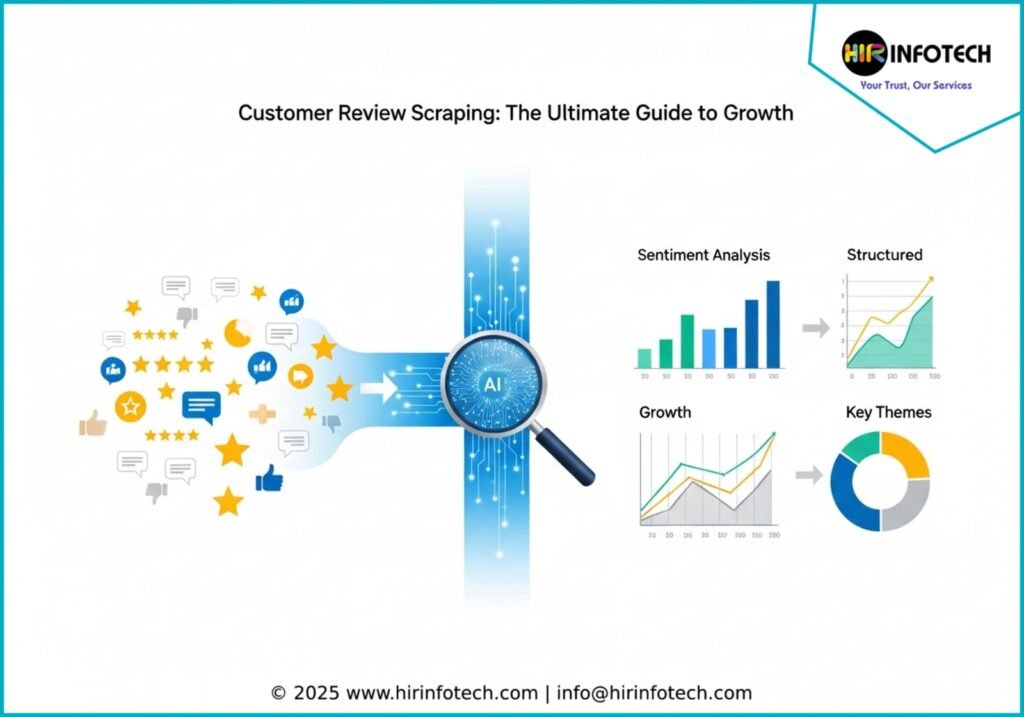
For mid to large companies, the sheer volume of this feedback across countless platforms is both a challenge and a massive opportunity. Manually sifting through thousands of comments on Google, Amazon, Yelp, G2, and social media is an impossible task. Yet, hidden within this unstructured data are the critical insights you need to innovate, outperform competitors, and build a loyal customer base. This is where web scraping for customer reviews comes in—a powerful technique to automatically gather and structure this data, turning customer chatter into your most valuable business intelligence asset.
This comprehensive guide will explore the immense benefits of scraping customer reviews. We will delve into how this practice transforms your approach to market analysis, brand management, and product development. Prepare to learn how to harness customer feedback at scale and make data-driven decisions that propel your business forward in 2026 and beyond.
Why Customer Reviews Are Your Most Undervalued Asset
Customer reviews are more than just star ratings. They are raw, unfiltered stories about the customer experience. Each review provides a direct line into your customers’ minds, revealing their joys, frustrations, and expectations. This user-generated content is a goldmine of qualitative data that traditional market research methods, like surveys and focus groups, often fail to capture with the same authenticity and scale.
Potential customers rely heavily on this feedback. Before committing to a purchase, nearly everyone seeks out reviews, testimonials, and recommendations. This social proof builds a foundation of trust and credibility that advertising alone cannot achieve. A strong base of positive reviews can significantly shorten the sales cycle, while negative reviews offer an invaluable chance to identify and rectify problems before they escalate.
The Challenge: Drowning in a Sea of Data
The modern business landscape is flooded with customer feedback. Reviews pour in from e-commerce sites, local directories, social media platforms, and industry-specific forums. For a large enterprise, this can mean tens of thousands of new data points every month. While this feedback is invaluable, its volume and unstructured nature present a significant hurdle.
How do you track sentiment trends over time? How do you know if a sudden dip in ratings is related to a new product feature or a competitor’s marketing campaign? How do you consolidate feedback from ten different websites to get a holistic view of your brand reputation? Attempting to answer these questions manually is not only inefficient but also prone to human error and bias. It’s like trying to understand an entire library by reading one page from each book. You get fragments of information but miss the overarching narrative.
The Solution: Automated Review Scraping Explained
Web scraping, also known as data extraction, is the process of using automated software (often called “bots” or “scrapers”) to collect public data from websites. Think of it as a super-fast research assistant that can visit thousands of web pages in minutes, copy the specific information you need, and organize it neatly into a structured format like a spreadsheet or a database.
When applied to customer reviews, this technology systematically pulls key pieces of information, such as:
- The star rating or score
- The full text of the review
- The date the review was posted
- Reviewer information (username, location if public)
- Product or service details
- Helpful/unhelpful votes
This structured dataset becomes the foundation for deep analysis, allowing you to move from anecdotal evidence to data-backed strategic decisions.
Transforming Feedback into Strategy: Key Benefits of Review Scraping
Harnessing customer reviews through web scraping unlocks powerful advantages across your entire organization. It allows you to build a comprehensive, real-time understanding of your market position and customer needs.
1. Uncover Actionable Insights with Advanced Sentiment Analysis
Going beyond a simple positive or negative classification is crucial. Modern sentiment analysis, supercharged by AI and machine learning, can perform aspect-based analysis. This means it can identify specific features or aspects of your product and the sentiment attached to them. For example, an analysis might reveal that customers love your new software’s “user interface” but are frustrated by its “slow loading times.”
Scraping reviews provides the massive dataset needed to train these AI models effectively. You can track sentiment shifts in real time, pinpointing the exact cause of customer dissatisfaction or delight. This allows you to address issues proactively and double down on what your customers truly value, leading to higher satisfaction and retention.
2. Sharpen Your Competitive Edge with Competitor Analysis
What are your competitors’ customers saying? Scraping their reviews is one of the most effective ways to conduct competitive intelligence. By analyzing their feedback, you can identify:
- Product Gaps: Are customers consistently requesting features that your competitor lacks but you could provide? This is a prime opportunity for innovation.
- Service Weaknesses: Do their reviews frequently mention poor customer support, slow shipping, or difficult return processes? This highlights areas where you can create a superior customer experience.
- Pricing Perception: Are customers complaining that a competitor’s product is overpriced for the value it delivers? This insight can inform your own pricing strategy.
- Market Positioning: How do customers describe your competitor’s brand? Understanding their perceived strengths and weaknesses helps you define and refine your unique selling proposition (USP).
3. Fuel Data-Driven Product Development
Your customers are your best product designers. They use your products every day and are the first to identify bugs, suggest improvements, and request new features. Scraping and analyzing their reviews allows your product development team to move beyond guesswork and build a roadmap based on real-world user needs.
By categorizing feedback into themes like “feature requests,” “usability issues,” “bug reports,” and “integration problems,” you can prioritize development efforts effectively. This data-driven approach ensures that your engineering resources are focused on changes that will have the most significant positive impact on the user experience. Criticism is only a problem when it goes unheard. When captured and analyzed, it becomes a catalyst for continuous improvement and innovation.
4. Enhance Brand Reputation and Build Trust
Active reputation management is essential in the digital age. Web scraping allows you to monitor what is being said about your brand across the web in near real-time. This continuous monitoring enables you to:
- Amplify Positive Feedback: Identify your happiest customers and glowing testimonials. With permission, you can feature this social proof on your website, in marketing materials, and on social media to build credibility and trust with potential buyers. For more on leveraging social proof, check out this insightful article on building trust from Sprout Social.
- Respond to Negative Reviews: Quickly identify and address negative feedback. A timely and helpful response can often turn a dissatisfied customer into a loyal advocate, showing the public that you care about your customers.
- Track Brand Health Metrics: Monitor your overall star ratings and sentiment scores over time to measure the health of your brand’s reputation and the impact of your marketing campaigns.
5. Mitigate Risks and Manage Crises
Sometimes, things go wrong. A product may have a defect, a service may experience an outage, or a supply chain issue may cause delays. In these situations, customer reviews are often the first place the problem surfaces at scale. By scraping and monitoring reviews in real time, you can set up alerts for sudden spikes in negative sentiment or keywords related to a specific issue. This early warning system allows your team to identify and address a potential crisis before it spirals out of control on social media and in the news, protecting your brand and maintaining customer trust.
Getting Started with Customer Review Scraping: A Practical Guide
Embarking on a data extraction project can seem daunting, but breaking it down into a clear process makes it manageable and highly effective.
Step 1: Define Your Business Goals
Start by asking the right questions. What specific business objectives are you trying to achieve? Your goals will determine the scope and focus of your scraping project. Examples include:
- “We want to identify the top three feature requests for our flagship software in Q3.”
- “We need to understand why our main competitor’s customer satisfaction score increased by 10% last quarter.”
- “We want to monitor brand sentiment across all major review platforms and receive daily reports.”
Clear goals ensure that you collect the right data and generate relevant, actionable insights.
Step 2: Identify Your Data Sources
Where are your customers and your competitors’ customers talking? Create a list of all relevant platforms. This could include broad platforms like Google Maps and Trustpilot, e-commerce giants like Amazon and Alibaba, or niche, industry-specific sites like G2 for software or TripAdvisor for travel.
Step 3: Understand the Ethics and Legality of Web Scraping
Building trust is paramount, and this extends to your data collection practices. Ethical web scraping involves focusing only on publicly available data and respecting the rules of the websites you are scraping. Key principles include:
- Respect robots.txt: This file on a website’s server tells bots which pages they should not access. Always adhere to these directives.
- Avoid Personal Data: Focus on the review content itself, not on collecting personally identifiable information (PII) about the reviewers.
- Don’t Overload Servers: Scrape at a reasonable pace to avoid disrupting the website’s performance for other users.
Partnering with a reputable data solutions provider ensures that these ethical considerations are handled professionally. For a deeper dive into the legal landscape, resources like the Electronic Frontier Foundation (EFF) provide valuable information on digital rights and data privacy.
Step 4: Choose Between an In-House Solution and a Professional Partner
You have two primary options for executing your scraping project: building a tool in-house or partnering with a managed data services provider. Building an in-house tool requires significant investment in skilled developers, infrastructure, and ongoing maintenance to deal with challenges like website structure changes and anti-scraping measures.
For most mid to large companies, partnering with a specialist firm like Hir Infotech is the more efficient and cost-effective solution. A dedicated partner provides the technology, expertise, and support needed to deliver high-quality, reliable data at scale, allowing your team to focus on what they do best: analyzing the insights and driving business growth.
The Hir Infotech Advantage: Your Expert Partner in Data Solutions
At Hir Infotech, we specialize in transforming the web’s vast, unstructured data into a strategic asset for your business. We understand the complexities of large-scale web scraping and are committed to delivering clean, accurate, and ready-to-use data tailored to your specific goals. Our team handles the entire data extraction process, from initial setup and site monitoring to data cleansing and delivery, ensuring you get the insights you need without the technical overhead. We are more than a vendor; we are your partner in building a data-driven culture.
Frequently Asked Questions (FAQs)
1. What exactly is customer review scraping?
Customer review scraping is the automated process of using software to collect public review data from websites. The scraper extracts specific information, such as ratings, review text, and dates, and organizes it into a structured format like a CSV file or database for easy analysis.
2. Is scraping customer reviews legal and ethical?
Yes, when done correctly. Scraping publicly available data is generally considered legal. Ethical scraping involves respecting website terms of service, honoring `robots.txt` files, not collecting private information, and ensuring the scraping process does not harm the website’s performance. A professional data services provider will ensure compliance with all legal and ethical standards.
3. What kind of data can be extracted from reviews?
You can extract a wide range of data points, including star ratings, full review text, reviewer usernames, review dates, product or service names, helpfulness votes, and any other public information associated with the review. This rich dataset allows for multifaceted analysis.
4. How can my company use scraped review data to increase sales?
Scraped review data can increase sales in several ways. Insights can help you improve your product to better meet customer needs, leading to higher satisfaction and retention. Competitive analysis can reveal market gaps you can fill. Finally, using positive reviews as social proof in your marketing can build trust and persuade new customers to buy.
5. How is AI used in analyzing customer reviews?
AI, particularly Natural Language Processing (NLP), is used to analyze the text of reviews at scale. AI models can automatically determine sentiment (positive, negative, neutral), identify key topics and themes being discussed, and even detect emotions like urgency or frustration. This allows for a much deeper and more nuanced understanding of customer feedback than manual reading ever could.
6. Do I need technical skills to use a web scraping service?
No. When you work with a managed data solutions provider like Hir Infotech, you don’t need any technical skills. You simply define your requirements—what data you need and from where—and we handle the entire technical process for you, delivering the final, clean dataset in your desired format.
7. How long does it take to scrape and analyze reviews?
The timeline depends on the volume of data and the complexity of the project. However, automated scraping is exponentially faster than manual collection. A large-scale project that would be impossible to do manually can often be completed in a matter of hours or days. Analysis can begin as soon as the first batch of data is delivered.
Take the Next Step Towards a Data-Driven Future
Your customers are constantly telling you how to win their business. The question is, are you listening effectively? Stop letting valuable insights get lost in the noise. By leveraging professional customer review scraping services, you can tap into the authentic voice of the customer, monitor your brand, and make strategic decisions with confidence.
Ready to unlock the full potential of your customer feedback? Don’t let your competitors get ahead.
Contact Hir Infotech today for a free consultation. Our experts will discuss your unique business needs and show you how our custom data solutions can help you achieve your goals. Let’s build your success story together.
#DataScraping #WebScraping #CustomerReviews #SentimentAnalysis #MarketResearch #BusinessIntelligence #DataSolutions #BigData #ReputationManagement #CompetitiveAnalysis