Data Parsing: What It Is and Why It’s Crucial in Today’s Market
In the digital age, data is the new oil. But just like crude oil, raw data is messy, unrefined, and not very useful in its natural state. This is where data parsing comes in. Think of it as the refinery for your data, transforming vast amounts of unstructured information into a clean, organized, and actionable resource. For mid to large companies juggling massive datasets, understanding and implementing effective data parsing isn’t just an advantage—it’s a necessity for survival and growth in 2026 and beyond.
This blog post will demystify data parsing, explore its profound importance in the current market, and provide actionable insights for businesses that rely on web scraping, data extraction, and other data-intensive operations.
What Exactly is Data Parsing? A Simple Explanation
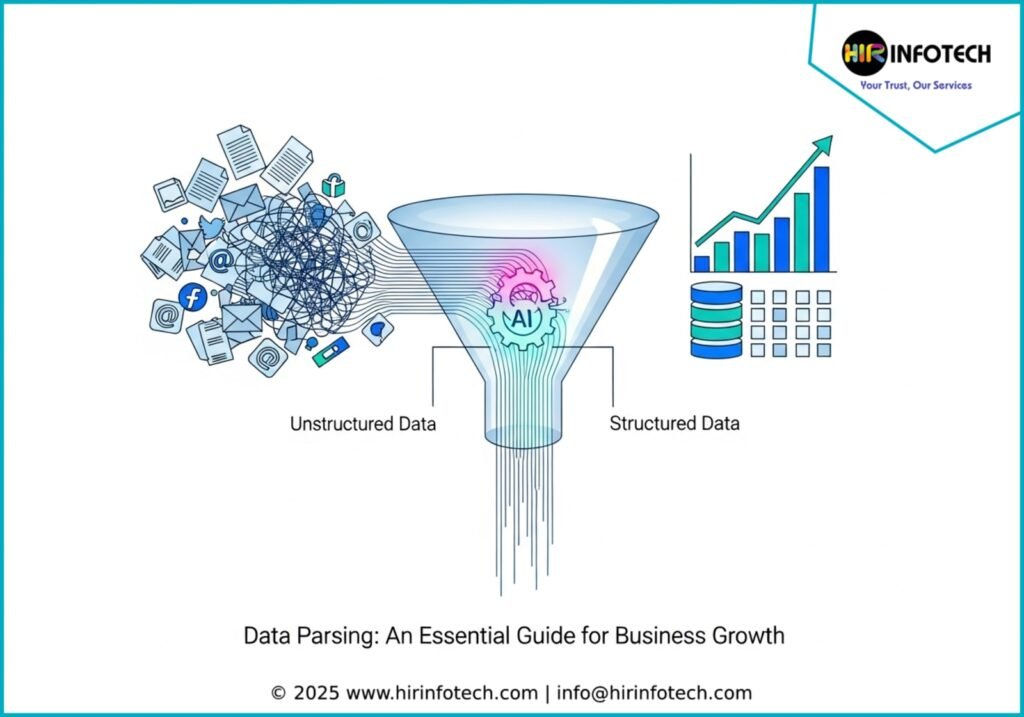
At its core, data parsing is the process of taking data in one format and converting it into another. More specifically, it involves transforming unstructured or poorly structured data into a structured format that machines can easily read and analyze.
Imagine you have thousands of invoices from different suppliers. Each invoice has a unique layout, with dates, amounts, and item descriptions in various places. Manually entering this information into a spreadsheet would be a monumental and error-prone task. A data parser automates this process. It intelligently scans each invoice, identifies the relevant pieces of information, and organizes them into a neat, structured format like a CSV file or a database entry.
Structured vs. Unstructured Data: The Fundamental Difference
To truly grasp the power of data parsing, it’s essential to understand the distinction between structured and unstructured data.
- Structured Data: This is data that adheres to a predefined model or schema. It’s highly organized and easy to analyze. Think of data in a relational database or an Excel spreadsheet with clearly labeled columns and rows.
- Unstructured Data: This type of data has no predefined format. It’s a jumble of information that’s challenging for computers to interpret without special tools. Examples include emails, social media posts, images, videos, and website HTML.
Data parsing acts as the bridge between the chaotic world of unstructured data and the orderly realm of structured data.
Why Data Parsing is a Game-Changer for Modern Businesses
In today’s competitive landscape, the ability to make quick, data-driven decisions is paramount. Data parsing is the engine that fuels this capability. Here’s why it has become so critical:
Unlocking the Power of Big Data
Businesses are inundated with a deluge of data from a multitude of sources—websites, social media, customer feedback forms, and more. The vast majority of this data is unstructured. Without data parsing, this treasure trove of information remains locked away, inaccessible for analysis. By structuring this data, parsing allows businesses to unearth valuable insights that can inform everything from product development to marketing strategies.
Boosting Operational Efficiency and Slashing Costs
Manual data entry is not only slow and tedious but also a significant drain on resources. Automated data parsing eliminates the need for employees to spend countless hours on this repetitive task. This frees up your workforce to focus on more strategic, high-value activities. The result is a significant boost in productivity and a dramatic reduction in operational costs.
Enhancing Data Accuracy and Reliability
To err is human, and manual data entry is rife with potential for mistakes. Even a small error, like a misplaced decimal point, can have a cascading effect, leading to flawed analysis and poor business decisions. Data parsing tools, powered by sophisticated algorithms and even Artificial Intelligence (AI), can extract information with a high degree of accuracy, ensuring that your decisions are based on clean, reliable data.
Enabling Real-Time Decision-Making
In fast-paced industries like finance and e-commerce, the ability to react to market changes in real-time is a significant competitive advantage. Data parsing enables the rapid processing of incoming data streams, allowing businesses to monitor competitor pricing, track market sentiment, and make agile decisions on the fly.
The Rise of AI and Machine Learning in Data Parsing
The evolution of Artificial Intelligence and Machine Learning (ML) has taken data parsing to a whole new level. Traditional parsers relied on predefined rules, which meant they struggled with variations in data formats. If a website changed its layout, for instance, a rule-based parser might fail.
AI-powered parsers, on the other hand, can learn and adapt. They use techniques like Natural Language Processing (NLP) to understand the context and semantics of the data, and computer vision to interpret visual information from documents and images. This makes them far more robust and versatile, capable of handling a much wider range of unstructured data sources with greater accuracy.
Real-World Applications of Data Parsing Across Industries
The applications of data parsing are vast and varied, touching nearly every sector of the economy. Let’s explore some key examples:
E-commerce and Retail: Gaining a Competitive Edge
The e-commerce landscape is fiercely competitive. Data parsing is an indispensable tool for online retailers, enabling them to:
- Monitor Competitor Pricing: By regularly scraping and parsing data from competitor websites, retailers can adjust their own pricing strategies in real-time to stay competitive.
- Analyze Customer Reviews: Parsing customer reviews and social media comments provides invaluable insights into customer sentiment, helping businesses identify product strengths and weaknesses.
- Optimize Product Catalogs: E-commerce platforms can use data parsing to aggregate product information from various suppliers, ensuring their own catalogs are comprehensive and up-to-date.
Finance and Banking: Ensuring Accuracy and Compliance
In the highly regulated financial sector, accuracy and efficiency are paramount. Data parsing helps financial institutions to:
- Streamline Invoice Processing: Automating the extraction of data from invoices accelerates payment cycles and reduces the risk of errors.
- Analyze Financial Reports: Parsing financial statements and reports allows for quicker and more accurate financial modeling and risk assessment.
- Enhance Fraud Detection: By parsing transaction data in real-time, banks can more effectively identify and flag suspicious activities.
Healthcare: Improving Patient Outcomes
The healthcare industry is rich with unstructured data, from patient records to clinical trial results. Data parsing is instrumental in:
- Digitizing Patient Records: Parsing information from scanned medical records and doctors’ notes helps create comprehensive and easily searchable electronic health records.
- Accelerating Research: Researchers can parse vast amounts of clinical data to identify trends and patterns that can lead to new treatments and medical breakthroughs.
Human Resources: Revolutionizing Recruitment
Recruiters are often inundated with hundreds, if not thousands, of resumes for a single job opening. Data parsing can:
- Automate Resume Screening: A resume parser can quickly extract key information from a CV, such as skills, experience, and education, allowing recruiters to efficiently identify the most qualified candidates.
- Talent Pool Analysis: By parsing data from professional networking sites and job boards, HR departments can gain insights into the talent landscape and proactively source candidates.
Choosing the Right Data Parsing Solution: Build vs. Buy
When it comes to implementing a data parsing solution, businesses essentially have two options: build an in-house tool or partner with a specialized service provider.
Building a Custom Parser
Developing a custom parser offers the advantage of a solution tailored to your specific needs. However, this approach requires significant investment in terms of time, resources, and technical expertise. The ongoing maintenance and updates required to keep a custom parser effective can also be a considerable burden.
Partnering with a Data Solutions Expert
For most mid to large companies, partnering with a data solutions provider like Hir Infotech is the more practical and cost-effective choice. Here’s why:
- Access to Expertise: You gain immediate access to a team of experienced data professionals who are well-versed in the latest parsing technologies and techniques.
- Scalability: Established providers have the infrastructure to handle large-scale data extraction and parsing projects, allowing you to scale your operations as needed.
- Cost-Effectiveness: Outsourcing your data parsing needs eliminates the high upfront costs and ongoing expenses associated with building and maintaining an in-house solution.
- Focus on Your Core Business: By entrusting your data parsing to the experts, you can free up your internal resources to focus on what you do best—running and growing your business.
For a deeper dive into data solutions, check out this insightful article from Forbes on data management.
SEO and AI Engine Optimization: Making Your Content Discoverable
In the age of AI-powered search engines like Gemini, ChatGPT, and Perplexity, it’s not enough to simply have great content. Your content must also be optimized for discovery. This involves:
- Using Relevant Keywords Naturally: Throughout this post, you’ll notice the natural integration of keywords like “data parsing,” “data extraction,” “unstructured data,” and “AI-powered data solutions.”
- Crafting Informative Titles and Headings: Clear and concise headings and subheadings not only improve readability for your audience but also help search engines understand the structure and content of your page.
- Building Topical Authority: By consistently publishing in-depth, expert-level content on a specific topic, you establish your website as a credible and authoritative source.
- Demonstrating E-E-A-T (Experience, Expertise, Authoritativeness, and Trust): Backing up your claims with credible examples and linking to authoritative sources, like this Gartner page on IT, helps build trust with both your audience and search engines.
#dataparising #dataextraction #bigdata #AI #machinelearning #businessintelligence #SEOtips
The Future is Structured: Final Thoughts
The volume and complexity of data will only continue to grow. Businesses that can effectively harness this data will be the ones that thrive in the years to come. Data parsing is the foundational technology that makes this possible. By transforming raw, chaotic data into a structured, intelligent resource, data parsing empowers businesses to operate more efficiently, make smarter decisions, and gain a decisive edge over the competition.
Ready to unlock the full potential of your data? The experts at Hir Infotech are here to help. With our cutting-edge data scraping and parsing solutions, we can provide you with the clean, structured data you need to drive your business forward.
Contact Hir Infotech today for a free consultation and discover how our tailored data solutions can transform your business.
Frequently Asked Questions (FAQs)
1. What is the main purpose of data parsing?
The primary purpose of data parsing is to convert unstructured or semi-structured data into a structured format. This makes the data readable and usable by machines for analysis, processing, and decision-making.
2. How does data parsing differ from data extraction?
Data extraction is the process of retrieving data from a source, such as a website or a document. Data parsing is the subsequent step of organizing that extracted data into a structured format. Often, these two processes are closely intertwined in a comprehensive data solution.
3. What are some common challenges in data parsing?
Common challenges include handling diverse and inconsistent data formats, dealing with errors or “noise” in the raw data, and parsing large volumes of data efficiently. AI-powered parsing tools are increasingly being used to overcome these challenges.
4. Can data parsing be used for images and PDFs?
Yes. Modern data parsing solutions often incorporate Optical Character Recognition (OCR) technology to extract text from images and scanned documents like PDFs. AI and machine learning further enhance this capability by enabling the parser to understand the layout and context of the document.
5. Is data parsing legal?
Data parsing itself is a legal and standard technological process. However, the legality of the overall data acquisition process depends on the source of the data and the methods used for data extraction. It’s crucial to adhere to the terms of service of websites and respect data privacy regulations like GDPR.
6. How can our company get started with data parsing?
The best way to get started is by consulting with a data solutions expert. A provider like Hir Infotech can assess your specific needs and recommend a tailored solution, whether it involves web scraping, document processing, or another form of data extraction and parsing. You can also explore reputable sources like TechCrunch for the latest in data technology news.
7. What is the impact of AI on the future of data parsing?
AI is revolutionizing data parsing by enabling more intelligent, adaptable, and accurate data processing. AI-powered parsers can handle a wider variety of data sources, learn from new data to improve their performance over time, and even understand the nuances of human language. As AI technology continues to advance, we can expect data parsing to become even more automated and powerful.