Data Mining vs. Machine Learning: Unlocking Business Value in 2026
Data is everywhere. For mid- to large-sized companies, the real challenge isn’t just gathering data—it’s knowing what to do with it. Mountains of information can be overwhelming, leading to missed opportunities and unrealized potential. This is where data mining and machine learning come in. These powerful technologies transform raw data into valuable insights, helping businesses make smarter decisions and drive growth. This blog post will break down the key differences between data mining and machine learning, explore their benefits, and show you how to leverage these technologies to unlock the true potential of your data in 2026 and beyond.
What is Data Mining?
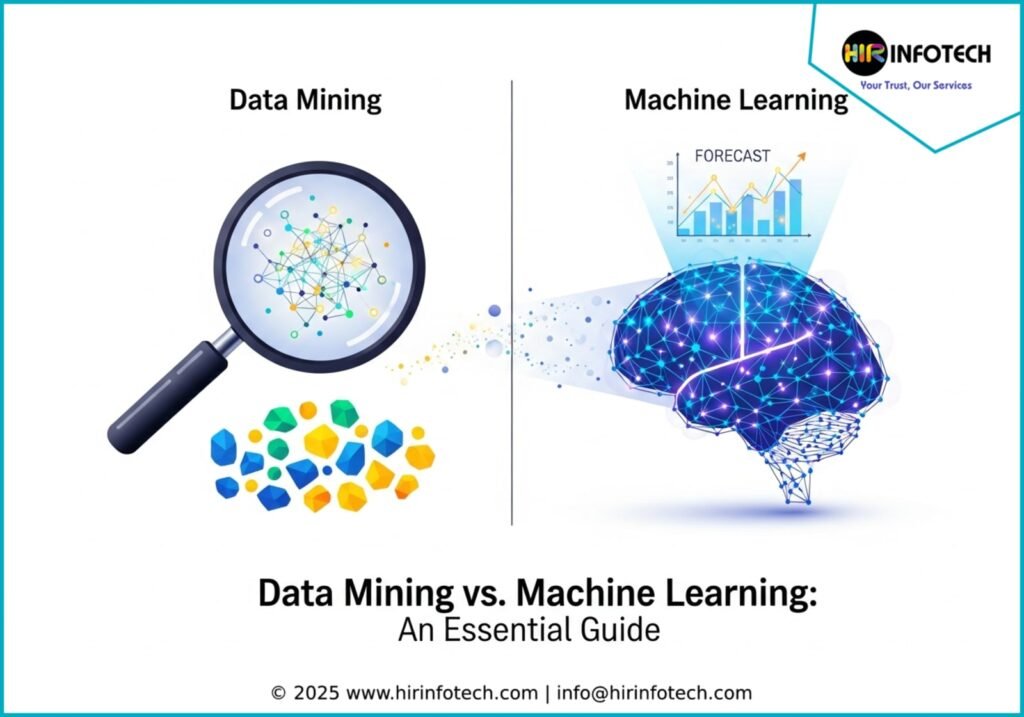
Think of data mining as a modern-day treasure hunt. You sift through massive datasets to uncover hidden gems—patterns, trends, and anomalies. These discoveries can help you understand your customers, optimize your operations, and gain a competitive edge. Data mining is a subset of business analytics that involves exploring large, existing datasets to unearth previously unknown patterns and relationships.
The process of data mining involves several key steps:
- Define your goals: Clearly identify the business challenges you are trying to solve.
- Gather data: Collect information from various sources, such as customer databases, website analytics, and social media.
- Prepare the data: Clean and organize the data to ensure accuracy and consistency. This includes handling missing values and removing duplicates.
- Apply data mining techniques: Use statistical analysis, algorithms, and visualization tools to identify patterns and relationships.
- Interpret the results: Translate the findings into actionable insights that can inform your business decisions.
Key Benefits of Data Mining
- Improved Decision-Making: By revealing hidden patterns, data mining provides the foundation for more informed strategic choices.
- Increased Efficiency: You can quickly analyze large volumes of data to identify trends and opportunities that would be impossible to spot manually.
- Cost Savings: By identifying inefficiencies, you can optimize processes and reduce waste.
To dive deeper into the foundational techniques of data mining, explore this comprehensive guide from Investopedia.
What is Machine Learning?
Machine learning takes data analysis to the next level. It is a subset of artificial intelligence (AI) that enables computers to learn from data without being explicitly programmed. By identifying patterns and making predictions, machine learning algorithms can automate tasks, personalize experiences, and drive innovation. As we look towards 2026, the global market for machine learning is projected to grow significantly, highlighting its increasing importance for businesses.
Here are some common applications of machine learning:
- Predictive Modeling: Forecast future outcomes, such as customer churn or sales trends.
- Customer Segmentation: Group customers based on shared characteristics to deliver personalized marketing campaigns.
- Fraud Detection: Identify suspicious activity in real-time to prevent financial losses.
- Image Recognition: Analyze images to identify objects, faces, and other features, which is becoming crucial in various industries.
Key Benefits of Machine Learning
- Automation: Streamline processes and reduce the need for manual effort, freeing up your team for more strategic work.
- Scalability: Handle massive datasets and complex analyses with ease, allowing your operations to grow without compromising quality.
- Continuous Improvement: Machine learning models become smarter over time as they are exposed to more data, leading to increasingly accurate predictions.
For a closer look at how machine learning is being applied in various industries, check out the NVIDIA AI & Data Science Blog.
Data Mining vs. Machine Learning: A Head-to-Head Comparison
While both data mining and machine learning analyze data to uncover patterns, they have distinct characteristics that set them apart. Understanding these differences is key to leveraging them effectively.
| Feature | Data Mining | Machine Learning |
|---|---|---|
| Goal | To extract knowledge and discover previously unknown patterns from existing data. | To build predictive models that can learn from data and make forecasts about future outcomes. |
| Focus | Primarily focused on descriptive analysis to understand what has happened. | Primarily focused on predictive analysis to forecast what will happen. |
| Approach | Largely a human-driven process that requires manual interpretation of results. | An algorithm-driven process where the system learns and adapts on its own. |
| Output | Typically reports, visualizations, and summaries of data patterns. | Predictive models and algorithms that can be integrated into applications. |
Key Differences: Accuracy and Scope
- Accuracy: Machine learning models generally provide more accurate results due to their ability to learn and adapt from new data. Data mining, on the other hand, relies on human interpretation, which can sometimes introduce bias.
- Scope: Data mining focuses on understanding the relationships within existing data. In contrast, machine learning aims to predict future outcomes based on historical data.
Choosing the Right Tool for the Job
Data mining and machine learning are not mutually exclusive; they are complementary techniques that can be used together to achieve powerful results. Data mining can help you understand your data and identify areas where machine learning can be applied. Machine learning, in turn, can automate tasks and provide more accurate predictions based on the insights discovered through data mining.
Here’s a simple guide to help you decide which to use:
- Use data mining to:
- Identify trends and patterns in your data.
- Understand customer behavior and preferences.
- Detect anomalies and outliers that could indicate fraud or other issues.
- Use machine learning to:
- Predict future outcomes, such as sales forecasts or customer lifetime value.
- Automate decision-making processes, like credit scoring or inventory management.
- Personalize customer experiences with product recommendations and targeted content.
Real-World Applications in Data Solutions for 2026
For companies dealing with web scraping, data extraction, and other data-related tasks, both data mining and machine learning offer significant advantages. As we move into 2026, the integration of AI and machine learning in these fields is becoming standard practice.
- Web Scraping: By 2026, AI-powered web scraping will be essential for businesses to gather real-time competitive intelligence. Machine learning can help identify relevant data sources and extract information more efficiently and accurately. Data mining can then be used to analyze the scraped data to identify market trends and pricing strategies.
- Data Extraction: Machine learning can automate the extraction of structured data from various unstructured sources, such as documents, emails, and images. This is particularly valuable for industries that handle large volumes of paperwork. Data mining can then be used to clean, analyze, and find patterns in the extracted data.
- Data Analysis: Both techniques are crucial for data analysis. Data mining helps in discovering initial insights and patterns, while machine learning builds on these insights to create predictive models that can drive proactive business strategies. The trend for 2026 is a move towards AI-driven analytics that can autonomously generate insights.
To see how leading tech companies are applying these concepts, the Google AI Blog offers a wealth of information on the latest research and applications.
Take Action: Partner with Hir Infotech
Ready to harness the power of data mining and machine learning for your business? Hir Infotech can help. Our team of experts is dedicated to helping you turn your data into a competitive advantage.
We can help you:
- Develop a data strategy: We’ll work with you to identify your business goals and determine the best approach for your specific needs.
- Implement data solutions: We build custom data mining and machine learning models and algorithms tailored to your unique challenges.
- Gain valuable insights from your data: We help you uncover hidden patterns, predict future outcomes, and make data-driven decisions that foster growth.
Contact Hir Infotech today to learn more about how we can help you unlock the true potential of your data and gain a competitive edge in 2026.
Frequently Asked Questions (FAQs)
1. Is data mining related to machine learning?
Yes, data mining and machine learning are closely related. Data mining often uses machine learning techniques to discover patterns and predict outcomes. Think of data mining as the process of finding insights, and machine learning as a set of tools that can be used in that process.
2. Is data mining a type of artificial intelligence?
Data mining is a key component of the broader field of artificial intelligence. It provides the data and insights that fuel AI applications. The patterns discovered through data mining are often used to train machine learning models, which are a form of AI.
3. What are the major elements of data mining?
The major elements of data mining include data collection, data preparation (cleaning and transformation), applying data mining algorithms to identify patterns, and interpreting the results to generate actionable insights for business decisions.
4. How is machine learning changing web scraping?
Machine learning is making web scraping more intelligent and efficient. AI-powered scrapers can automatically adapt to changes in website structure, handle complex JavaScript-heavy sites, and extract data with higher accuracy, reducing the need for manual maintenance.
5. Can my business use machine learning without a team of data scientists?
Yes, with the rise of user-friendly machine learning platforms and expert partners like Hir Infotech, businesses can leverage machine learning without a large in-house team. We can help you implement solutions that are tailored to your business needs and easy to manage.
6. What is the future of data mining and machine learning?
The future points towards greater integration of AI, with a focus on explainable AI (XAI) to make complex models more understandable. We will also see more automation in data engineering and the rise of agent-ready data, designed to be easily consumed by autonomous AI agents.
7. How do I ensure the ethical use of data in data mining?
Ethical data mining involves transparency in data collection and use, ensuring individual privacy, and developing fairness-aware models to prevent biased outcomes. Adhering to regulations like GDPR is crucial.
#DataMining #MachineLearning #DataScience #AI #DataSolutions #BigData #Analytics #WebScraping #DataExtraction #HirInfotech