Google News Scraping in 2026: The Data-Driven Leader’s Guide to Market Intelligence
In today’s hyper-competitive business world, the speed of information dictates the speed of success. Markets shift, reputations are built or broken, and opportunities emerge not in days or hours, but in minutes. While your team is busy compiling reports, the narrative that shapes your industry is already changing. For mid to large-sized companies, relying on manual monitoring is no longer a viable strategy—it’s a significant liability. The key to proactive, data-driven decision-making lies in harnessing the world’s largest real-time information source: Google News.
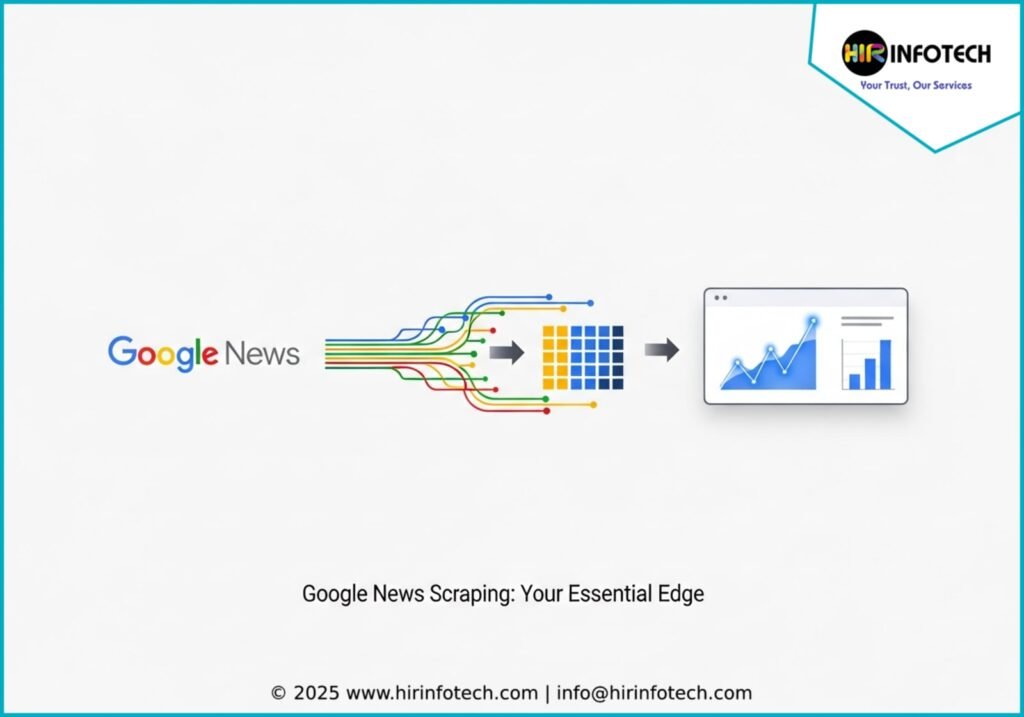
This is where Google News scraping evolves from a technical task into a cornerstone of modern business strategy. It’s the automated process of extracting structured, actionable data from the flood of global news, allowing you to see the market, your competitors, and your own brand with unparalleled clarity. By transforming raw headlines into strategic intelligence, you can move from reacting to market changes to anticipating them.
This comprehensive guide is designed for business leaders, not coders. We’ll explore how companies are leveraging Google News data in 2026 to gain a decisive edge, how it works in simple terms, and how to implement it ethically and effectively. Welcome to the future of competitive intelligence.
What is Google News? A Goldmine of Business Intelligence
Google News is far more than just a news aggregator; it’s a dynamic, algorithmically curated map of global events, trends, and sentiments. It compiles headlines and articles from thousands of vetted sources worldwide, personalizing the feed based on user interests and search history. For a business, this ecosystem represents an incredibly rich and centralized source of intelligence.
Think of it as the world’s largest focus group and competitive analysis tool rolled into one. Every minute, it reflects what matters to the market, which narratives are gaining traction, and how key players are being perceived. The data available is vast and includes:
- Headlines and Snippets: Get a high-level overview of breaking stories.
- Publication Source: Identify which media outlets are covering specific topics.
- Timestamps: Track the velocity and evolution of a news story in real-time.
- Geographic Location: Filter news by region to understand local market dynamics.
- Related Articles: Analyze how a single event is being reported from multiple perspectives.
Manually tracking this is impossible. Automated scraping, however, unlocks its full potential, turning this firehose of information into a structured, queryable database tailored to your business needs.
Beyond the Headlines: 5 Ways Market Leaders Use Google News Scraping to Win
Forward-thinking companies are no longer asking if they should use news data; they are innovating how they use it. By scraping Google News, they build intelligent systems that provide actionable insights across the organization, from marketing and PR to finance and strategy. Here are the most impactful applications for 2026.
1. Real-Time Market Intelligence and Trend Spotting
The business landscape is in constant flux. New technologies, regulatory shifts, and changing consumer behaviors can create enormous opportunities or existential threats. Google News scraping acts as an early warning system. By setting up automated monitoring for industry-specific keywords and topics, you can detect emerging trends long before they become mainstream. A sudden spike in news articles about “sustainable supply chains” in your industry, for instance, is a powerful signal to re-evaluate your operations. Financial analysts leverage this to track market sentiment and predict stock movements, gaining a critical time advantage.
2. Proactive Online Reputation Management (ORM)
In the digital age, your brand’s reputation is your most valuable asset. Negative news can spread globally in an instant, causing significant damage. Google News scraping allows you to monitor all mentions of your brand, key executives, and products in real-time. This isn’t just about damage control; it’s about proactive management. By integrating this data with sentiment analysis tools, you can gauge the tone of the coverage (positive, negative, neutral) and respond strategically before a narrative spirals out of control. This constant vigilance helps you protect your brand equity and maintain stakeholder trust.
3. Sharpen Your Competitive Edge
What are your competitors planning? A new product launch? An M&A deal? A strategic partnership? Often, the first clues appear in the news. Automated scraping of competitor mentions provides a live feed of their activities. You can track their press releases, media coverage, and even mentions in relation to specific industry trends. This intelligence allows you to anticipate their moves, identify gaps in their strategy, and position your own offerings more effectively. It turns your strategy sessions from reactive brainstorming into data-informed planning.
4. Supercharge Your Content and SEO Strategy
Creating content that resonates with your audience and ranks high on search engines is a constant challenge. Google News scraping provides a direct line into what topics are currently trending and what journalists are covering. By analyzing the most popular headlines and articles in your niche, your marketing team can identify keyword opportunities and craft content that is timely, relevant, and authoritative. Furthermore, securing positive media mentions on high-authority news sites can generate powerful backlinks, a cornerstone of any successful SEO strategy. This synergy between news monitoring and SEO drives organic traffic and builds your brand’s digital authority.
5. Identify Investment Opportunities and Mitigate Risk
For companies focused on growth through acquisition or investment, Google News is a crucial due diligence tool. Scraping news data can reveal insights about potential investment targets, including their market position, recent innovations, or any unfolding crises. Conversely, it can also flag risks within your own portfolio or supply chain. For example, news of political instability in a region where a key supplier operates can trigger an immediate risk assessment, allowing you to diversify and protect your operations proactively.
The Mechanics of News Scraping: A Non-Technical Overview
Understanding how Google News scraping works doesn’t require a degree in computer science. The core concept is simple: an automated program (a “scraper” or “bot”) visits Google News and extracts specific pieces of information you’ve defined, then organizes it into a usable format like a spreadsheet or a database.
There are generally two approaches:
- Using Pre-built Tools & APIs: Many companies offer “no-code” scraping tools or Application Programming Interfaces (APIs). These are designed for ease of use. You simply input your search terms (e.g., your company name, competitor names, industry keywords), and the service handles the technical heavy lifting of fetching and structuring the data for you.
- Developing a Custom Solution: For highly specific or large-scale needs, a company might develop its own scraping solution. This offers maximum flexibility but requires technical expertise.
Regardless of the method, the goal is the same: to automate the collection of clean, reliable data so your team can focus on analysis and action, not manual data entry.
Navigating the Legal and Ethical Landscape of Web Scraping
For any large enterprise, compliance and ethics are non-negotiable. The legality of web scraping is a nuanced topic, but the guiding principles are clear. In general, scraping publicly available data is legally permissible, a stance reinforced by landmark court cases. However, ethical and responsible scraping is paramount.
Here are the core tenets of ethical data extraction:
- Respect Terms of Service: Always review a website’s Terms of Service (ToS). While violating ToS isn’t necessarily illegal, it can lead to being blocked.
- Check Robots.txt: Most websites have a file called `robots.txt` that tells bots which pages they should not access. Respecting these directives is a fundamental rule of ethical scraping.
- Scrape Responsibly: An overly aggressive scraper can slow down a website’s servers. Ethical scraping involves making requests at a reasonable rate to avoid disrupting the site for other users.
- Focus on Public Data: Never scrape data that is behind a login or paywall or that contains private personal information. The focus should always be on information that is publicly accessible to anyone.
Partnering with a reputable data solutions provider ensures these best practices are followed, protecting your company from legal and reputational risk. For further reading, organizations like the Electronic Frontier Foundation provide excellent resources on digital rights and legal precedents in the tech space.
Choosing the Right Data Partner for Your Business
While the benefits of Google News scraping are clear, implementing a robust and scalable solution in-house can be a significant drain on resources. It requires specialized technical skills, constant maintenance to adapt to website changes, and a deep understanding of the legal landscape. This is why many leading companies choose to partner with a data solutions expert like Hir Infotech.
A dedicated data partner offers several key advantages:
- Expertise and Reliability: We handle the complex technical challenges of data extraction, from bypassing anti-scraping measures to ensuring data quality and consistency.
- Scalability: Whether you need to track five keywords or five thousand, a data partner can scale the infrastructure to meet your needs without requiring you to invest in new hardware or personnel.
- Focus on Insights: By outsourcing the data collection, you free up your team to do what they do best: analyze the insights and drive strategic decisions that grow the business.
- Compliance and Peace of Mind: We operate under a strict ethical framework, ensuring all data is collected responsibly and legally, so you can focus on leveraging the data with confidence.
In the data-driven economy of 2026, raw information is a commodity. Actionable intelligence, however, is priceless. Making the strategic decision to automate your market intelligence gathering is the first step toward building a more agile, informed, and competitive organization. Leading data analytics firm Gartner consistently emphasizes that data-driven organizations are more productive and profitable.
Frequently Asked Questions (FAQs)
-
1. Is it legal to scrape data from Google News?
- Yes, scraping publicly available data from Google News is generally considered legal. The key is to do so responsibly. This means not overwhelming their servers with requests, respecting their `robots.txt` file, and never scraping copyrighted content for republication. Ethical scraping focuses on extracting factual data points like headlines, sources, and dates for internal analysis.
-
2. Will our company’s IP address get blocked?
- If not done correctly, yes. Websites can block IP addresses that send too many requests in a short period. Professional data solution providers like Hir Infotech use sophisticated techniques, such as rotating IP addresses through proxy networks, to ensure reliable and uninterrupted data collection without getting blocked.
-
3. How is the scraped data delivered?
- The data can be delivered in various formats depending on your needs. Common formats include structured files like CSV, JSON, or Excel spreadsheets. For more advanced use cases, the data can be delivered directly to your database or business intelligence dashboard via an API for real-time updates.
-
4. How is this different from setting up Google Alerts?
- Google Alerts are a useful tool for casual monitoring, but they lack the structure, scale, and analytical depth required for serious business intelligence. Alerts provide email notifications, whereas scraping provides structured data that can be queried, filtered, and visualized. You can’t perform large-scale sentiment analysis or trend analysis on a series of emails, but you can with a structured dataset.
-
5. Can we scrape news in different languages and from different countries?
- Absolutely. This is one of the most powerful features of Google News scraping. A professional data extraction service can configure the scraper to pull news from specific editions of Google News (e.g., Google News Germany, Google News Japan) and in various languages, providing a truly global perspective on your market and brand.
-
6. What kind of ROI can we expect from investing in news scraping?
- The ROI manifests in several ways: reduced risk through proactive reputation management, cost savings from automating manual research tasks, increased revenue from identifying new market opportunities faster, and improved marketing effectiveness by aligning content with trending topics. It’s an investment in faster, smarter, data-driven decision-making across the entire organization.
Your Next Move: Transform Data into Market Dominance
The information you need to outmaneuver the competition, protect your brand, and innovate faster is already out there. The challenge is no longer finding it; it’s harnessing it at scale and with the speed the modern market demands. Google News scraping is the bridge between raw, public data and transformative business intelligence.
Don’t let your organization be the last to react. Equip your teams with the real-time insights they need to become proactive leaders in your industry.
Ready to unlock the strategic power of news data?
Contact the experts at Hir Infotech today for a free consultation. We’ll discuss your unique business needs and design a custom data solution that delivers clean, reliable, and actionable intelligence to fuel your growth. Make your next decision your best decision.
#GoogleNewsScraping #DataExtraction #CompetitiveIntelligence #MarketResearch #ReputationManagement #SEOtips #DataAnalytics #BusinessStrategy #LeadGeneration #DataSolutions