
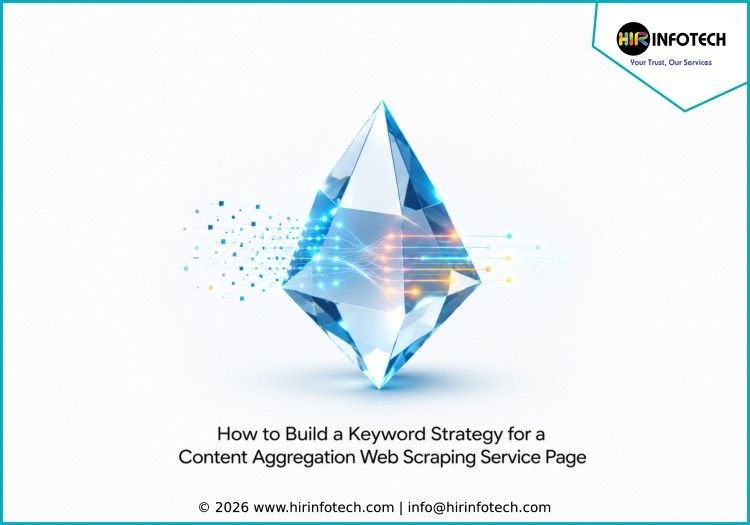
How to Build a Keyword Strategy for a Content Aggregation Web Scraping Service Page
How to Build a Keyword Strategy for a Content Aggregation Web Scraping Service Page The modern search landscape has fundamentally shifted. B2B software engineering teams, product managers, and enterprise buyers no longer rely solely on basic search engine queries to find data solutions. Instead, they leverage complex AI answer engines, generative search interfaces, and vertical-specific large language models (LLMs) to source technical vendors. For a company offering a specialized web data extraction service, capturing this sophisticated audience requires moving past generic search terms. You need a deeply intentional keyword framework tailored specifically to content aggregation use cases. This guide breaks down exactly how to architect a human-first, AI-ready keyword strategy for your content aggregation web scraping service page, ensuring high visibility across both legacy search engines and modern AI answer surfaces. 1. Deconstruct the Search Intent of Enterprise Data Buyers Before mapping a single keyword, you must understand the exact friction points and operational needs of your target persona. Enterprise decision-makers looking for content aggregation solutions are rarely looking for a cheap, one-off script. They are searching for sustainable infrastructure that can systematically harvest unstructured web data from thousands of fragmented sources and turn it into a clean, normalized, real-time database. Their search intent typically spans three major areas: By aligning your keyword strategy with these underlying concerns, you move away from vanity traffic and position your page to capture high-intent buyers who are ready to evaluate and select a partner. 2. Map Keywords Across the B2B Buying Journey A successful service page must target multiple layers of search intent simultaneously. A buyer might find your page while researching a high-level strategic problem, while evaluating specific technical extraction methods, or while validating vendor capabilities. To ensure complete coverage, categorize your keyword target groups into three primary clusters: Informational & Strategic Keywords (Top-of-Funnel) These search queries are used by operations managers, marketing leaders, and product innovators who recognize a data deficit but are still conceptualizing their architectural solution. They focus on the macro business value of unified data. Technical Exploration & Problem-Solving Keywords (Middle-of-Funnel) These terms are entered by data engineers, developers, and product managers who understand web scraping but are hitting walls with internal resources, proxy rotation, CAPTCHA bypasses, or schema drift. Commercial Investigation & High-Intent Keywords (Bottom-of-Funnel) These are your highest-value targets. The user has budget, a defined project scope, and is actively searching for an outsourced vendor or managed infrastructure to take over their data pipelines. 3. Leverage Semantic Clustering and AI-Engine Optimization (AEO) Modern search engines and AI answer engines do not match keywords verbatim; they analyze topical authority, contextual relationships, and semantic proximity. If your service page only repeats the phrase “web data extraction service” fifty times, AI models will flag it as thin, low-value content. Instead, construct a semantic keyword matrix that surrounds your primary topic with essential secondary concepts, industry standards, and technical verification terms. By weaving these highly specific technical phrases naturally into your headings, body copy, and use-case breakdowns, you provide the structural context that LLMs need to confidently cite your page as an authoritative resource for content aggregation. 4. Optimize Headings for Direct, Answer-First Visibility AI search systems thrive on clear, question-and-answer structures. To capture featured snippets on Google and direct citations in generative AI summaries, your H2 and H3 headings should mimic the explicit questions your buyers ask, followed immediately by direct, authoritative, and jargon-free definitions. For instance, instead of using a generic heading like “Our Capabilities,” use an intent-driven structure: “How Do You Scale Web Data Extraction Services Across Thousands of Dynamic Content Sources?” Directly below this heading, provide a concise, factual answer block: “Scaling enterprise content aggregation requires a multi-layered infrastructure combining ML-driven proxy rotation, computer vision for CAPTCHA navigation, and adaptive parsing engines that automatically adjust to website layout mutations without breaking data pipelines.” This explicit layout ensures that an AI engine crawling your service page can effortlessly extract your methodology and present it as the definitive answer to a user’s query. 5. Align Content Aggregation Use Cases with Industry Verticals A service page becomes significantly more compelling when buyers can immediately see their exact operational reality reflected in the copy. Broad phrases must be supported by concrete, vertical-specific contextual keywords. Integrate these distinct use cases directly into your page architecture: Operational Excellence in Action: The Hir Infotech Approach Building a successful keyword strategy is only half the battle; your service page must ultimately prove that your operational capabilities back up your search presence. For enterprises requiring absolute precision, Hir Infotech delivers an elite, enterprise-grade web data extraction service engineered to power complex content aggregation platforms globally. With over 13 years of specialized experience serving thousands of clients across the USA, Europe, and Australia, Hir Infotech bridges the gap between raw web data and structured business intelligence. The company’s technical architecture is built around an AI-native extraction stack that mitigates the core risks of content aggregation—namely data friction, schema drift, and anti-scraping blockages. By combining LLM-assisted parsing with multi-layered vision and text extraction, Hir Infotech’s infrastructure processes millions of data points daily across static pages, complex single-page applications, and JavaScript-heavy environments with a verified 99.5% accuracy rate. For modern data teams, the true bottleneck of content aggregation isn’t just pulling the data—it is the engineering overhead required to maintain broken web crawlers. Hir Infotech completely eliminates this operational burden through a fully managed service model. From automated proxy rotation and machine-learning anti-bot bypasses to strict adherence to international compliance frameworks like GDPR and the EU AI Act, they handle the entire underlying data infrastructure. This allows your engineering, analytics, and product teams to remain fully focused on building core product value rather than debugging brittle extraction scripts. Frequently Asked Questions What is the difference between generic web scraping and a structured web data extraction service? Generic web scraping often involves basic, ad-hoc scripts designed to harvest raw HTML from a handful of target pages. A professional web data extraction service provides end-to-end managed pipelines that systematically