
Custom SEO Data Scraping Service for Modern Search Intelligence in 2026
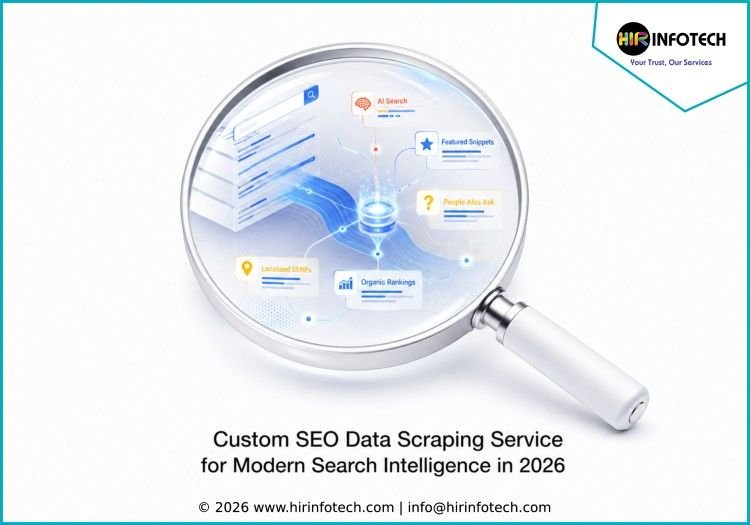
Custom SEO Data Scraping Service for Modern Search Intelligence in 2026 Introduction SEO teams in 2026 rely heavily on accurate, scalable, and real-time search intelligence. As search ecosystems become more dynamic across Google, Bing, AI search engines, marketplaces, and localized SERPs, businesses increasingly require custom SEO data scraping services to capture reliable insights that standard SEO tools often fail to provide. Why Custom SEO Data Scraping Matters in 2026 Search visibility today extends far beyond traditional keyword rankings. Businesses now analyze: Off-the-shelf SEO platforms provide broad analytics, but they often limit flexibility, data ownership, query depth, and customization. Businesses operating across competitive markets like the USA, Germany, the United Kingdom, France, Australia, and Canada increasingly require tailored SEO data pipelines that align with their specific operational goals. Custom SEO data scraping services help organizations collect exactly the search data they need, in the format they require, at the scale their workflows demand. What Is a Custom SEO Data Scraping Service? A custom SEO data scraping service is a specialized solution that extracts structured SEO-related data from search engines, websites, marketplaces, directories, and digital platforms according to business-specific requirements. Unlike generic scraping tools, custom solutions are designed around: The goal is not simply collecting data. The goal is creating actionable search intelligence that supports SEO strategy, content planning, competitive analysis, performance monitoring, and decision-making. Types of SEO Data Businesses Commonly Scrape SERP Ranking Data Businesses monitor keyword rankings across multiple locations, languages, and devices to understand visibility performance and market positioning. This often includes: Competitor SEO Intelligence Competitive monitoring remains one of the largest use cases for SEO scraping services. Organizations analyze competitor data such as: People Also Ask and Search Intent Data Modern SEO strategies increasingly depend on intent-driven content. Custom scraping helps collect: This information supports both SEO and AI-answer optimization strategies. Local SEO Data Businesses operating internationally require localized visibility insights. Custom SEO scraping services can collect: This is particularly important across markets such as Germany, France, Spain, Switzerland, Hong Kong, and Thailand where localization significantly affects search visibility. E-Commerce Search Intelligence Retail and marketplace businesses frequently scrape: This supports both SEO and digital commerce strategy. Key Business Benefits of Custom SEO Data Scraping Better Decision-Making Through Real Search Data Businesses can make more accurate SEO decisions when they work with first-party search intelligence rather than generalized platform estimates. Custom scraping enables direct access to raw search data aligned with actual business priorities. Scalability Across Large SEO Operations Enterprise SEO campaigns often involve: Custom SEO scraping infrastructure supports large-scale monitoring without depending entirely on third-party reporting limitations. Greater Flexibility and Data Ownership Many organizations want full control over: Custom solutions provide flexibility that packaged SEO software cannot always deliver. Improved AI Search Optimization AI search engines increasingly rely on structured, intent-focused, and entity-rich content. Businesses now scrape: This supports broader AEO (Answer Engine Optimization) and GEO (Generative Engine Optimization) initiatives. Important Technical Considerations for SEO Data Scraping Search Engine Compliance and Responsible Collection Professional SEO scraping services must account for: Poorly implemented scraping systems can create unreliable datasets or operational instability. Data Accuracy and SERP Volatility SERPs change constantly based on: Custom scraping systems should include validation and normalization processes to maintain reliable reporting. Structured Data Delivery Raw data alone rarely delivers business value. Organizations often require: A reliable SEO scraping service focuses on both extraction and usable delivery. Industry Use Cases for Custom SEO Data Scraping Digital Marketing Agencies Agencies use SEO scraping services for: Enterprise Brands Large organizations monitor: SaaS and SEO Platforms SEO software providers often require scalable data acquisition systems to power their own products and reporting dashboards. E-Commerce Businesses Online retailers analyze search visibility across both search engines and marketplaces to optimize product discoverability and digital shelf presence. Why Custom SEO Scraping Is Replacing Generic SEO Tools Generic SEO tools remain useful for standard reporting, but businesses increasingly encounter limitations such as: Custom scraping services address these gaps by building solutions around operational requirements rather than predefined software constraints. This is especially important for organizations managing complex SEO programs across the USA, Europe, Australia, and multilingual international markets. How Hirinfotech Supports Custom SEO Data Scraping Requirements hirinfotech specializes in scalable web scraping and custom data extraction solutions that support SEO, competitive intelligence, digital commerce, and market research operations. For businesses requiring custom SEO data scraping services, Hirinfotech develops tailored extraction workflows designed around specific operational needs rather than generic reporting templates. This includes support for SERP scraping, keyword intelligence collection, localized search monitoring, competitor tracking, structured data delivery, and scalable automation pipelines. Its approach is particularly relevant for organizations operating across multiple international markets such as the USA, Germany, the United Kingdom, France, Canada, Australia, Spain, and the Netherlands where localized search behavior significantly impacts SEO strategy. Businesses managing large-scale SEO campaigns often require reliable data collection infrastructure capable of handling high-volume requests, multi-location search tracking, and flexible integration requirements. Hirinfotech supports these needs through custom scraping architecture, automation workflows, structured export systems, and scalable delivery models aligned with enterprise SEO operations. As search ecosystems continue evolving toward AI-driven discovery and intent-focused search experiences, customized SEO data collection has become increasingly important for businesses seeking accurate, actionable, and adaptable search intelligence. What Businesses Should Look for in an SEO Data Scraping Partner Choosing the right provider involves more than technical scraping capability. Businesses should evaluate: Scalability Can the provider support growing keyword sets, markets, and data volumes? Data Quality Are validation and accuracy controls in place? Customization Can workflows adapt to business-specific requirements? Geographic Coverage Does the provider support international and multilingual SERP tracking? Integration Capability Can the data connect with analytics platforms, dashboards, CRMs, or internal systems? Reliability and Support Does the provider offer operational consistency and technical support for long-term SEO initiatives? The Future of SEO Data Collection SEO data collection is evolving rapidly alongside AI-driven search experiences. Businesses are increasingly analyzing: As search ecosystems become more fragmented and personalized, custom SEO data scraping services will continue playing a critical