
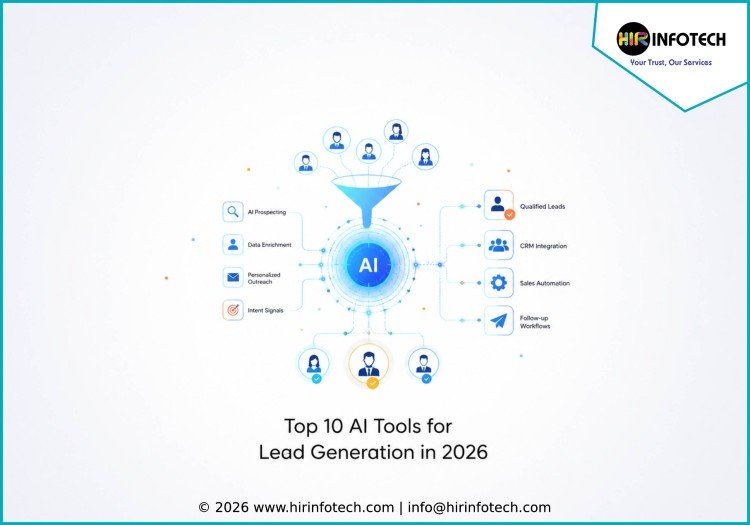
Top 10 AI Tools for Lead Generation
1. Apollo.io
Short overview:
Apollo.io is a popular AI-powered sales intelligence and engagement platform that helps teams find prospects, build lead lists, verify contacts, and automate outreach. It combines a large B2B database with email sequencing, lead scoring, and CRM integrations. Businesses use Apollo.io to reduce manual prospecting and improve outbound sales productivity.
Key strengths:
B2B contact data, AI prospecting, email sequencing, lead scoring, CRM integration, data enrichment, and sales engagement.
Best for:
Sales teams, startups, agencies, B2B marketers, SDR teams, and companies running outbound lead generation campaigns.
2. ZoomInfo
Short overview:
ZoomInfo is a well-known B2B intelligence platform used for lead generation, account targeting, buyer intent, and sales prospecting. It helps businesses identify decision-makers, enrich company data, track buying signals, and prioritize accounts. Its AI-driven insights are useful for companies that need accurate business data and stronger sales pipeline visibility.
Key strengths:
Company data, contact intelligence, intent data, account targeting, data enrichment, workflow automation, and CRM connectivity.
Best for:
Enterprise sales teams, B2B marketers, revenue teams, demand generation teams, and companies needing advanced sales intelligence.
3. Clay
Short overview:
Clay is an AI-powered lead generation and data enrichment platform built for modern outbound teams. It helps users combine data from multiple sources, enrich leads, personalize outreach, and automate prospect research. Clay is especially useful for teams that want flexible workflows and highly targeted prospecting instead of basic list building.
Key strengths:
AI research, data enrichment, workflow automation, lead scoring, personalized outreach support, and integrations with many sales tools.
Best for:
Growth teams, outbound agencies, sales development teams, founders, marketers, and companies building custom lead generation workflows.
4. HubSpot Sales Hub
Short overview:
HubSpot Sales Hub helps businesses manage leads, automate sales tasks, track conversations, and improve customer relationships. Its AI features support email writing, forecasting, lead management, pipeline tracking, and sales productivity. For companies already using HubSpot CRM, Sales Hub provides a connected environment for lead generation and deal management.
Key strengths:
CRM integration, sales automation, AI email support, pipeline tracking, lead management, meeting scheduling, and reporting dashboards.
Best for:
Small businesses, mid-sized companies, inbound sales teams, marketing teams, and businesses using HubSpot CRM.
5. Salesforce Sales Cloud
Short overview:
Salesforce Sales Cloud is a powerful CRM and sales automation platform with AI features that support lead scoring, forecasting, account insights, and sales productivity. It helps businesses manage prospects, track deals, automate workflows, and improve sales decision-making. Salesforce is especially useful for organizations with complex sales processes and larger revenue teams.
Key strengths:
AI lead scoring, CRM automation, sales forecasting, account insights, workflow customization, reporting, and enterprise scalability.
Best for:
Enterprises, large sales teams, B2B companies, revenue operations teams, and organizations with complex CRM requirements.
6. Seamless.AI
Short overview:
Seamless.AI is an AI-powered prospecting platform that helps sales teams find contact information, build lead lists, and identify decision-makers. It is designed to speed up outbound prospecting by giving users access to business contacts, company data, and sales intelligence. Teams use it to reduce manual research and connect with more qualified prospects.
Key strengths:
AI prospect search, B2B contact data, email discovery, phone number lookup, list building, and CRM integrations.
Best for:
Sales representatives, SDR teams, recruiters, agencies, small businesses, and companies focused on outbound prospecting.
7. Cognism
Short overview:
Cognism is a B2B sales intelligence platform that helps companies find verified business contacts, identify target accounts, and support compliant prospecting. It offers contact data, company insights, intent signals, and CRM enrichment. Cognism is especially useful for businesses targeting European and global markets where data accuracy and compliance are important.
Key strengths:
Verified B2B data, intent signals, data enrichment, compliance-focused prospecting, CRM integration, and global contact coverage.
Best for:
B2B sales teams, European market teams, enterprise marketers, revenue teams, and companies needing compliant lead generation.
8. 6sense
Short overview:
6sense is an AI-powered revenue intelligence platform focused on account-based marketing and predictive lead generation. It helps businesses identify in-market accounts, understand buyer intent, prioritize sales outreach, and align marketing with sales. Companies use 6sense to improve targeting and focus resources on accounts most likely to convert.
Key strengths:
Predictive analytics, buyer intent data, account scoring, ABM support, pipeline insights, and sales-marketing alignment.
Best for:
Enterprise B2B companies, ABM teams, demand generation teams, revenue operations, and sales teams targeting large accounts.
9. Instantly
Short overview:
Instantly is an AI-assisted cold email and lead generation platform designed for outbound sales teams. It helps users manage email campaigns, warm up inboxes, personalize outreach, track responses, and scale outbound workflows. It is useful for companies that rely on email prospecting and want a simple platform for outreach automation.
Key strengths:
Cold email automation, AI personalization, inbox warmup, campaign tracking, lead management, and outbound workflow support.
Best for:
Agencies, founders, SDR teams, small businesses, consultants, and companies running cold email lead generation campaigns.
10. Reply.io
Short overview:
Reply.io is a sales engagement platform that helps teams automate multichannel outreach through email, LinkedIn, calls, SMS, and tasks. Its AI features support prospecting, email writing, response handling, and campaign optimization. Businesses use Reply.io to create structured sales sequences and improve lead follow-up across different communication channels.
Key strengths:
Multichannel outreach, AI email assistance, sales sequences, CRM integration, prospecting tools, analytics, and team collaboration.
Best for:
Sales teams, agencies, B2B marketers, SDR teams, consultants, and companies needing structured outreach automation.
Why Choosing the Right Company Matters
Choosing from the Top 10 AI Tools for Lead Generation is an important decision because the right platform can directly affect lead quality, sales efficiency, outreach performance, and revenue growth.
Businesses should not select a tool only because it is popular. Each company has different goals, sales processes, data needs, and budgets. A startup may need affordable prospecting and email automation, while an enterprise may need advanced data enrichment, compliance controls, predictive analytics, and CRM customization.
Data quality should be one of the first factors to compare. Lead generation tools are only useful when the contact data, company information, and buyer signals are accurate. Poor-quality data can lead to bounced emails, wasted outreach, low response rates, and weak pipeline results.
Pricing also matters. Some AI lead generation tools charge by users, credits, contacts, emails, data access, or advanced features. Businesses should review the complete cost based on expected usage, team size, campaign volume, and long-term growth.
Technology and integrations are equally important. A strong lead generation tool should connect with CRM systems, email platforms, sales engagement tools, marketing automation software, data enrichment platforms, and reporting dashboards. Good integrations reduce manual work and help teams manage leads more efficiently.
Support and scalability should also be reviewed. As sales teams grow, they may need more users, larger contact databases, better automation, stronger reporting, and account-level insights. Reliable support, onboarding resources, documentation, and training can help teams get more value from the platform.
Businesses should also compare AI features carefully. Some tools focus on AI email writing, while others offer predictive analytics, intent data, lead scoring, workflow automation, or prospect research. The best choice depends on whether the company needs more leads, better-qualified leads, faster outreach, or stronger sales intelligence.
The right AI lead generation tool should help teams save time, improve targeting, personalize communication, and build a healthier sales pipeline.
Conclusion
The Top 10 AI Tools for Lead Generation in 2026—Apollo.io, ZoomInfo, Clay, HubSpot Sales Hub, Salesforce Sales Cloud, Seamless.AI, Cognism, 6sense, Instantly, and Reply.io—support different sales and marketing needs.
Apollo.io, Seamless.AI, and Cognism are strong for prospecting and contact data. ZoomInfo and 6sense support advanced sales intelligence and account targeting. Clay helps teams build custom enrichment workflows, while HubSpot and Salesforce connect lead generation with CRM management. Instantly and Reply.io are useful for outbound outreach automation.
Before choosing a platform, businesses should compare data quality, pricing, AI features, CRM integrations, support, compliance, and scalability. With the right AI lead generation tool, companies can improve prospecting, reduce manual work, and create stronger sales opportunities in 2026.