
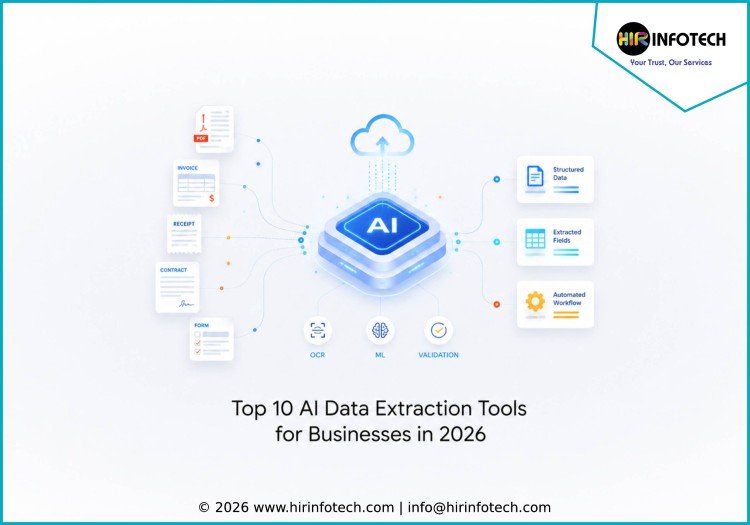
Top 10 AI Data Extraction Tools for Businesses
1. Nanonets
Short overview:
Nanonets is an AI-powered data extraction platform that helps businesses automate document processing, invoice extraction, purchase order handling, and workflow approvals. It uses OCR, machine learning, and automation to extract structured data from documents, emails, PDFs, images, and forms. Nanonets is especially useful for teams that want flexible document automation without heavy technical setup.
Key strengths:
AI OCR, document classification, invoice processing, custom workflows, data validation, API integration, and automation support.
Best for:
Finance teams, operations teams, logistics companies, healthcare businesses, agencies, and enterprises handling high document volumes.
2. Rossum
Short overview:
Rossum is an AI document processing platform built for transactional workflows such as invoices, purchase orders, bills of lading, and financial documents. It helps businesses extract, validate, and route document data into ERP, accounting, and internal systems. Rossum is useful for companies that need intelligent document processing with workflow automation and human review options.
Key strengths:
Transactional document processing, AI data extraction, validation workflows, ERP integration, audit trails, and document automation.
Best for:
Accounts payable teams, finance departments, logistics firms, enterprise operations teams, and companies managing complex documents.
3. UiPath Document Understanding
Short overview:
UiPath Document Understanding is part of the UiPath automation platform and helps businesses extract, classify, and process data from structured and unstructured documents. It combines OCR, AI models, validation, and robotic process automation to automate document-heavy workflows. This makes it a strong option for businesses already using RPA or planning enterprise automation.
Key strengths:
RPA integration, AI document extraction, classification, human validation, workflow automation, and enterprise orchestration.
Best for:
Enterprises, shared service centers, finance teams, insurance companies, banks, and businesses using UiPath automation.
4. ABBYY Vantage
Short overview:
ABBYY Vantage is an intelligent document processing platform designed to extract data from invoices, contracts, receipts, forms, IDs, and other business documents. It uses OCR, AI, and machine learning to classify documents, capture information, and send structured data into business systems. ABBYY is useful for companies needing mature document capture and multilingual processing.
Key strengths:
Advanced OCR, document classification, data extraction, pre-trained skills, low-code setup, multilingual support, and enterprise connectors.
Best for:
Large businesses, financial services, insurance teams, government agencies, logistics firms, and document-heavy operations.
5. Amazon Textract
Short overview:
Amazon Textract is a machine learning service from AWS that extracts text, handwriting, tables, forms, and layout data from scanned documents and images. It is a strong choice for technical teams that want to build document extraction pipelines inside the AWS ecosystem. Textract works well for businesses needing scalable API-based extraction.
Key strengths:
Text extraction, table extraction, form recognition, handwriting support, API access, AWS integration, and scalable document processing.
Best for:
Developers, data engineers, cloud teams, enterprises using AWS, financial services, and businesses building custom extraction workflows.
6. Google Document AI
Short overview:
Google Document AI helps businesses extract, classify, split, and process structured and unstructured documents using Google Cloud. It supports use cases such as invoice processing, lending documents, contracts, forms, and custom document extraction. Google Document AI is useful for teams that want AI-powered document processing connected with cloud storage, analytics, and data pipelines.
Key strengths:
Document parsing, classification, custom processors, entity extraction, cloud integration, workflow automation, and scalable APIs.
Best for:
Cloud-first companies, SaaS platforms, data teams, enterprises using Google Cloud, and businesses with custom document workflows.
7. Microsoft Azure AI Document Intelligence
Short overview:
Microsoft Azure AI Document Intelligence helps businesses extract text, tables, key-value pairs, forms, and structured data from documents. It includes prebuilt models for common document types and custom model options for specific business needs. It is especially useful for companies already using Microsoft Azure, Power Platform, Dynamics, or Microsoft-based analytics systems.
Key strengths:
Prebuilt models, custom extraction, table recognition, key-value extraction, REST API, Azure integration, and business workflow support.
Best for:
Enterprises, Microsoft-based teams, developers, finance departments, operations teams, and companies needing cloud-based extraction.
8. Docsumo
Short overview:
Docsumo is an intelligent document processing platform that helps businesses extract, validate, analyze, and process unstructured document data. It is commonly used for invoices, bank statements, insurance documents, financial forms, and operational paperwork. Docsumo is practical for teams that need AI extraction with review workflows and business-friendly automation.
Key strengths:
Document extraction, classification, validation, prebuilt models, workflow automation, analytics, and integration options.
Best for:
Finance teams, insurance companies, lending businesses, operations teams, back-office teams, and document review departments.
9. Instabase
Short overview:
Instabase is an AI-powered platform for automating complex document-heavy workflows at enterprise scale. It helps businesses extract data, validate outputs, classify documents, and build custom automation apps. Instabase is useful for organizations handling high-volume, complex documents where accuracy, governance, review workflows, and compliance are important.
Key strengths:
Enterprise document automation, AI agents, extraction workflows, validation, accuracy benchmarking, secure workspaces, and API support.
Best for:
Banks, insurers, government teams, healthcare organizations, enterprises, and businesses with complex document operations.
10. Klippa
Short overview:
Klippa offers AI-powered OCR and document processing tools for extracting structured data from invoices, receipts, bank statements, passports, contracts, and other documents. It combines OCR, AI, workflow automation, and validation to reduce manual data entry. Klippa is useful for businesses that need practical document extraction across finance, compliance, and administrative workflows.
Key strengths:
AI OCR, receipt extraction, invoice processing, identity document extraction, data validation, API access, and workflow automation.
Best for:
Finance teams, accounting firms, compliance teams, retail businesses, logistics companies, and businesses handling recurring document data.
Why Choosing the Right Company Matters
Choosing from the Top 10 AI Data Extraction Tools for Businesses is important because data extraction directly affects operational speed, reporting accuracy, compliance, cost control, and decision-making.
Many businesses still rely on manual data entry from PDFs, emails, forms, invoices, receipts, contracts, and scanned documents. This creates delays, errors, duplicate work, and poor visibility. The right AI data extraction tool can help teams convert messy information into structured data that can be used in CRMs, ERPs, spreadsheets, databases, and analytics systems.
Data quality should be the first factor to compare. A tool may extract information quickly, but if the output is inaccurate, incomplete, or poorly structured, it can create more work for the team. Businesses should review extraction accuracy, validation options, confidence scores, and human review workflows.
Pricing is also important. Some platforms charge by page, document volume, users, API usage, or enterprise plan. A tool that looks affordable for small volumes may become expensive as document processing grows. Companies should compare pricing based on real monthly usage and future scalability.
Technology and integrations matter as well. The best AI data extraction tools should connect with accounting systems, ERP platforms, CRMs, cloud storage, databases, workflow tools, and business intelligence software. Strong integrations reduce manual exports and help teams automate end-to-end processes.
Support and ease of use should not be ignored. Some tools are designed for developers, while others are built for business users. A company with technical resources may prefer API-first platforms, while operations teams may need no-code workflows, templates, and simple review screens.
Scalability is another key factor. A small business may process hundreds of documents per month, while an enterprise may process millions. The right provider should support current needs while allowing future growth across departments, document types, and regions.
The best AI data extraction tool is the one that fits your document complexity, team skills, budget, integration needs, and long-term automation strategy.
Conclusion
The Top 10 AI Data Extraction Tools for Businesses in 2026—Nanonets, Rossum, UiPath Document Understanding, ABBYY Vantage, Amazon Textract, Google Document AI, Microsoft Azure AI Document Intelligence, Docsumo, Instabase, and Klippa—help companies automate document processing and improve data accuracy.
Each platform serves a different business need. Nanonets and Docsumo are useful for flexible document workflows. Rossum is strong for transactional documents. UiPath connects extraction with automation. ABBYY supports advanced document capture. Amazon Textract, Google Document AI, and Azure AI Document Intelligence are strong cloud-based options. Instabase supports complex enterprise workflows, while Klippa is practical for document OCR and structured extraction.
Before choosing a platform, businesses should compare accuracy, pricing, integrations, validation, workflow automation, support, security, and scalability. With the right AI data extraction tool, companies can reduce manual work, improve reporting, and make faster business decisions in 2026.