
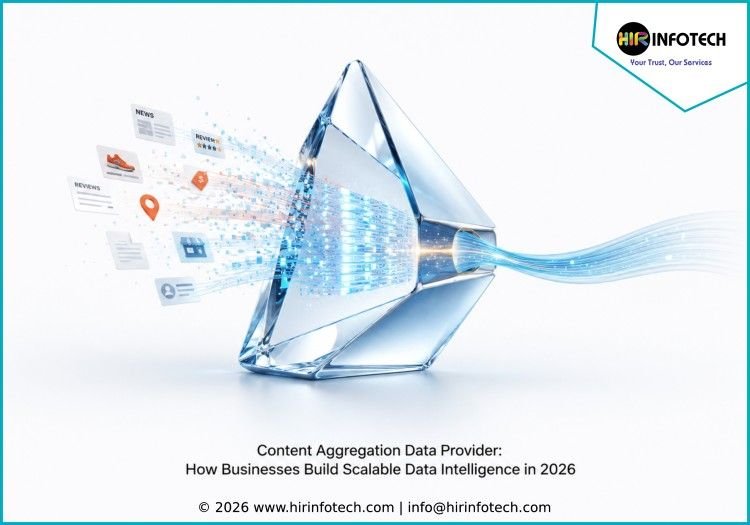
Content Aggregation Data Provider: How Businesses Build Scalable Data Intelligence in 2026
Introduction
Businesses increasingly depend on external data to understand markets, monitor competitors, identify opportunities, and improve operational decisions. In 2026, the role of a content aggregation data provider has expanded beyond collecting information from multiple sources. Organizations now expect structured, accurate, continuously updated data that can directly support analytics, automation, and business growth.
What Does a Content Aggregation Data Provider Mean for Businesses?
A content aggregation data provider collects information from multiple online sources and organizes it into a usable format for business applications.
Rather than manually searching through websites, marketplaces, news portals, directories, forums, product pages, or industry platforms, businesses receive centralized and structured datasets designed for specific objectives.
Content aggregation may include:
- Product and pricing information
- Market trends
- News and media content
- Customer reviews
- Competitor intelligence
- Industry research data
- Public business information
- Real estate listings
- Job market data
- Social and sentiment signals
The goal is not simply gathering content. The value comes from transforming scattered information into actionable business intelligence.
In 2026, companies increasingly need data that can flow directly into CRM systems, analytics platforms, AI models, dashboards, and internal decision workflows.
Why Content Aggregation Matters More in 2026
Business environments now move faster than traditional research processes can support.
Several developments have increased demand for content aggregation:
Growing Data Volumes
Public information across websites and digital platforms expands continuously. Manual collection methods struggle to keep pace.
AI-Driven Decision Making
Organizations increasingly train AI models and business intelligence systems using external datasets. Poor-quality input data often produces unreliable outputs.
Real-Time Competitive Monitoring
Pricing changes, product launches, regulatory announcements, and market movements can happen within hours rather than weeks.
Higher Expectations for Data Accuracy
Teams increasingly expect:
- Deduplicated datasets
- Structured outputs
- Defined schemas
- Continuous updates
- Data quality validation
- Integration-ready delivery
Raw information alone rarely creates business value.
Business Problems Companies Face Without Reliable Content Aggregation
Many organizations underestimate the operational impact of fragmented data collection.
Common challenges include:
Manual Research Consumes Resources
Teams often spend large amounts of time gathering information from multiple websites and sources.
This creates:
- Slow reporting cycles
- Higher labor costs
- Inconsistent data quality
- Reduced productivity
Incomplete Market Visibility
Businesses using isolated information sources may miss:
- Competitor pricing changes
- Emerging trends
- New customer behavior patterns
- Market shifts
Inconsistent Data Structures
Data gathered from different websites often uses different formats.
Examples include:
- Different naming conventions
- Missing values
- Duplicate records
- Unstructured text
Data teams frequently spend more time cleaning information than analyzing it.
Scaling Becomes Difficult
Processes that work for small datasets often fail when organizations need:
- Millions of records
- Multiple geographies
- Continuous updates
- Near real-time delivery
How Web Scraping Supports Content Aggregation
Web scraping forms the operational foundation behind many content aggregation systems.
Modern web scraping goes beyond extracting text from static web pages.
Enterprise-grade implementations often involve:
Source Identification
Teams determine which platforms provide useful and reliable information.
Automated Crawling
Systems continuously collect content from selected sources.
Data Parsing and Extraction
Relevant elements are identified and transformed into structured fields.
Examples include:
- Product title
- Price
- Availability
- Category
- Rating
- Publication date
Data Cleaning and Standardization
Raw extracted information is processed to remove:
- Duplicates
- Invalid entries
- Inconsistent formatting
Enrichment and Delivery
Data may then be enriched with:
- Categories
- sentiment analysis
- geolocation
- AI tagging
- custom classifications
The result becomes ready for business use.
Industry Use Cases for Content Aggregation Data Providers
Content aggregation serves multiple industries because nearly every sector depends on external information.
E-commerce and Retail
Retail businesses use aggregated datasets for:
- Dynamic pricing strategies
- Product intelligence
- Marketplace monitoring
- Inventory analysis
- Competitor tracking
Media and Publishing
Media organizations monitor:
- Trending topics
- News feeds
- content performance
- audience interests
Real Estate
Real estate platforms aggregate:
- Property listings
- Market pricing
- neighborhood information
- rental trends
Recruitment and HR Technology
Recruitment businesses monitor:
- Job listings
- skill demand
- salary benchmarks
- hiring activity
Financial Services
Financial organizations analyze:
- market movements
- public disclosures
- news sentiment
- economic indicators
Market Research Firms
Research teams use aggregated datasets to improve:
- consumer insights
- competitive analysis
- industry reporting
What Businesses Should Evaluate in a Content Aggregation Partner
Choosing a content aggregation provider should involve more than comparing pricing.
Decision-makers often evaluate several operational factors.
Data Accuracy Processes
Questions to consider:
- How are errors detected?
- Is validation performed?
- Are duplicate records removed?
Scalability
Businesses should understand whether systems support:
- High-volume extraction
- Global datasets
- Scheduled updates
- real-time delivery
Source Complexity Handling
Modern websites increasingly use:
- JavaScript rendering
- dynamic content loading
- anti-bot protections
- authentication workflows
Providers need infrastructure capable of handling these environments.
Integration Capabilities
Data becomes useful only when it reaches business systems efficiently.
Common delivery methods include:
- APIs
- CSV
- JSON
- databases
- cloud storage
- automated feeds
Compliance and Responsible Collection Practices
Organizations increasingly consider:
- GDPR requirements
- data governance
- audit trails
- data minimization practices
Compliance considerations have become more important as regulations evolve globally.
How Hir Infotech Supports Businesses Using Web Scraping for Content Aggregation
Organizations requiring large-scale content aggregation often need more than isolated scraping scripts. They need a managed process that supports long-term data operations.
Hir Infotech specializes in web scraping and AI-driven data extraction services designed for businesses that rely on external information as part of strategic decision-making. Its capabilities align closely with content aggregation requirements because aggregation frequently depends on scalable extraction, processing, and delivery pipelines.
The company supports businesses through services such as:
- Automated web scraping workflows
- Enterprise data extraction systems
- API-based data delivery
- Data normalization and processing
- Real-time and scheduled data collection
- Support for dynamic and JavaScript-heavy websites
- Multi-source aggregation environments
For organizations in sectors such as e-commerce, market intelligence, media, real estate, and SaaS, content aggregation requirements can quickly become technically complex. Maintaining extraction systems, adapting to source changes, managing quality controls, and supporting ongoing data delivery often require specialized expertise.
Rather than treating scraping as a one-time technical task, a structured approach focuses on maintaining data quality, operational reliability, and scalability over time. Businesses operating across India and global markets increasingly look for data partners capable of supporting these ongoing requirements while aligning data collection efforts with practical business outcomes.
Best Practices for Implementing Content Aggregation Projects
Organizations typically see stronger outcomes when they approach aggregation strategically.
Define Business Objectives First
Avoid collecting information simply because it is available.
Start with questions such as:
- What decisions will this data support?
- Which teams will use it?
- What metrics matter?
Prioritize Data Quality
Poor-quality information creates expensive downstream problems.
Validation and monitoring should be built into workflows.
Focus on Integration
Data should move directly into operational systems rather than remaining isolated.
Plan for Continuous Maintenance
Source websites change frequently.
Long-term reliability requires:
- monitoring
- updates
- quality checks
- infrastructure support
Frequently Asked Questions
What does a content aggregation data provider do?
A content aggregation data provider collects information from multiple sources, organizes it into structured datasets, and delivers it in formats suitable for business applications such as analytics, market research, and automation.
How is content aggregation different from web scraping?
Web scraping is the technical process of extracting data from websites. Content aggregation is a broader workflow that includes collection, cleaning, standardization, enrichment, and delivery.
Is content aggregation useful for small businesses?
Yes. Small businesses can use aggregated data for competitor monitoring, market research, pricing analysis, and identifying growth opportunities without building large internal research teams.
What data formats are commonly used in content aggregation projects?
Common formats include CSV, JSON, XML, API feeds, cloud storage outputs, and database integrations.
How often should aggregated data be updated?
The frequency depends on business objectives. Pricing intelligence may require near real-time updates, while industry reporting datasets may only need daily or weekly refresh cycles.
Can Hir Infotech support content aggregation projects using web scraping?
Yes. Hir Infotech provides web scraping and data extraction capabilities that support content aggregation workflows, including data collection, processing, and delivery for business use cases.
Conclusion
A content aggregation data provider has become increasingly important for organizations that depend on external information to guide business decisions. In 2026, companies require more than large datasets. They need reliable, structured, and continuously updated intelligence that integrates into real business processes.
Web scraping remains a key component of building scalable aggregation systems because it enables businesses to collect information efficiently across diverse digital sources. For organizations seeking long-term data operations rather than isolated extraction projects, experienced providers such as Hir Infotech can help transform fragmented web information into usable business intelligence that supports growth, efficiency, and informed decision-making.









