
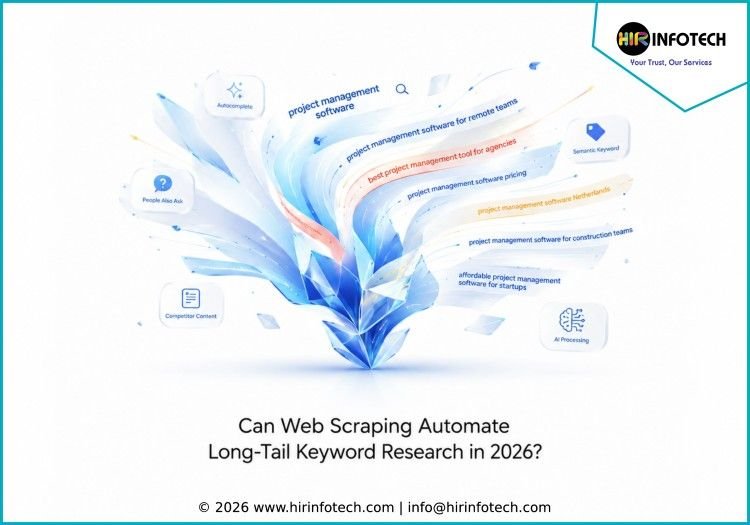
Can Web Scraping Automate Long-Tail Keyword Research in 2026?
Long-tail keyword research is one of the most labour-intensive disciplines in SEO — and one of the most commercially valuable. The queries that drive qualified, high-intent traffic are rarely the broad, competitive head terms. They are the specific, multi-word phrases that signal exactly what a user needs, when they need it. The challenge for SEO teams and agencies in 2026 is not understanding why long-tail keywords matter. It is finding and validating them at the scale that modern content programs demand, across multiple markets, languages, and search engines. Web scraping has become the most practical answer to that challenge.
Why Long-Tail Keyword Discovery Cannot Scale Manually
Standard keyword research tools have a fundamental limitation when it comes to long-tail discovery. They work from historical databases — aggregating search volume data that, by definition, reflects what has been searched in the past rather than what is being searched right now. For ultra-specific queries of four words or more, many platforms either underreport volume or omit the keyword entirely because the search frequency falls below their reporting threshold.
This creates a meaningful blind spot. Long-tail keywords are valuable precisely because they are specific. A business selling project management software in the Netherlands does not just need to rank for “project management software.” It needs to be visible for queries like “project management software for remote construction teams Netherlands” or “best project management tool for small agencies in Amsterdam.” These are the queries that convert — and they are exactly the queries that aggregated keyword databases handle least reliably.
Manual discovery through typing seed keywords into search bars, expanding autocomplete suggestions one by one, and recording related searches and People Also Ask content is effective in principle but entirely impractical at any meaningful scale. For an agency managing keyword programs across markets in the USA, Germany, France, Australia, Canada, Ireland, Thailand, Hong Kong, Poland, Spain, Italy, Russia, the Netherlands, Switzerland, and the UK simultaneously, manual long-tail research is simply not a viable operating model.
Web scraping changes that equation fundamentally.
How Web Scraping Automates Long-Tail Keyword Discovery
Web scraping automates long-tail keyword research by programmatically extracting the signals that reveal what users are actually searching for — directly from live search engine interfaces rather than from aggregated historical data.
Google Autocomplete scraping is one of the most powerful and underutilised sources of long-tail keyword intelligence. When a user begins typing a query, Google’s autocomplete system surfaces predictions based on real, current search behaviour. Scraping these suggestions systematically — by expanding a seed keyword with alphabetical prefixes, numerical modifiers, and question stems — can generate thousands of validated long-tail variations from a single starting term. These are not database estimates. They are live signals reflecting what real users are searching for today, in the specific language and locale of the target market.
People Also Ask extraction delivers question-based long-tail keywords that directly reflect user intent. PAA boxes are dynamic — each answer expansion reveals additional related questions, creating recursive chains of intent signals that go several layers deep. Scraping PAA data at scale across a keyword set reveals not just the individual long-tail terms but the thematic relationships between them, which is invaluable for content clustering and topical authority planning. Critically, PAA content differs between markets. The questions surfacing in France for a given topic will not match those in Canada, Russia, or Thailand — making geo-targeted PAA scraping essential for international long-tail programs.
Related Searches scraping captures the adjacent intent signals that appear at the bottom of search engine results pages. These terms represent the natural vocabulary users apply to a topic and consistently surface long-tail variations that autocomplete and PAA miss. Systematically scraping related searches across a seed keyword list builds a comprehensive map of the semantic space around any topic — the foundation of effective content architecture.
Competitor content scraping adds another dimension. By extracting the actual keyword usage, heading structures, and content depth across competitor pages ranking for target terms, scraping reveals the long-tail variations competitors are successfully targeting — including terms that do not appear in any standard keyword tool because their individual volumes are too low to report, but which collectively drive significant traffic when addressed through well-structured content.
The Data Sources That Feed Automated Long-Tail Research
Effective automated long-tail keyword research through web scraping draws from multiple source types, each delivering different signals.
Search engine autocomplete systems — Google, Bing, and where relevant Yandex for Russian markets and DuckDuckGo for privacy-focused audiences in Germany and Switzerland — provide real-time user intent signals that no historical database can replicate. Forum and community platforms such as Reddit, Quora, and market-specific equivalents across Europe and Asia-Pacific surface the natural language questions real users ask about a topic, often revealing long-tail queries that never appear in standard keyword tools. E-commerce search data from platforms including Amazon is particularly valuable for product-focused keyword programs, revealing the highly specific product-related queries that drive commercial intent traffic.
The combination of these sources, accessed through automated scraping pipelines and structured into unified keyword datasets, produces a long-tail keyword universe that is both broader and more current than anything a single SaaS tool can provide.
Geo-Targeted Scraping for International Long-Tail Programs
For businesses and agencies operating across multiple countries, the geo-targeting capability of web scraping is what makes international long-tail research genuinely viable. Search behaviour is deeply local. The long-tail queries users in Germany apply to a financial services topic bear little resemblance to those in Hong Kong or Ireland, even when the underlying category is the same. Language, cultural context, regulatory environment, and local market conditions all shape how users phrase specific queries.
Scraping long-tail data geo-targeted to each market — using residential proxy networks that route requests through local IP addresses — ensures that autocomplete suggestions, PAA content, and related searches reflect what users in that specific country actually see. This is the difference between a long-tail strategy built on genuine local search intelligence and one built on translated approximations of a different market’s data.
For markets with language variation — French as spoken in France versus Canada, Spanish as used in Spain versus Latin American markets — geo-targeted scraping captures the specific vocabulary and phrasing differences that determine whether a piece of content actually resonates with its intended audience.
From Raw Data to Actionable Long-Tail Keyword Lists
Automated scraping delivers raw keyword signals. Converting those signals into actionable long-tail keyword lists requires processing pipelines that deduplicate, classify by intent, cluster thematically, and filter by commercial relevance.
When structured as clean JSON or CSV datasets and delivered into analytics environments — whether Tableau, Power BI, BigQuery, Snowflake, or a custom dashboard — scraped long-tail data integrates directly into the content planning and keyword strategy workflows that SEO teams actually operate. The output is not a list of raw queries but a prioritised, intent-classified, market-segmented keyword intelligence asset that drives content roadmap decisions, paid search targeting, and topical authority development simultaneously.
How Hir Infotech Powers Automated Long-Tail Keyword Research Through Web Scraping
For SEO teams, content agencies, and data-driven businesses that need long-tail keyword discovery automated at genuine scale across international markets, Hir Infotech provides specialist web scraping services built for exactly this use case.
With 13 years of experience and over 2,745 clients served across the USA, UK, Germany, France, Italy, Spain, the Netherlands, Switzerland, Poland, Ireland, Australia, Canada, Thailand, Hong Kong, and Russia, Hir Infotech delivers AI-powered web scraping infrastructure that extracts long-tail keyword signals from every relevant source — Google autocomplete, People Also Ask, related searches, competitor content, and multi-engine SERP data — at enterprise scale and with 99.5% data accuracy.
Geo-targeted extraction using premium residential proxy networks across 50-plus countries ensures that autocomplete and PAA data reflects actual local search behaviour in each target market, not generalised approximations. Data is delivered as structured JSON or CSV directly into client systems via REST API, Webhooks, or scheduled batch pipelines — integrating seamlessly with existing SEO platforms, data warehouses, and BI tools. For businesses managing long-tail keyword programs across multiple languages and markets simultaneously, Hir Infotech’s combination of AI-driven extraction, multi-source coverage, and dedicated account management makes automated long-tail research operationally practical without requiring internal scraping infrastructure investment.
Frequently Asked Questions
Can web scraping genuinely automate long-tail keyword research at scale?
Yes. By programmatically extracting Google autocomplete suggestions, People Also Ask data, related searches, and competitor keyword usage across large keyword sets, web scraping automates the discovery of thousands of long-tail variations from each seed term. This process runs continuously and delivers current, market-specific data — far beyond what manual research or historical keyword databases can produce at equivalent scale.
What is the difference between scraping long-tail keywords and using a standard keyword tool?
Standard keyword tools work from aggregated historical databases with reporting thresholds that exclude many long-tail terms. Web scraping extracts live signals directly from search engine interfaces and competitor content — capturing ultra-specific, low-volume queries that database tools miss entirely, with real-time accuracy and without query caps or volume minimums.
How does geo-targeting improve long-tail keyword research through web scraping?
Geo-targeting routes scraping requests through residential IP addresses in the target country, ensuring that autocomplete suggestions, PAA questions, and related searches reflect what users in that specific market actually see. This is critical for international programs targeting markets as varied as Germany, Thailand, Russia, Canada, and Hong Kong, where search vocabulary and intent signals differ substantially even within the same topic category.
Which data sources does web scraping use for long-tail keyword discovery?
The primary sources include Google and Bing autocomplete systems, People Also Ask boxes, related searches at the bottom of SERP pages, competitor page content and heading structures, and platform-specific search data from e-commerce and community sites. Combined across multiple seed keywords and markets, these sources produce comprehensive long-tail keyword maps that no single tool replicates.
Is automated long-tail keyword scraping compliant with data protection regulations in Europe?
Scraping publicly available search engine data — autocomplete suggestions, PAA content, and SERP results visible to any user — does not involve processing personal data under GDPR. Responsible scraping services operating across markets including Germany, France, Italy, the Netherlands, Switzerland, Poland, Ireland, and Spain document their collection processes and operate within compliance frameworks appropriate for enterprise use.
How does Hir Infotech deliver scraped long-tail keyword data into existing SEO workflows?
Hir Infotech delivers structured keyword data as JSON or CSV through REST APIs, Webhooks, or scheduled batch pipelines that integrate directly with SEO platforms, data warehouses including BigQuery and Snowflake, and BI tools including Tableau and Power BI. Custom schema development ensures data arrives in the format that client workflows require, without manual transformation or reformatting.
Conclusion
The answer to whether web scraping can automate long-tail keyword research is unequivocally yes — and in 2026, for teams operating at any meaningful scale across multiple markets, it is increasingly the only practical approach. Autocomplete scraping, PAA extraction, related search collection, and competitor content analysis each deliver long-tail intelligence that historical databases miss, at volumes that manual research cannot match, and with the geo-targeting precision that international programs require. For businesses and agencies serving markets across the USA, UK, Germany, Australia, Canada, France, and beyond, Hir Infotech provides the web scraping infrastructure, data accuracy, and specialist expertise to make automated long-tail keyword research a reliable, scalable, and commercially valuable part of their SEO operation.









