
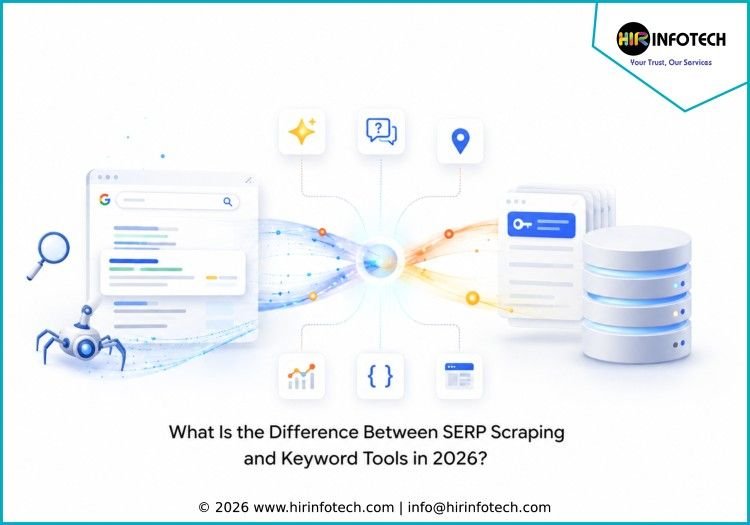
What Is the Difference Between SERP Scraping and Keyword Tools in 2026?
For SEO professionals, agencies, and data teams building keyword intelligence programs across markets including the USA, UK, Germany, France, Italy, Spain, the Netherlands, Switzerland, Poland, Ireland, Australia, Canada, Thailand, Hong Kong, and Russia, understanding the difference between SERP scraping and keyword tools is not a theoretical exercise. It is a practical decision that shapes the quality, depth, and scalability of every keyword strategy built on top of that data.
Both approaches serve keyword research. Both deliver useful intelligence. But they work differently, serve different operational needs, and produce meaningfully different outputs. Knowing which to use — and when to combine them — is one of the more consequential technical decisions an SEO program makes.
How Keyword Tools Work and What They Deliver
Standard keyword research tools — the platforms that have become central to most SEO workflows — work from databases. These databases are built by aggregating search volume data from sources including Google Keyword Planner, clickstream panel data from browser extensions and toolbars, and proprietary crawl indexes that track ranking pages over time.
When you enter a seed keyword into a standard tool, you are querying a pre-built database of historical search signal data. The platform returns estimates of monthly search volume, keyword difficulty scores based on the competitive landscape of ranking pages, suggested variations drawn from its database, and in many cases intent classification based on the types of pages ranking for each term.
This model has genuine strengths. It provides volume context at scale without requiring real-time data collection infrastructure. It surfaces keyword variations and related terms efficiently from large databases. It enables competitive comparison across domains based on indexed ranking data. And it presents all of this through purpose-built user interfaces that make keyword research accessible to analysts without technical infrastructure requirements.
The limitations of this model are equally real and well documented. Database-driven volume estimates are averaged across date ranges, grouped into broad buckets, and frequently diverge from actual query frequency — particularly for long-tail and niche terms where panel data is sparse. Data freshness is constrained by database update cycles, meaning the intelligence a standard tool delivers reflects conditions from weeks or months ago rather than today. Query caps and keyword limits impose operational ceilings on programs that need to work at genuine enterprise scale. And geographic granularity is limited — most tools aggregate data at country level without the city or postal code precision that localised SEO programs require.
How SERP Scraping Works and What It Delivers
SERP scraping takes a fundamentally different approach. Rather than querying a pre-built database, scraping collects data directly from live search engine results pages at the time of collection — extracting what Google, Bing, Yandex, and other engines are actually showing to real users in specific markets right now.
A SERP scraping pipeline sends geo-targeted requests through residential proxy networks to retrieve the actual search results pages for target keywords in specified markets. It then parses those pages to extract structured data — organic ranking positions, SERP feature presence, page titles, meta descriptions, featured snippet content, People Also Ask questions and answers, related searches, paid ad placements, Local Pack listings, and any other elements present on the results page — and delivers that data as structured JSON or CSV output.
The data this produces is not an estimate. It is a direct observation of current search conditions in a specific market at a specific moment. When a scraping pipeline retrieves organic ranking positions for a competitive keyword set in Germany, it is recording exactly what appeared on google.de for those queries at collection time — not a statistical approximation of what typically appears based on historical patterns.
This direct observation model delivers several capabilities that database tools structurally cannot provide. It captures current SERP features — AI Overviews, Featured Snippets, PAA boxes, Local Packs, Shopping tiles — as they exist today across any keyword set and geography. It extracts competitor ranking data without keyword volume caps or database coverage limitations. It geo-targets results at country, city, and postal code level using residential proxy infrastructure that accurately replicates local user experience. And it scales without the query limits that constrain standard tool use for large keyword programs.
The Core Differences That Matter for Keyword Research
Understanding where these two approaches diverge most significantly helps clarify which serves each use case best.
Data freshness is the most fundamental difference. Standard tools deliver historical aggregates. SERP scraping delivers current conditions. For rank monitoring, competitor tracking, and SERP feature analysis in fast-moving verticals — financial services, retail, technology, healthcare — the difference between data that is days old and data that is weeks old is commercially significant. For strategic keyword discovery where historical volume patterns are more relevant than real-time ranking snapshots, the freshness advantage of scraping is less decisive.
Geographic precision separates the two approaches for international programs. Standard keyword tools typically operate at country-level granularity. SERP scraping geo-targeted through residential proxy networks delivers results at city or postal code level — showing exactly what a user in Munich, Lyon, Warsaw, Dublin, or Sydney sees for a given query. For multi-location businesses, franchise networks, and local SEO programs across markets in Europe, Australia, Canada, Thailand, and Hong Kong, this level of geographic precision is not achievable through database tools.
Scalability without caps differentiates the approaches for enterprise programs. Standard keyword tools impose keyword tracking limits and query caps that make large-scale programs operationally constrained. SERP scraping pipelines handle keyword programs of any volume — millions of queries across hundreds of markets — without the ceiling that SaaS tool pricing tiers impose. For agencies managing multi-client programs, SaaS product teams building keyword intelligence features, and enterprise SEO teams tracking hundreds of thousands of keywords simultaneously, scraping infrastructure removes the scale constraints that tools cannot.
Data portability and integration separates the approaches for teams building custom analytics. Standard tools present data through proprietary interfaces. SERP scraping delivers raw structured data — JSON, CSV — directly into the data warehouses, BI platforms, and custom dashboards that enterprise analytics teams actually operate. This enables keyword intelligence to feed machine learning pipelines, custom reporting systems, and data products in ways that tool-locked data cannot support.
Search volume estimation is the dimension where standard tools retain a clear advantage. Volume estimates — however imperfect — provide baseline context for prioritising keyword investment that SERP scraping alone does not generate. SERP scraping delivers competitive density signals, SERP feature presence, and autocomplete frequency that contextualise volume estimates, but it does not replace them.
When to Use Each Approach — and When to Use Both
The practical answer for most enterprise SEO programs is not SERP scraping or keyword tools. It is SERP scraping and keyword tools applied according to what each does best.
Standard keyword tools serve strategic keyword discovery and volume-based prioritisation. When building initial keyword lists, estimating traffic potential across a new keyword category, or identifying broad competitive positioning across a domain, database tools deliver efficient, accessible intelligence.
SERP scraping serves operational keyword intelligence at scale — live rank tracking across large keyword sets, real-time SERP feature monitoring, geo-targeted keyword research for international programs, competitor content and keyword analysis, and the raw data infrastructure that custom SEO products and enterprise analytics require.
The most sophisticated keyword research programs use scraped data for what it does accurately and at scale, and use tool-based volume estimates for the strategic context that historical database patterns provide. Together the two sources produce keyword intelligence that neither delivers alone.
How Hir Infotech Delivers SERP Scraping for SEO Keyword Intelligence
For SEO teams, agencies, and data platforms that need SERP scraping infrastructure delivering the real-time, geo-targeted keyword intelligence that standard tools cannot provide, Hir Infotech provides specialist services purpose-built for search intelligence programs at enterprise scale.
With 13 years of experience and over 2,745 clients served across the USA, UK, Germany, France, Italy, Spain, the Netherlands, Switzerland, Poland, Ireland, Australia, Canada, Thailand, Hong Kong, and Russia, Hir Infotech delivers AI-powered SERP scraping across Google, Bing, Yandex, and regional search engines — extracting the full keyword data layer including organic rankings, Featured Snippets, PAA content, AI Overviews, related searches, competitor page metadata, Local Pack data, and paid ad intelligence.
Geo-targeted collection using premium residential proxy networks across 50-plus countries ensures that keyword data for each target market reflects actual local search conditions — at country, city, and postal code level — rather than generalised approximations. Data delivers as structured JSON or CSV through REST API, Webhooks, or scheduled batch pipelines, integrating directly with existing data warehouses including BigQuery and Snowflake, and BI platforms including Tableau and Power BI. AI-driven validation maintains 99.5% data accuracy across all delivery formats, with dedicated account management and SLA-backed delivery commitments ensuring the reliability that enterprise keyword programs depend on.
Frequently Asked Questions
Is SERP scraping better than keyword tools for SEO research?
Neither is categorically better — they serve different purposes. SERP scraping delivers real-time, geo-targeted, scalable keyword intelligence that database tools cannot match for live rank monitoring, SERP feature analysis, and large-volume programs. Keyword tools deliver historical volume context and accessible discovery interfaces that complement scraped data. The most effective keyword research programs combine both approaches according to what each does best.
Can SERP scraping replace keyword tools entirely?
For most enterprise programs, no. SERP scraping provides superior data freshness, geographic precision, scalability, and data portability. Standard keyword tools provide volume estimation context that scraping alone does not generate. Teams replacing tools entirely with scraping lose volume benchmarks that help prioritise keyword investment. Teams using scraping alongside tools gain the real-time, market-specific intelligence that drives operational SEO decisions.
Why do standard keyword tools have keyword limits but SERP scraping does not?
Standard keyword tools are SaaS products with database infrastructure costs that tier pricing by usage volume. SERP scraping pipelines, when operated through managed infrastructure services, scale horizontally to handle any keyword volume without the per-seat or per-query pricing structures that create caps in SaaS tools. This makes scraping the operationally practical approach for enterprise programs tracking hundreds of thousands of keywords across multiple markets.
How does geographic targeting differ between SERP scraping and keyword tools?
Most standard keyword tools operate at country level, providing volume estimates and ranking data aggregated nationally. SERP scraping geo-targeted through residential proxy networks delivers results at city or postal code level — capturing exactly what local users in specific areas see. For programs requiring local precision across markets including Germany, France, Australia, Canada, and Thailand, SERP scraping is the only approach that delivers this granularity reliably.
What SERP data can be extracted through scraping that keyword tools do not provide?
Scraped SERP data captures real-time organic ranking positions, Featured Snippet content and formatting, People Also Ask questions and answers, AI Overviews, Local Pack listings with ratings and reviews, paid ad copy and positions, related searches, Shopping tile data, Knowledge Panel content, and competitor page metadata — all at collection time and at geo-targeted precision. Standard tools provide estimates and summaries of some of these elements but rarely deliver the raw, complete, real-time data that scraping produces.
How does Hir Infotech’s SERP scraping service integrate with existing SEO workflows?
Hir Infotech delivers structured SERP data directly into existing analytics environments — BigQuery, Snowflake, Tableau, Power BI, AWS S3, PostgreSQL, and REST API endpoints — via scheduled batch pipelines, Webhooks, or real-time API calls. Custom schema development ensures data arrives in the format client workflows require, with no manual transformation needed between collection and analysis.
Conclusion
SERP scraping and keyword tools are complementary rather than competing approaches to keyword research intelligence. Keyword tools offer accessible, database-driven volume context and discovery interfaces. SERP scraping delivers real-time, geo-targeted, scalable keyword data that reflects current search conditions in each target market — the intelligence that operational SEO programs across the USA, UK, Germany, France, Australia, Canada, Russia, Thailand, Hong Kong, and across Europe need to make decisions grounded in what is actually happening in search today. Understanding the difference between the two — and applying each where it excels — is what separates keyword programs built on genuine market intelligence from those limited by the constraints of any single data source. Hir Infotech provides the SERP scraping infrastructure and specialist expertise to deliver that live, market-specific intelligence at enterprise scale, across every major market your program operates in.









