
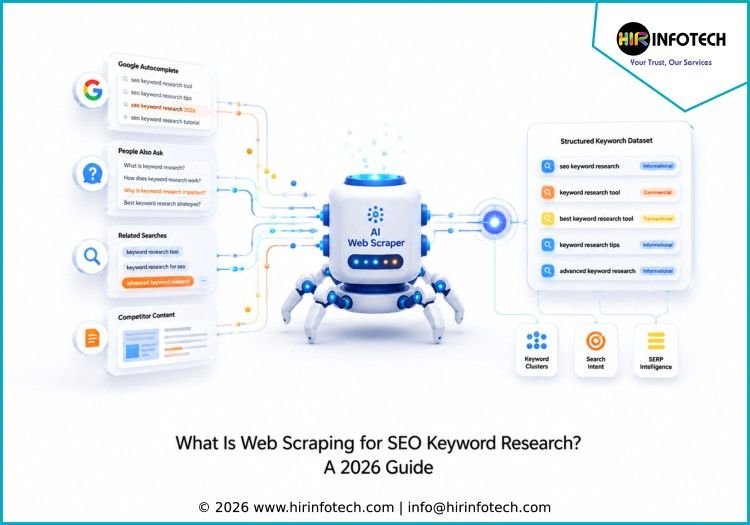
What Is Web Scraping for SEO Keyword Research? A 2026 Guide
Introduction
Keyword research has traditionally meant logging into subscription tools and downloading static lists. Web scraping takes a different approach. It automatically extracts live data directly from search engines, competitor sites, and trends platforms — revealing what users are actually searching for right now, not what they searched for months ago.
Defining Web Scraping for Keyword Research
Web scraping for SEO keyword research is the automated process of extracting search-related data from public web sources. These sources include Google Autocomplete suggestions, People Also Ask boxes, Related Searches sections, search engine results pages, competitor websites, and trend platforms like Google Trends .
The fundamental distinction matters. Traditional keyword tools maintain large but static databases that update periodically. Web scraping pulls live data in real time, capturing the precise keywords, questions, and intent signals that exist on search engines at this moment .
Web scraping and web crawling are related but not identical. A web crawler discovers URLs by following links across the internet, focusing on broad discovery of pages. A web scraper extracts specific structured fields — like keyword suggestions, ranking positions, or competitor titles — from known pages or search results. Modern SEO workflows combine both: crawl to discover relevant pages, then scrape to extract keyword intelligence .
How Web Scraping Works for Keyword Discovery
The technical process varies by data source, but the core logic is consistent. A scraping script sends automated requests to a target source — such as Google’s autocomplete endpoint or a competitor’s blog — receives the response, parses the HTML or JSON, and extracts the specific data fields needed for analysis.
For Google Autocomplete, the scraper targets an endpoint like https://suggestqueries.google.com/complete/search?client=firefox&q=your+keyword. The response arrives as JSON containing a list of predicted completions. Each completion represents a keyword that real users are actively typing .
For People Also Ask boxes, the scraper must handle interactive elements. PAA questions load dynamically as users click. Automated scrapers simulate those clicks to expand the full question tree, capturing 15 to 30 related questions per seed keyword .
For competitor keyword analysis, the scraper extracts titles, meta descriptions, headings, and visible text from competing pages. Natural language processing libraries like NLTK then tokenize the text, remove common stop words, and count word frequencies to identify the most important keywords on each page .
Types of Keyword Data Accessible Through Scraping
Web scraping provides access to several distinct categories of keyword intelligence that traditional tools cannot match.
Discovery-level data comes directly from Google’s suggestion engines. Autocomplete reveals what users are typing right now, often capturing emerging trends before they appear in volume databases. PAA questions expose the specific information gaps users are trying to fill. Related searches reveal thematic clusters that help content teams build comprehensive topic coverage .
SERP feature data captures the full composition of search results. For any keyword, scraping reveals whether the SERP includes featured snippets, shopping results, local packs, video carousels, or AI Overviews. This intelligence directly informs content format decisions. A keyword with video results demands video content. A keyword with a local pack demands local SEO optimization .
Competitor keyword data comes from extracting ranking positions, titles, and content metadata from the top organic results for your priority keywords. Comparing your pages against competitors reveals gaps in coverage and opportunities for optimization .
Trend data from platforms like Google Trends shows whether keyword interest is rising or falling over time, with geographic breakdowns revealing regional variations. A keyword with steady average volume might be in terminal decline, while a keyword with rising interest represents a growth opportunity .
Why Traditional Keyword Tools Have Blind Spots
Premium SEO platforms maintain massive keyword databases. But those databases have inherent limitations that web scraping solves.
The first limitation is freshness. When a new search trend emerges — driven by news, product launches, or cultural events — traditional tools may take weeks or months to reflect it. Scraping captures the trend as it happens .
The second limitation is granularity. Traditional tools provide country-level data but struggle with city-level or neighborhood-level variations. A search trend specific to a single city may never reach the volume threshold required to appear in aggregated databases. Scraping with precise geographic parameters captures those hyper-local variations .
The third limitation is question-based queries. People Also Ask boxes and conversational search patterns are underrepresented in traditional keyword databases because these platforms prioritize keywords with measurable search volume. Scraping captures the exact questions users ask, which often perform better for featured snippets and AI Overviews .
Types of Web Scraping for SEO Keyword Research
Different keyword research goals require different scraping approaches.
SERP scraping extracts search engine results pages for specific keywords. The output includes organic ranking positions, titles, URLs, meta descriptions, paid ads, and all SERP features. This data powers rank tracking, competitive analysis, and intent classification .
Autocomplete scraping targets Google’s suggestion endpoint. With alphabet expansion — appending each letter of the alphabet to a seed keyword — a single seed generates up to 360 unique long-tail keyword suggestions. Recursive depth expansion multiplies this further .
PAA scraping extracts People Also Ask boxes with full depth expansion. Each seed keyword returns 15 to 30 related questions, each representing a distinct content opportunity. The sequence of questions reveals the user’s information journey — what they want to know first, then next, then after that .
Content scraping extracts keywords directly from competitor web pages. The process involves fetching the HTML, parsing with BeautifulSoup, extracting visible text, tokenizing, removing stop words, and counting frequencies to identify the most important terms on each page .
Trends scraping captures interest-over-time data from Google Trends. Output includes daily, weekly, or monthly interest scores, geographic breakdowns, and related queries. This data reveals seasonality and emerging interest patterns .
Web Scraping Versus Traditional SEO Tools
The choice between web scraping and traditional tools depends on the specific use case rather than one approach being universally superior.
Traditional tools excel at providing historical search volume, keyword difficulty scores, and backlink data. These metrics require massive aggregated databases that scraping alone cannot replicate .
Web scraping excels at providing real-time discovery-level data, SERP feature intelligence, competitor content analysis, and multi-market variations. These data types require live extraction that traditional tools cannot provide at the same level of freshness or granularity .
The most effective SEO teams combine both approaches. They use scraping for discovery and intent analysis, then enrich that data with volume and difficulty metrics from traditional tools for prioritization .
How Hir Infotech Approaches Keyword Research Scraping
At Hir Infotech, we have built our web scraping practice around delivering actionable keyword intelligence to B2B SEO teams. With over 13 years of experience and thousands of successful projects across real estate, retail, healthcare, travel, and technology sectors, we understand the specific data requirements of modern SEO workflows.
Our approach to keyword research through web scraping focuses on three core capabilities. First, we extract discovery-level keyword data including Google Autocomplete suggestions with alphabet expansion, People Also Ask questions with depth expansion, and Related Searches from any seed keyword list. This provides the raw material for content ideation and topic clustering.
Second, we enrich discovered keywords with SERP-based intent classification. We scrape live search results to detect SERP features including featured snippets, shopping results, local packs, knowledge panels, video results, image results, and paid ads. Using a multi-layer analysis of keyword signals, SERP features, and domain patterns, we classify each keyword with an intent label and confidence score — informational, commercial, transactional, navigational, or local.
Third, we support multi-market collection across the USA, Germany, United Kingdom, France, Italy, Russia, Spain, Netherlands, Switzerland, Poland, Ireland, Australia, Canada, Thailand, and Hong Kong. Using country-specific parameters, we reveal regional intent and keyword differences that single-market research would miss entirely.
Our infrastructure includes rotating proxy networks, request throttling, and CAPTCHA handling to ensure reliable extraction at scale. We do not sell software subscriptions. We deliver structured, decision-ready keyword datasets that feed directly into content calendars, brief-writing processes, and competitive analysis workflows.
Frequently Asked Questions
What is the difference between web scraping and web crawling for SEO?
Web crawling discovers URLs by following links across the internet. Web scraping extracts specific structured data fields from known pages or search results. For keyword research, you crawl to find relevant pages, then scrape to extract keyword intelligence from those pages .
Is web scraping for keyword research legal?
Web scraping occupies a complex legal space. Scraping publicly accessible data for internal analysis typically carries lower legal risk than scraping protected data or redistributing results. Compliance depends on use case, data storage, redistribution, and jurisdiction. Consult legal teams for specific applications .
What types of keywords can scraping find that traditional tools miss?
Scraping captures real-time emerging trends before they appear in databases, hyper-local variations specific to individual cities or regions, question-based queries from PAA boxes, and long-tail variations revealed through alphabet expansion .
Does web scraping provide search volume data?
Not directly. Web scraping captures the keywords themselves and SERP features, but search volume estimates require integration with paid APIs like Google Ads API, SEMrush, or Similarweb. Most effective workflows use scraping for discovery and traditional tools for volume enrichment .
How often should I scrape for keyword research?
For stable B2B topics, monthly scraping suffices for discovery-level data. For news-driven or seasonal industries, weekly scraping captures emerging opportunities. Intent classification should be refreshed quarterly, as Google occasionally reclassifies intent for competitive keywords .
Conclusion
Web scraping for SEO keyword research is the automated extraction of live search data from Google Autocomplete, People Also Ask boxes, Related Searches, SERPs, competitor content, and trends platforms. Unlike traditional keyword tools that rely on static databases, scraping delivers real-time discovery-level intelligence that captures exactly what users are searching for right now. The data categories accessible through scraping include autocomplete suggestions, PAA questions, SERP features, competitor keywords, and trend data — each providing unique value for content strategy. While traditional tools remain essential for search volume and difficulty metrics, scraping fills critical gaps in freshness, granularity, and question-based discovery. For organizations ready to move beyond assumption-based keyword lists and build content around live search intelligence, Hir Infotech delivers structured keyword data extraction tailored to your markets and use cases — turning Google’s real-time signals into your content strategy foundation.









