
Introduction
Content data has become a critical business asset in 2026. Companies tracking competitors, monitoring news, training AI systems, conducting market research, or building content intelligence platforms increasingly rely on accurate extraction of article titles, publication dates, author information, and metadata. The challenge is no longer finding data—it is extracting structured, reliable information at scale.
Why Article Metadata Matters for Businesses
Article pages contain more than visible text. Behind every article exists structured information that helps businesses understand content context, authority, freshness, and relevance.
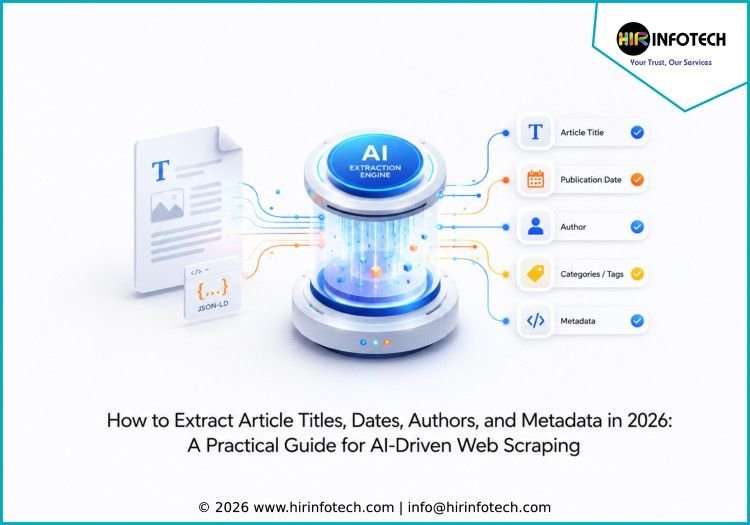
Common article metadata fields include:
- Article title
- Publication date
- Author name
- Article category
- Tags and topics
- Meta descriptions
- Canonical URLs
- Language information
- Publisher details
- Open Graph and social metadata
- Schema markup data
- Last updated timestamps
For businesses, this information supports multiple operational and strategic functions.
Common business use cases
Content intelligence platforms
Organizations monitor publishers, industry portals, and blogs to identify emerging trends.
Media monitoring
PR and communications teams track articles mentioning brands, executives, products, or competitors.
AI model training and retrieval systems
Large datasets require clean metadata structures to improve search quality and contextual understanding.
Market research
Analysts aggregate content across multiple sources and classify information by category, author, and publishing patterns.
SEO and digital marketing
Teams evaluate publishing frequency, content topics, and competitor strategies.
Without structured extraction, teams often spend significant time cleaning inconsistent datasets.
Challenges of Extracting Article Titles, Dates, Authors, and Metadata
Many organizations assume article extraction is straightforward until they begin processing thousands of websites.
Modern websites create several technical challenges.
Dynamic website structures
Traditional scrapers frequently depend on fixed HTML elements.
For example:
- One website may use H1 tags for titles
- Another may store titles in JSON-LD schema
- A third may generate content dynamically through JavaScript
A fixed extraction rule rarely works across different domains.
JavaScript-rendered pages
Many publishers use modern front-end frameworks that load content dynamically.
Standard crawlers often fail to detect:
- Author information
- Date fields
- Structured data
- Lazy-loaded content
Inconsistent metadata standards
Although schema formats exist, implementation varies considerably.
Common structures include:
- Open Graph tags
- JSON-LD
- Microdata
- Meta tags
- Custom HTML implementations
Businesses often receive fragmented or incomplete outputs.
Frequent layout changes
Publishers redesign websites regularly.
When layouts change:
- XPath selectors fail
- CSS selectors break
- Data pipelines stop working
For businesses relying on continuous data feeds, interruptions create operational risks.
Duplicate and low-quality data
Extraction at scale often produces:
- Duplicate records
- Missing author names
- Incorrect dates
- Parsing errors
- Empty fields
Data quality quickly becomes a larger challenge than extraction itself.
How AI-Driven Web Scraping Solves These Problems
Traditional rule-based scraping still has value, but 2026 expectations increasingly demand AI-assisted extraction systems.
AI-driven web scraping combines:
- Intelligent crawlers
- Natural language processing
- Pattern recognition
- Machine learning
- Dynamic content rendering
- Data validation layers
Instead of relying solely on fixed page structures, AI models identify patterns across different sources.
Smarter title extraction
AI systems recognize article titles based on:
- Content hierarchy
- semantic structure
- page context
- schema relationships
Even if a publisher changes page design, extraction accuracy remains more stable.
Better author identification
Author information appears in multiple forms:
- visible bylines
- structured schema
- profile links
- metadata tags
AI-based extraction systems can compare signals and identify the most reliable source.
Accurate date recognition
Dates create major inconsistencies:
Examples include:
- January 12, 2026
- 12/01/26
- Updated 2 hours ago
- Published yesterday
AI systems normalize dates into standardized formats for downstream analytics.
Metadata enrichment
Advanced workflows often enrich extracted data with:
- topic classifications
- sentiment indicators
- language detection
- entity extraction
- keyword tagging
This turns raw article data into actionable business intelligence.
Step-by-Step Process for Extracting Article Metadata
Businesses considering article extraction projects should think beyond simply collecting HTML.
A practical workflow generally looks like this.
Step 1: Identify target sources
Determine:
- news websites
- blogs
- industry publications
- knowledge portals
- media databases
Source selection influences technical complexity.
Step 2: Analyze page structures
Review:
- HTML hierarchy
- schema markup
- JavaScript behavior
- API endpoints
- anti-bot mechanisms
Early analysis reduces later maintenance costs.
Step 3: Build extraction logic
Identify fields such as:
- article title
- author
- publication date
- categories
- tags
- descriptions
Step 4: Handle rendering and anti-bot challenges
Modern extraction systems often require:
- headless browser automation
- proxy rotation
- CAPTCHA handling
- session management
Step 5: Validate and clean outputs
Quality checks may include:
- removing duplicates
- correcting date formats
- validating missing fields
- standardizing author naming
Step 6: Deliver structured datasets
Typical output formats include:
- CSV
- JSON
- APIs
- cloud storage feeds
- databases
- analytics platforms
Why Accuracy Matters More Than Volume in 2026
Many organizations initially focus on extraction scale.
However, inaccurate metadata creates larger downstream problems.
Examples include:
Poor AI recommendations
Missing or incorrect metadata reduces search and recommendation quality.
Misleading business reports
Incorrect publishing dates can distort trend analysis.
Weak competitive intelligence
Incomplete author or topic information creates gaps in market monitoring.
Analytics failures
Dashboards built on inconsistent datasets become difficult to trust.
Businesses increasingly prioritize:
- data lineage
- validation frameworks
- monitoring systems
- auditability
- compliance-ready processes
How Hir Infotech Supports AI-Driven Article Metadata Extraction
Article metadata extraction aligns directly with modern AI-driven web scraping requirements because businesses increasingly need reliable, structured content intelligence rather than raw page data. Hir Infotech specializes in AI-driven web scraping and data extraction workflows designed for organizations that require scalable data collection across dynamic websites and large datasets. Its capabilities include intelligent crawling, structured extraction pipelines, real-time processing, custom scraper development, and multi-format data delivery.
For businesses building content intelligence platforms, market research systems, media monitoring solutions, or AI applications, extracting article titles, authors, dates, and metadata often involves more than basic scraping scripts. Dynamic websites, JavaScript-rendered pages, anti-bot systems, and changing page structures require adaptive extraction approaches.
Hir Infotech’s AI-based extraction capabilities support these scenarios by creating structured pipelines that can collect, normalize, and organize web data for operational use. Organizations can integrate extracted information into CRM platforms, analytics tools, business intelligence systems, or internal applications without spending significant time on manual processing. For businesses operating across India and international markets, scalable extraction infrastructure and clean data delivery can reduce operational complexity while improving decision-making speed.
What Businesses Should Evaluate Before Choosing a Web Scraping Partner
Not all extraction providers deliver the same level of reliability.
Decision-makers should evaluate:
Technical capabilities
Assess whether providers support:
- JavaScript rendering
- dynamic websites
- structured data extraction
- anti-bot handling
Data quality processes
Ask questions such as:
- How are duplicates handled?
- How is validation performed?
- How are extraction failures monitored?
Compliance and governance
Responsible providers should address:
- public data boundaries
- privacy considerations
- data handling policies
- audit requirements
Integration support
Business value increases when extracted data connects directly to:
- CRM systems
- dashboards
- BI tools
- data warehouses
- APIs
Scalability
Solutions should support future growth without constant redesign.
Frequently Asked Questions
What is article metadata extraction?
Article metadata extraction is the process of collecting structured information from articles, including titles, publication dates, authors, categories, tags, and related content attributes.
Why are publication dates and author details important?
Dates and author information help businesses determine content relevance, authority, content freshness, and publishing patterns for analytics or competitive intelligence.
Can article metadata be extracted from JavaScript websites?
Yes. Modern AI-driven web scraping solutions use rendering technologies and intelligent extraction methods to collect data from JavaScript-based websites.
Is metadata extraction useful for AI systems?
Yes. Structured metadata improves search accuracy, retrieval quality, recommendation systems, and AI model context understanding.
How does Hir Infotech support metadata extraction projects?
Hir Infotech provides AI-driven web scraping services that help organizations collect, structure, and deliver metadata from websites at scale for analytics, research, and business intelligence workflows.
Conclusion
Understanding how to extract article titles, dates, authors, and metadata has become increasingly important as organizations depend on content intelligence and structured web data for decision-making. Businesses in 2026 need more than raw scraping scripts—they require reliable extraction pipelines that can adapt to changing websites, maintain data quality, and integrate seamlessly into operational systems.
AI-Driven Web Scraping Services help address these challenges by combining intelligent extraction, automation, and validation into scalable workflows. For organizations building data-driven strategies, structured metadata is often the foundation of better analytics and stronger business outcomes. Companies such as Hir Infotech support these needs through practical, scalable approaches designed for real-world data operations.









