
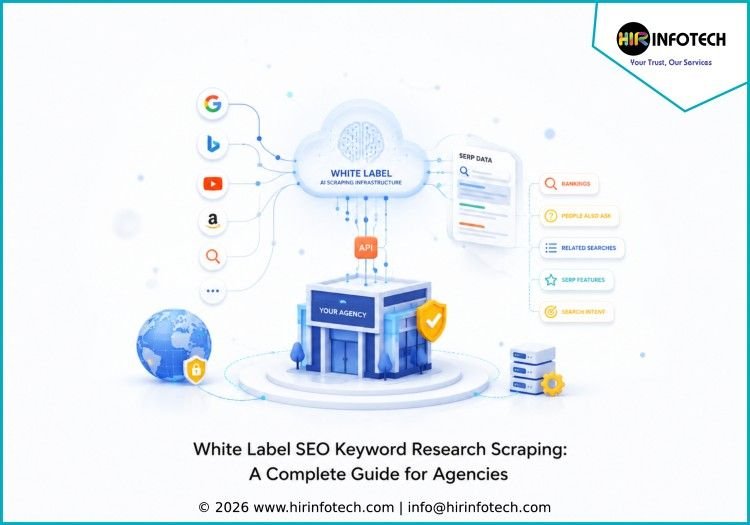
White Label SEO Keyword Research Scraping: A Complete Guide for Agencies
Introduction
For SEO agencies, white label keyword research scraping is the infrastructure that powers scalable client reporting. Instead of building and maintaining scrapers, agencies partner with data providers who deliver structured SERP intelligence under the agency’s own brand. This model eliminates the engineering overhead of proxy management, CAPTCHA solving, and parser maintenance — letting agencies focus on strategy and client results.
What Is White Label SEO Keyword Research Scraping?
White label SEO keyword research scraping refers to a data service model where a provider collects keyword intelligence from search engines and delivers it in a way that agencies can rebrand as their own. The provider handles all technical aspects of data collection — rotating proxies, parsing SERP layouts, extracting organic rankings, People Also Ask questions, related searches, and SERP features — while the agency presents the insights to clients under its own name and logo.
The key characteristic of white label delivery is invisibility. The client never sees the underlying data provider. API responses come from the agency’s domain. Reports carry the agency’s branding. Pricing and packaging are controlled by the agency, not the provider.
For agencies managing SEO for dozens or hundreds of clients, this model transforms keyword research from a manual, repetitive task into an automated, scalable operation. Instead of spending hours checking rankings manually, agencies receive structured data ready for analysis and client presentation.
Why SEO Agencies Choose White Label Keyword Data
Several factors drive agencies toward white label keyword research solutions.
Client reporting demands accuracy and timeliness. When you are managing SEO for 50 or more clients, manual ranking checks become impossible. API-powered white label solutions deliver daily or weekly ranking snapshots automatically, ensuring reports are always current.
Cost predictability matters. Building custom scraping infrastructure requires ongoing investment in proxies, engineering time, and maintenance. White label providers offer predictable usage-based or subscription pricing, with wholesale rates that leave room for agency margin.
Focus on core competencies is another driver. Most agencies are not in the business of running scrapers at scale. Their value is in SEO strategy, content planning, and client communication. White label keyword data lets agencies outsource the data collection layer while retaining full ownership of the client relationship.
Scalability is the final factor. Adding a new client means adding new keywords to track. White label APIs scale horizontally — you pay for additional volume, not additional infrastructure.
How White Label Keyword Research Scraping Works
The technical architecture of white label keyword research is straightforward. The agency integrates with a provider’s API, which handles all search engine data collection. The agency then serves that data to clients through its own reporting dashboards, API endpoints, or white-labeled PDF reports .
A typical integration flow:
The agency sends a request to the provider’s API with keyword parameters, location targeting, and device type. The provider fetches live SERP data using its proxy infrastructure and anti-bot systems. The provider returns structured JSON with organic rankings, positions, titles, and URLs. The agency transforms the data into its own response schema — branded with its logo, field names, and metadata. The client sees only the agency’s branding.
For scheduled tracking, the agency’s backend runs daily or weekly jobs that call the provider’s API for each client’s keyword list, stores the results in a database, and generates reports on demand. The entire process is automated, requiring no manual intervention.
A key concept here is the SERP tracking white-label API, which is a data provider that lets you serve real-time search engine result data under your own brand while the provider handles all the collection infrastructure behind the scenes. It is the difference between building a data pipeline and buying one .
What Keyword Data Can Be White Labeled
White label keyword research scraping can deliver several categories of search intelligence, each serving different client needs.
Organic ranking positions are the most common deliverable. For each keyword and client domain, the provider returns the current ranking position, the ranking URL, and often historical position data for trend analysis.
SERP features provide additional visibility intelligence. Featured snippets, People Also Ask boxes, local packs, video carousels, and shopping results all affect how users interact with search results. White label providers can extract which features appear for each keyword and which competitors occupy them.
Competitor keyword data reveals which terms competing domains rank for. By analyzing competitor SERP positions, agencies can identify content gaps and opportunities for their clients. The SpyFu competitor data scraper, for instance, extracts organic keywords, traffic estimates, top pages, backlinks, and competitor domains for up to 200 domains in a single run across 30 countries .
Search volume and difficulty metrics help prioritize which keywords to target. While raw scraping does not provide volume data, many white label providers enrich SERP data with metrics from third-party APIs or integrated databases. The Semrush Global Keyword Data Scraper can fetch search volume by country, CPC, keyword difficulty percentage, and intent scores for any keyword .
People Also Ask questions surface specific user information needs. Extracted with depth expansion, these questions become content opportunities for blog posts, FAQ sections, and featured snippet optimization.
White Label SEO Platforms for Agencies
Several platforms offer white label SEO capabilities that include keyword research, rank tracking, and reporting.
SE Ranking is a cloud-based SEO platform that agencies can rebrand and resell. It offers daily rank tracking, competitor tracking, keyword research covering 5+ billion keywords, white-label reports with custom branding, local rank tracking by ZIP code or city, and API endpoints for rankings and keyword data. The Agency Pack add-on provides full white-label platform and reports, unlimited scheduled reports with AI summaries, and agency catalog placement .
CartLegit offers an SEO panel designed specifically for digital marketing agencies and resellers. The panel can be fully rebranded with your logo, colors, and domain. It includes keyword tracking, backlink management, site audits, and white-label reporting. Resellers can create client portals that mirror their own branding, set custom pricing for keyword tracking packages, and automate daily rank checks and weekly report generation .
ContentForge provides a white-label platform for agencies serving local businesses. It includes keyword research, competitor analysis, backlink analysis, keyword tracking, local rank heat maps, and technical SEO audits. The platform is built specifically for agencies who want to deliver SEO services under their own brand without paying for multiple tools .
API-First White Label Solutions
For agencies building custom products or dashboards, API-first white label solutions offer maximum flexibility.
The Keyword Suggest Multi actor on Apify fetches keyword suggestions from Google, Bing, DuckDuckGo, YouTube, Amazon, eBay, Yandex, Baidu, and Naver for a batch of seed keywords in one country. It includes A-Z and question expansion that turns one seed into ~100 related queries. The output includes a cross-engine-ranked summary where suggestions bubble up by consensus across multiple engines — suggestions that appear across multiple search engines represent mass-market intent, not one-engine quirks .
The SpyFu Competitor Data Scraper extracts complete competitor intelligence from SpyFu overview pages. For each domain, it returns organic keywords count, monthly traffic estimates, paid keywords, estimated ad spend, competitors list, top organic keywords, top pages, backlinks, and newly ranked keywords. All data comes in one row per domain, making it easy to import into spreadsheets or databases .
For white label SERP tracking specifically, providers like MrScraper offer infrastructure that lets agencies build their own SERP collection layer on top of reliable, residential-proxy-backed scraping. This gives full control over parsing logic and data schema while the provider handles proxy rotation, anti-bot bypass, and JavaScript rendering .
Building White Label Reports from Scraped Data
Raw keyword data becomes valuable when transformed into client-facing reports. White label providers support several reporting approaches.
API-first reporting lets agencies build custom dashboards that pull real-time keyword data directly from the provider. The agency’s frontend calls its own backend, which calls the provider’s API. The client sees rankings updated on demand within the agency’s branded interface.
Scheduled report generation works for clients who prefer periodic PDF or email reports. The agency’s backend runs daily or weekly jobs, calls the provider’s API for each keyword, stores the results, and generates branded PDFs.
Many white label platforms include built-in reporting. SE Ranking’s white-label reports can be scheduled for automatic email delivery with AI-generated summaries and custom branding . CartLegit’s panel includes one-click export to PDF or CSV with templates that can be scheduled for automatic email delivery .
Multi-Market Keyword Research for Global Clients
For agencies serving clients with international operations, white label keyword research must support multi-market extraction. The same keyword in the USA, Germany, the United Kingdom, France, and other markets produces different rankings, different SERP features, and different competitors.
A white label provider should support geo-targeted extraction with country-specific parameters. For agencies serving clients across the USA, Germany, United Kingdom, France, Italy, Russia, Spain, Netherlands, Switzerland, Poland, Ireland, Australia, Canada, Thailand, and Hong Kong, the provider must deliver localized results that reflect what users actually see in each market .
The Keyword Suggest Multi actor supports 25 pre-configured markets across the Americas, Europe, Asia, the Middle East, Oceania, and Africa. For each country, it auto-routes each search engine to its local endpoint, language, and marketplace. This means one input configuration can return country-native results for all nine search engines simultaneously .
Similarly, the Semrush Global Keyword Data Scraper accepts a two-letter country code for primary market context and returns search volume and SEO metrics across multiple countries including the US, UK, IN, CA, AU, DE, and FR .
Choosing a White Label Keyword Research Provider
Selecting a white label provider requires evaluating several technical and business dimensions.
Data accuracy and freshness are critical. Your clients make SEO decisions based on this data. If it is stale or inaccurate, your credibility suffers. Does the API return real-time data or cached results? Cached data from 24+ hours ago is often useless for rank tracking. How does the provider handle Google’s frequent layout changes? Providers with dedicated parsing teams update faster than those relying on community-maintained scrapers .
SERP feature coverage matters beyond organic rankings. Modern SERPs include featured snippets, local packs, video carousels, and AI Overviews. Ensure your provider captures the features relevant to your clients’ industries.
Geolocation accuracy is essential for local SEO. Correct geo-targeting should produce meaningfully different results for location-dependent queries across different cities. If “coffee shop near me” returns the same top results for New York and Chicago, the provider’s geo-targeting is not working .
White label terms determine how invisible the provider remains. Does the provider require you to display their name or logo? Any required attribution undermines your white-label positioning. Are you explicitly permitted to resell the data or embed it in a commercial product? Who owns the stored ranking data if you switch providers? .
Pricing models vary. Some providers charge per query, others offer monthly credit packages, and some have unlimited plans. Match the provider’s pricing model to your product’s economics. If you are building a SaaS with per-seat pricing, per-query costs can eat your margin unpredictably as customers use the product more than expected. Unlimited or credit-bundle plans offer more predictable costs of goods sold .
Why Hir Infotech Provides White Label Keyword Research Scraping
At Hir Infotech, we deliver AI-driven SERP data extraction purpose-built for white label SEO agencies. With over 13 years of experience and 2,745+ satisfied clients across the USA, Europe, and Australia, we provide the infrastructure that agencies need to scale keyword research without building and maintaining scrapers .
Our approach to white label keyword research focuses on three core capabilities.
First, we extract complete SERP data including organic rankings, People Also Ask questions with depth expansion, related searches, local packs, and featured snippets. Our AI-driven extraction models auto-adapt to layout changes, maintaining high data accuracy even when Google updates its DOM structure.
Second, we support geo-targeted extraction across the USA, Germany, United Kingdom, France, Italy, Russia, Spain, Netherlands, Switzerland, Poland, Ireland, Australia, Canada, Thailand, and Hong Kong. Using our premium residential proxy network, we deliver hyperlocal SERP results down to city and postal code levels .
Third, we offer white label delivery options including unbranded API responses, custom API domains, and integration support for agency reporting dashboards. We do not require attribution in client-facing materials.
We deliver structured, decision-ready SERP data that agencies can resell, embed, or report on under their own brand. For organizations ready to scale keyword research operations without infrastructure overhead, we provide the data foundation for white label SEO success.
Frequently Asked Questions
What is the difference between white label keyword scraping and using a keyword tool directly?
A keyword tool offers pre-calculated metrics through a dashboard you cannot rebrand. White label keyword scraping delivers raw SERP data that you can serve under your own brand, with your pricing and your reporting. You control the client relationship; the provider remains invisible .
How do white label providers ensure data accuracy?
Professional providers use AI-driven extraction models that auto-adapt to SERP layout changes, residential proxy networks to avoid blocks, and dedicated parsing teams. Hir Infotech achieves high data accuracy through these methods.
Can white label keyword research support multiple countries?
Yes. The right provider supports geo-targeted extraction for the USA, Germany, United Kingdom, France, Italy, Spain, Australia, Canada, and other markets using region-specific proxy networks and country parameters .
What is the typical pricing model for white label keyword data?
Pricing varies by provider. Common models include per-API-call pricing, monthly credit packages, unlimited plans, or subscription tiers based on keyword volume. Wholesale rates for agencies are typically lower than direct consumer pricing .
How do I integrate white label keyword data into my client reports?
Most providers offer API access that you can connect to your reporting infrastructure. You store ranking data in your database, then generate branded PDFs or interactive dashboards using your own templates. Some white label platforms include built-in reporting with scheduled PDF delivery and AI summaries .
Conclusion
White label SEO keyword research scraping lets agencies deliver scalable, data-driven client reporting without building and maintaining scraping infrastructure. The model is straightforward: providers handle proxy rotation, CAPTCHA solving, parser maintenance, and data normalization. Agencies focus on strategy, client communication, and growth. The technical integration ranges from simple API calls to scheduled tracking jobs, with output delivered through branded dashboards or automated PDF reports. White label platforms like SE Ranking and CartLegit offer turnkey solutions with built-in reporting, while API-first providers like the Keyword Suggest Multi actor and SpyFu scraper offer maximum flexibility for custom products. For multi-market agencies, geo-targeted extraction ensures accurate localization. For agencies ready to scale, white label keyword research turns data collection from an operational burden into a competitive advantage. Hir Infotech provides white label SERP data extraction across the USA, Germany, United Kingdom, France, Italy, Russia, Spain, Netherlands, Switzerland, Poland, Ireland, Australia, Canada, Thailand, and Hong Kong — delivering the infrastructure that powers agency growth.









