
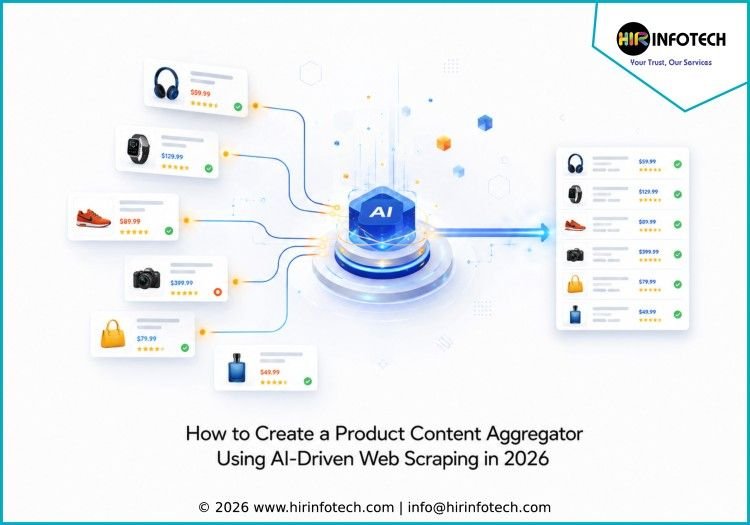
How to Create a Product Content Aggregator Using AI-Driven Web Scraping in 2026
Businesses that sell, compare, or analyse products across multiple sources know the core challenge well: product data is scattered, inconsistently structured, and changes constantly. Building a product content aggregator solves that problem systematically — and in 2026, AI-driven web scraping has made it faster, more accurate, and genuinely scalable to build one.
What Is a Product Content Aggregator?
A product content aggregator is a system that automatically collects, consolidates, and organises product information from multiple web sources into a single, structured dataset or platform. Depending on the business purpose, it might pull together product names, descriptions, pricing, availability, images, specifications, ratings, reviews, and category data from dozens — or hundreds — of sources simultaneously.
The applications are wide-ranging. eCommerce businesses use aggregators to monitor competitor pricing and product catalogues. Comparison platforms use them to build searchable product databases. Procurement teams use them to track supplier inventory and pricing shifts. Data teams use them to feed pricing intelligence tools, category management systems, or product matching engines.
The common thread is structured, reliable, multi-source product data — and that data foundation is built through web scraping.
Defining Your Aggregator’s Data Scope Before You Build
Before any technical work begins, the data scope needs to be clearly defined. This determines everything from which sources to target to how the pipeline should be structured and how frequently it needs to run.
Sources: Which websites, marketplaces, or platforms hold the product data you need? Consider whether they render content dynamically via JavaScript, whether they have login requirements, and whether their product pages follow consistent structures across categories.
Data points: What product fields matter for your use case? Common fields include product title, SKU or identifier, price, discount or offer details, availability status, product description, images, specifications, category taxonomy, brand, seller, ratings, and review count. Defining these upfront avoids rework downstream.
Update frequency: Some product data — particularly pricing and availability — changes daily or even hourly. Other content, such as product descriptions and specifications, is more static. Your scraping schedule should reflect these differences to avoid unnecessary load while maintaining data freshness where it matters.
Output format: How will the aggregated data be used? Whether the downstream application is a database, a business intelligence dashboard, an API feed, a price comparison tool, or a product information management system shapes the output schema you need to design for.
Getting these requirements defined clearly is the difference between a pipeline that delivers what the business needs and one that produces technically functional but practically useless data.
The Core Architecture of a Product Content Aggregator
A well-built product content aggregator typically consists of several interconnected components working as a coordinated pipeline.
Web Crawlers and Scrapers
The crawling layer visits target URLs and navigates product category pages, search results, and individual product listings. Scrapers then extract the defined data points from each page. In 2026, AI-driven scrapers are capable of identifying and extracting content without rigid predefined CSS selectors — adapting to page structure variations intelligently rather than breaking when a website updates its layout.
This adaptability matters significantly in multi-source aggregators. Different retailers and platforms structure their product pages differently. A scraper architecture that relies entirely on hardcoded selectors requires constant manual maintenance as source sites evolve. AI-assisted extraction models reduce that maintenance burden considerably.
Data Cleaning and Normalisation
Raw product data from multiple sources rarely arrives in a consistent format. Prices may use different currency symbols and decimal conventions. Category names vary across retailers. Product titles follow different naming conventions. Units of measurement are expressed differently. Specifications are organised in entirely different ways.
The normalisation layer resolves these inconsistencies — standardising field names, cleaning text, converting units, validating data types, and flagging or filling missing fields. This step is often underestimated, but it directly determines whether the aggregated dataset is actually usable for analysis, comparison, or display.
Deduplication and Product Matching
When aggregating product data across multiple sources, the same product often appears under different titles, with different identifiers, on different platforms. A product matching component identifies these duplicates and consolidates them under a single canonical product record — linking the different source listings to that record for comparison.
This is technically one of the harder problems in product aggregation, and it’s where AI-based matching approaches provide genuine advantages over rule-based deduplication, particularly for product catalogues with high variation in naming conventions or lack of consistent SKUs.
Storage and Delivery
Aggregated product data needs a structured home. Depending on scale and use case, this might be a relational database, a document store, a data warehouse, or a direct API feed. The delivery layer then makes that data available to downstream applications — whether that’s a price comparison interface, a business intelligence tool, a procurement platform, or an automated alerting system.
Key Technical Challenges and How AI-Driven Scraping Addresses Them
Building a product content aggregator at any meaningful scale encounters several technical obstacles that determine whether a pipeline runs reliably in production.
Dynamic content rendering. Many modern product pages load data through JavaScript frameworks rather than serving it in initial HTML. Traditional scrapers that parse static HTML miss this content. AI-driven scraping infrastructure handles JavaScript rendering natively, ensuring complete data extraction from dynamic product pages.
Anti-scraping mechanisms. High-traffic retail and marketplace websites deploy bot detection systems, CAPTCHAs, IP rate limiting, and fingerprinting to block automated access. Production-grade scraping pipelines manage these through rotating proxy infrastructure, request throttling, browser automation, and CAPTCHA-aware workflows — maintaining reliable access without triggering defensive responses.
Scale and scheduling. Aggregating product data across hundreds of source URLs on a defined schedule — whether hourly for pricing or daily for catalogue updates — requires infrastructure that handles concurrent requests, manages failures gracefully, and resumes without data loss. This is meaningfully different from running occasional one-off scrapes.
Source change management. Websites update their structures regularly. An aggregator pipeline that breaks silently every time a source updates its page layout creates data gaps that downstream systems won’t catch until the damage is already done. Monitoring for source changes and triggering alerts or automatic reconfigurations is an operational requirement, not an optional enhancement.
Compliance and Ethical Scraping Considerations
A product content aggregator built on web scraping operates within a legal and ethical framework that responsible providers take seriously.
Scraping publicly accessible product data — prices, descriptions, availability, specifications — is generally permissible in most jurisdictions, but the specifics depend on source terms of service, data use, and applicable regulations. Where scraped datasets include personal data, GDPR applies. The EU AI Act, coming into broader effect in 2026, introduces additional data sourcing requirements for businesses using scraped data in AI applications.
Responsible aggregator pipelines respect robots.txt configurations, avoid placing excessive load on target servers, conduct legal reviews of target sources before scraping, and maintain audit trails of what was collected and when. Working with a scraping provider that builds compliance into the pipeline architecture — rather than treating it as an afterthought — reduces both legal risk and reputational exposure.
How Hir Infotech Builds Product Content Aggregators
For businesses that need a production-ready product content aggregator without building internal scraping infrastructure from scratch, Hir Infotech offers AI-driven web scraping and data extraction services purpose-built for this kind of use case.
Hir Infotech’s approach begins with a structured scoping process — understanding the business objective, defining the target sources, mapping required data fields, and assessing the technical characteristics of each source. This upfront clarity prevents the rework that comes from treating aggregation projects as generic scraping tasks.
Their AI-powered extraction models handle dynamic content, adapt to structural variations across different source sites, and are supported by proxy infrastructure and CAPTCHA-aware workflows designed for reliable operation against protected websites. Data cleaning and normalisation are handled within the pipeline, delivering structured, analysis-ready output in formats including CSV, JSON, XML, or direct database and API integration.
Ongoing pipeline maintenance — including source change monitoring and scraper updates — is managed by their team, removing the operational burden from clients. For businesses in eCommerce, retail, travel, real estate, and related sectors that need scalable product data infrastructure, Hir Infotech provides both the technical capability and the subject understanding to deliver aggregators that work reliably in production.
Frequently Asked Questions
What types of product data can be aggregated through web scraping?
Most publicly accessible product information can be aggregated, including product names, pricing, availability, descriptions, images, specifications, categories, brand details, seller information, ratings, and review counts. The specific fields depend on what’s available on target source pages and what the business use case requires.
How often should a product content aggregator be updated?
Update frequency depends on the data type and use case. Pricing and availability data typically requires daily or more frequent updates given how quickly it changes. Product descriptions, specifications, and catalogue data change less frequently and can be updated on longer cycles. Well-designed pipelines use differentiated scheduling for different data types.
How does AI-driven scraping differ from traditional web scraping for product aggregation?
Traditional scrapers rely on predefined rules and CSS selectors tied to specific page structures. When source websites update their layouts, these scrapers break. AI-driven scraping uses intelligent extraction models that identify and extract data based on contextual understanding, adapting to structural variations more resilently and reducing ongoing maintenance requirements.
Can a product content aggregator handle hundreds of source websites?
Yes, with appropriately designed infrastructure. Scaling to hundreds of sources requires concurrent crawling, robust proxy management, failure handling, and scheduling systems that go beyond single-source scraping setups. Purpose-built managed scraping services are often more practical for this scale than in-house builds.
Is it legally compliant to build a product aggregator using web scraping?
Scraping publicly accessible product data is generally permissible, but compliance depends on source terms of service, data use, and jurisdiction. GDPR applies where personal data is involved. Responsible practice includes legal review of target sources, respecting robots.txt, and maintaining data audit trails. Working with a compliant scraping provider reduces risk significantly.
How does Hir Infotech support businesses building product content aggregators?
Hir Infotech provides end-to-end AI-driven web scraping services covering source scoping, custom scraper development, dynamic content handling, data cleaning and normalisation, structured output delivery, and ongoing pipeline maintenance. Their services are designed to handle multi-source aggregation at scale across eCommerce, retail, and related sectors.
Conclusion
Building a product content aggregator is fundamentally a data infrastructure project — and the quality of that infrastructure depends directly on how well the underlying web scraping pipeline is designed, maintained, and scaled. In 2026, AI-driven scraping has raised the standard considerably, making it possible to aggregate product content from complex, dynamic, multi-source environments with greater accuracy and less ongoing maintenance than traditional approaches required. Whether you’re building an internal pricing intelligence tool, a product comparison platform, or a procurement data system, getting the scraping foundation right determines whether the aggregator delivers business value consistently. Hir Infotech’s AI-driven web scraping capabilities provide a practical starting point for businesses that need reliable, structured product data without building that infrastructure entirely in-house.









