
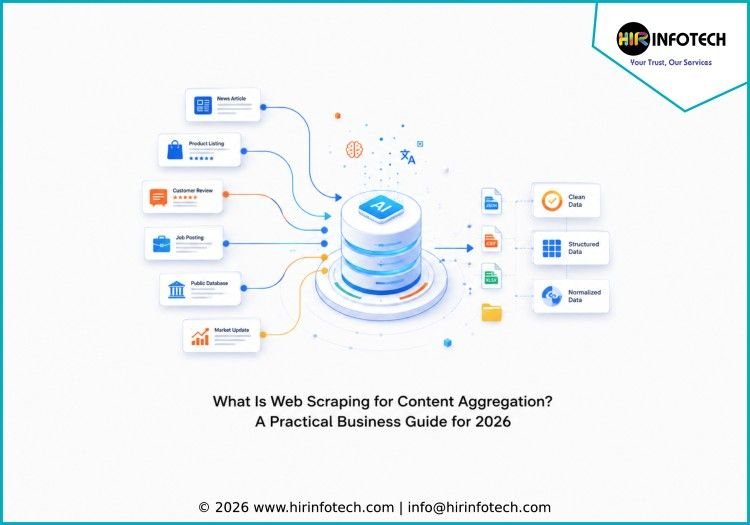
What Is Web Scraping for Content Aggregation? A Practical Business Guide for 2026
Introduction
Businesses today rely heavily on external digital data to make faster and more informed decisions. Web scraping for content aggregation helps organizations collect and organize large volumes of online information from multiple sources, enabling better market visibility, automation, analytics, and operational intelligence in increasingly data-driven environments.
What Is Web Scraping for Content Aggregation?
Web scraping for content aggregation is the process of automatically extracting data from multiple websites and consolidating it into a structured format for analysis, monitoring, reporting, or business operations.
Instead of manually collecting information from different online sources, businesses use automated scraping systems to gather:
- Articles
- Product listings
- Reviews
- Pricing data
- News content
- Market updates
- Public records
- Social discussions
- Directory information
- Metadata
The aggregated content is then processed, normalized, filtered, and stored in centralized systems for business use.
In 2026, content aggregation is no longer limited to simple data collection. Modern web scraping workflows involve AI-assisted extraction, dynamic rendering support, multilingual processing, and large-scale automation capabilities.
Why Businesses Use Content Aggregation in 2026
The digital economy generates enormous amounts of public online data every day. Businesses increasingly depend on aggregated web content to improve operational efficiency and competitive awareness.
Content aggregation supports several important business functions, including:
- Market research
- Competitor monitoring
- Price intelligence
- Trend analysis
- AI training datasets
- Brand monitoring
- Lead generation
- News aggregation
- Product catalog management
- Search engine indexing
Organizations that can efficiently collect and process large-scale web data often gain stronger visibility into changing market conditions.
How Web Scraping Works for Content Aggregation
Although workflows vary by use case, most content aggregation systems follow a similar process.
Source Identification
The first step involves identifying the websites, platforms, directories, or digital sources that contain the required information.
These may include:
- E-commerce platforms
- News websites
- Public databases
- Forums
- Job boards
- Review platforms
- Government portals
- Marketplaces
The quality of the aggregation project depends heavily on selecting reliable and relevant data sources.
Automated Data Extraction
Web scraping tools automatically access target web pages and extract relevant content elements.
This may include:
- Text
- Images
- Product details
- Structured tables
- Metadata
- URLs
- Ratings
- Reviews
- Prices
- Contact information
Modern websites often use dynamic rendering technologies, so advanced scraping systems frequently rely on headless browsers and browser automation tools.
Data Cleaning and Normalization
Raw scraped data is rarely ready for direct use.
Businesses usually need to:
- Remove duplicate entries
- Standardize formats
- Normalize categories
- Clean corrupted fields
- Translate multilingual content
- Validate records
- Organize structured outputs
This stage is critical for maintaining reliable analytics and operational consistency.
Aggregation and Storage
Once processed, the extracted data is consolidated into centralized systems such as:
- Databases
- Dashboards
- Data warehouses
- APIs
- Analytics platforms
- Search engines
- AI pipelines
Businesses can then use the aggregated content for reporting, automation, monitoring, or strategic decision-making.
Types of Content Commonly Aggregated Through Web Scraping
News and Media Content
Businesses monitor online publications to track:
- Industry developments
- Competitor announcements
- Market trends
- Public sentiment
- Regulatory changes
Real-time news aggregation is particularly valuable for finance, technology, logistics, and research-driven sectors.
Product and Pricing Data
Retailers and marketplaces aggregate product information to monitor:
- Pricing changes
- Stock availability
- Product descriptions
- Promotional campaigns
- Marketplace competition
This supports dynamic pricing and competitive intelligence strategies.
Customer Reviews and Public Feedback
Review aggregation helps businesses understand:
- Customer satisfaction
- Product issues
- Brand reputation
- Regional preferences
- Market sentiment
AI-driven sentiment analysis often depends on large-scale review aggregation pipelines.
Job Listings and Hiring Trends
Recruitment platforms and workforce analytics providers aggregate job data to analyze:
- Hiring demand
- Skill trends
- Salary benchmarks
- Regional workforce shifts
Research and Knowledge Databases
Educational and research organizations often aggregate public knowledge repositories, academic content, and industry publications for indexing and analysis purposes.
Benefits of Web Scraping for Content Aggregation
Faster Access to Large-Scale Data
Manual data collection is slow and difficult to scale.
Automated scraping systems can gather millions of records across multiple sources much faster than manual workflows.
Improved Market Visibility
Aggregated content helps businesses identify:
- Emerging trends
- Competitor strategies
- Customer behavior changes
- Pricing movements
- Demand patterns
This improves strategic planning and operational responsiveness.
Better Data Consistency
Structured aggregation workflows help standardize fragmented online information into usable formats for analytics and reporting.
Scalable Monitoring Capabilities
Businesses can continuously monitor digital ecosystems in near real time without requiring large manual research teams.
Stronger AI and Automation Workflows
Many AI applications rely on large, continuously updated datasets.
Web scraping supports:
- Machine learning models
- Search engines
- Recommendation systems
- Conversational AI
- Semantic analysis
- Predictive analytics
Common Challenges in Content Aggregation Projects
Dynamic Website Structures
Modern websites frequently change layouts, APIs, and rendering methods, which can disrupt scraping systems.
Anti-Bot Protection Systems
Many websites use:
- CAPTCHA challenges
- Rate limiting
- IP blocking
- Bot detection mechanisms
Reliable aggregation projects require infrastructure capable of handling these limitations responsibly.
Data Quality Problems
Without proper validation, aggregated datasets may contain:
- Missing records
- Duplicate entries
- Incorrect formatting
- Inconsistent categorization
Multi-Language and Regional Variations
Global aggregation projects often require handling:
- Multiple languages
- Different currencies
- Regional layouts
- Local terminology
- Varying compliance rules
Scalability and Maintenance
Large scraping systems require continuous maintenance, monitoring, and infrastructure optimization to remain reliable over time.
The Role of AI in Modern Web Scraping
AI is significantly changing how content aggregation systems operate.
Traditional scraping methods relied heavily on fixed extraction rules. Modern AI-assisted systems are more adaptive and capable of handling complex environments.
AI-driven scraping can support:
- Intelligent content recognition
- Layout adaptation
- Semantic categorization
- Language detection
- Automated deduplication
- Context-aware parsing
- Anomaly detection
- Smart extraction workflows
This reduces maintenance complexity and improves extraction accuracy.
Best Practices for Content Aggregation Projects
Define Clear Business Goals
Businesses should identify:
- Required data types
- Update frequency
- Delivery formats
- Reporting objectives
- Scalability expectations
This prevents unnecessary infrastructure complexity.
Prioritize Data Quality
Reliable datasets require:
- Validation workflows
- Deduplication logic
- Schema consistency
- Monitoring systems
- Error detection pipelines
Use Scalable Infrastructure
Large-scale aggregation often requires:
- Distributed crawling
- Cloud infrastructure
- Proxy management
- Queue orchestration
- Parallel processing
Maintain Responsible Scraping Practices
Businesses should follow ethical and compliance-aware data collection practices, including respectful crawl frequency and privacy-conscious workflows.
How Hir Infotech Supports Web Scraping for Content Aggregation
Hir Infotech provides web scraping solutions designed to support scalable content aggregation and structured data extraction workflows for modern business operations.
As online data environments become more complex, businesses increasingly require reliable systems capable of handling:
- Dynamic websites
- Large-scale crawling
- Real-time extraction
- Structured normalization
- Multi-source aggregation
- AI-assisted processing
- Long-term maintenance
Hir Infotech supports organizations by developing customized web scraping workflows tailored to specific aggregation requirements rather than relying on generic extraction scripts.
Their capabilities include:
- Automated data extraction pipelines
- Content aggregation systems
- Dynamic website scraping
- Structured data transformation
- Scalable crawling infrastructure
- Multi-language data handling
- API-ready outputs
- Monitoring and maintenance support
For businesses using aggregated content for analytics, AI systems, pricing intelligence, research, or operational automation, scalable and reliable web scraping infrastructure plays an increasingly important role in long-term data strategy.
Frequently Asked Questions
What is web scraping for content aggregation?
Web scraping for content aggregation is the automated process of collecting and organizing data from multiple online sources into structured datasets for analysis, monitoring, or operational use.
Is content aggregation legal?
Content aggregation depends on how the data is collected, stored, and used. Businesses should consider website terms, privacy regulations, and responsible data collection practices.
What types of businesses use web scraping for aggregation?
Many organizations use web scraping, including companies involved in analytics, e-commerce, research, AI development, media monitoring, and competitive intelligence.
Why is AI becoming important in web scraping?
AI improves extraction accuracy, supports dynamic website handling, automates classification, reduces maintenance complexity, and enhances multilingual processing capabilities.
What challenges are common in content aggregation projects?
Common challenges include dynamic websites, anti-bot systems, data quality issues, infrastructure scaling, multilingual content handling, and ongoing maintenance requirements.
Does Hir Infotech provide scalable web scraping solutions?
Yes. Hir Infotech provides web scraping services that support scalable content aggregation, structured data extraction, automation workflows, and long-term scraping infrastructure management.
Conclusion
Web scraping for content aggregation has become an essential business capability in 2026 as organizations increasingly depend on large-scale digital data for analytics, automation, AI systems, and operational intelligence. Effective aggregation workflows help businesses collect, organize, and process information from multiple online sources more efficiently and accurately.
However, successful content aggregation requires more than basic scraping scripts. Businesses need scalable infrastructure, reliable data processing workflows, ongoing maintenance, and intelligent extraction capabilities. Companies such as Hir Infotech help organizations build structured web scraping solutions that support long-term data collection, operational scalability, and modern content aggregation requirements.









