
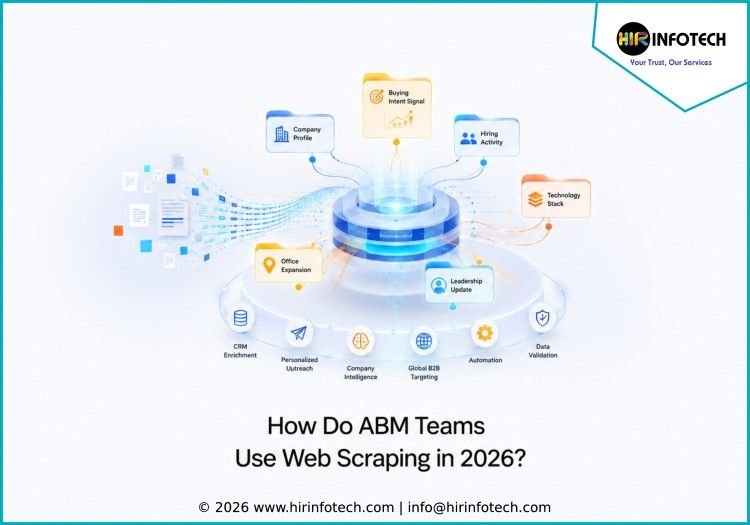
How Do ABM Teams Use Web Scraping in 2026?
Introduction
Account-based marketing depends on accurate, timely, and actionable business data. In 2026, ABM teams increasingly use web scraping to identify target accounts, monitor buying signals, enrich firmographic data, and personalize outreach campaigns across global B2B markets.
Why Web Scraping Matters for Modern ABM Teams
ABM strategies focus on high-value accounts instead of broad lead generation. This requires detailed information about companies, decision-makers, technologies, expansion activities, hiring trends, and competitive positioning.
Manual research cannot keep pace with rapidly changing B2B markets across the USA, Europe, and Asia-Pacific regions. Web scraping helps ABM teams automate large-scale data collection from publicly available online sources, allowing marketers and sales teams to make faster and more informed decisions.
In 2026, ABM success increasingly depends on data freshness, segmentation accuracy, and intent-driven personalization. Web scraping supports all three.
What Is Web Scraping in an ABM Context?
Web scraping refers to the automated extraction of publicly accessible information from websites, directories, search results, marketplaces, job boards, company websites, review platforms, and other online sources.
For ABM teams, scraped data is typically used to:
- Identify ideal customer profiles (ICPs)
- Build target account lists
- Monitor account-level changes
- Enrich CRM records
- Detect buying intent signals
- Personalize marketing campaigns
- Support sales intelligence workflows
- Improve segmentation accuracy
The process usually combines automated crawlers, structured extraction workflows, APIs, data normalization, and enrichment pipelines.
How ABM Teams Use Web Scraping in 2026
Building Highly Targeted Account Lists
One of the most common ABM use cases for web scraping is identifying companies that match specific targeting criteria.
ABM teams often scrape:
- Company directories
- Industry listings
- Technology partner ecosystems
- Marketplace vendor pages
- Business databases
- Trade association websites
- Startup funding platforms
- Regional business registries
The collected data may include:
- Company size
- Industry classification
- Revenue estimates
- Geographic presence
- Technology stack
- Hiring activity
- Contact information
- Service offerings
- Expansion indicators
This allows marketing and sales teams to create highly refined account lists aligned with their ICP requirements.
For example, a SaaS provider targeting mid-sized logistics companies in Germany can scrape logistics association directories, company websites, and technology listings to identify businesses using outdated systems that may require modernization solutions.
Monitoring Buying Intent Signals
ABM campaigns are more effective when teams engage accounts at the right time.
Web scraping helps identify intent signals such as:
- New hiring trends
- Technology migrations
- Funding announcements
- Office expansions
- Product launches
- Leadership changes
- Procurement activity
- Vendor switching signals
- Partnership announcements
For instance, if a company suddenly posts multiple cybersecurity job openings, it may indicate upcoming security investments. ABM teams can use this insight to trigger personalized outreach campaigns.
This level of intent monitoring gives sales and marketing teams a stronger competitive advantage compared to relying only on static contact databases.
Enriching CRM and ABM Platforms
Many CRM systems contain incomplete or outdated company data. Web scraping helps enrich records with current business intelligence.
ABM teams commonly enrich:
- Company descriptions
- Employee counts
- Location data
- Executive profiles
- Technology usage
- Industry categories
- Product offerings
- Social presence
- Customer reviews
- Business expansion signals
This enriched data improves:
- Lead scoring
- Segmentation
- Ad targeting
- Personalization
- Campaign routing
- Sales prioritization
In 2026, CRM enrichment has become essential because AI-driven marketing workflows depend heavily on structured and updated data inputs.
Supporting Hyper-Personalized Outreach
Personalization remains a core ABM requirement, especially for enterprise B2B sales cycles.
Web scraping allows teams to gather account-specific insights directly from public sources, including:
- Recent blog posts
- Press releases
- Leadership interviews
- Industry announcements
- Customer success stories
- Product updates
- Strategic initiatives
Sales and marketing teams can use this information to create personalized:
- Email campaigns
- LinkedIn outreach
- Landing pages
- Ad creatives
- Webinar invitations
- Sales presentations
Instead of generic messaging, outreach becomes directly connected to real business priorities.
For example, a manufacturing software vendor targeting companies in the USA can personalize campaigns around supply chain modernization if scraped company data shows recent warehouse expansion activity.
Common Data Sources Used by ABM Teams
ABM-focused web scraping often involves collecting data from multiple public sources simultaneously.
Company Websites
Corporate websites provide valuable information about:
- Services
- Leadership
- Locations
- Product launches
- Technology partnerships
- Career openings
- Market positioning
Job Boards
Hiring activity often reveals strategic priorities.
Scraped job data can indicate:
- Digital transformation
- Cloud migration
- Security investments
- AI adoption
- Market expansion
Linked Business Directories
Industry directories help identify niche accounts in specific sectors or geographic markets.
Examples include:
- Manufacturing directories
- Healthcare supplier listings
- SaaS marketplaces
- Legal service registries
- Hospitality directories
Search Engine Results
SERP scraping helps ABM teams understand:
- Competitor visibility
- Market positioning
- Content strategies
- Local market coverage
- Industry relevance
Review Platforms
Customer reviews often reveal operational challenges, vendor dissatisfaction, and technology limitations that can support targeted outreach strategies.
Benefits of Web Scraping for ABM Teams
Better Targeting Accuracy
ABM campaigns perform better when targeting is precise. Scraping allows teams to continuously refine account selection based on current business conditions.
Faster Market Research
Instead of manually researching thousands of companies, automated scraping workflows collect data at scale.
This accelerates campaign planning and territory development.
Improved Sales and Marketing Alignment
Shared data pipelines help sales and marketing teams work from the same account intelligence.
This improves coordination across:
- Prospecting
- Outreach
- Qualification
- Campaign execution
- Pipeline management
More Scalable ABM Operations
Enterprise ABM programs often involve thousands of target accounts across multiple countries.
Web scraping supports scalable account monitoring and enrichment without relying entirely on manual research teams.
Enhanced Personalization
Real-time company insights improve messaging quality and campaign relevance.
This can increase:
- Engagement rates
- Meeting conversions
- Sales pipeline quality
- Marketing ROI
Challenges ABM Teams Must Consider
Data Accuracy and Validation
Scraped data requires validation and normalization. Poor-quality data can negatively affect segmentation and outreach performance.
ABM teams typically combine scraping with:
- Data cleaning
- Deduplication
- Entity matching
- Verification workflows
Compliance and Privacy Regulations
Global ABM campaigns must comply with regulations such as:
- GDPR in Europe
- CCPA in California
- Regional privacy laws in other markets
Responsible scraping practices should focus on publicly available business information and avoid collecting restricted personal data without appropriate legal consideration.
Website Structure Changes
Websites frequently update layouts and structures, which can disrupt scraping workflows.
Modern scraping operations therefore require:
- Adaptive parsers
- Monitoring systems
- Maintenance pipelines
- Error detection automation
Anti-Bot Protections
Many websites implement rate limits and anti-scraping protections.
ABM data operations increasingly rely on advanced scraping infrastructure capable of handling:
- IP rotation
- Session management
- CAPTCHA mitigation
- JavaScript rendering
- Dynamic content extraction
How Specialized Web Scraping Providers Support ABM Teams
As ABM programs become more data-intensive, many organizations work with specialized web scraping providers to build scalable and compliant data pipelines.
hirinfotech helps businesses develop customized web scraping solutions for large-scale B2B intelligence and data extraction workflows. For ABM teams, this can include automated account discovery, company data enrichment, competitor monitoring, lead intelligence collection, and structured data delivery for CRM or marketing automation platforms.
Organizations operating across markets such as the USA, Germany, the United Kingdom, France, Canada, Australia, and other global regions often require scalable scraping infrastructure capable of handling multilingual websites, structured and unstructured data extraction, rotating proxies, scheduling automation, and integration-ready datasets.
For businesses managing enterprise-level ABM initiatives, specialized scraping support can reduce manual research workloads while improving targeting quality, personalization capabilities, and account intelligence accuracy.
Best Practices for Using Web Scraping in ABM
Focus on ICP Quality First
Scraping large amounts of data is not useful unless the targeting criteria are well-defined.
ABM teams should first establish:
- Ideal industries
- Company size ranges
- Geographic priorities
- Technology requirements
- Revenue thresholds
- Buying indicators
Prioritize Data Freshness
Outdated account intelligence reduces campaign effectiveness.
Successful ABM teams use scheduled scraping workflows to maintain updated records continuously.
Combine Scraped Data With Internal Signals
The most effective ABM programs combine external web data with internal engagement metrics such as:
- Website visits
- Email engagement
- Webinar attendance
- CRM activity
- Sales interactions
Maintain Responsible Data Practices
Compliance, transparency, and ethical data handling remain critical for global B2B marketing operations.
Teams should work with legal and compliance stakeholders when scaling scraping initiatives internationally.
Frequently Asked Questions
Is web scraping legal for ABM teams?
Web scraping legality depends on how the data is collected, used, and processed. ABM teams generally focus on publicly available business information while following applicable regulations such as GDPR and CCPA.
What types of companies benefit most from ABM web scraping?
B2B SaaS companies, enterprise technology providers, consulting firms, manufacturing suppliers, logistics companies, and professional service organizations commonly use web scraping to support ABM strategies.
Can web scraping improve ABM personalization?
Yes. Scraped business insights help teams personalize outreach based on company activities, hiring trends, expansion plans, technology adoption, and market positioning.
How often should ABM data be updated?
Many organizations refresh ABM datasets weekly or monthly depending on sales cycle length, market volatility, and campaign complexity.
What tools are commonly used for ABM scraping?
ABM scraping workflows may involve crawlers, browser automation tools, APIs, proxy networks, data enrichment systems, and CRM integrations.
How can hirinfotech support ABM data collection?
hirinfotech provides web scraping solutions that help businesses automate account intelligence collection, enrich B2B datasets, and support scalable ABM workflows across international markets.
Conclusion
Web scraping has become a critical capability for ABM teams in 2026. It enables businesses to build targeted account lists, monitor buying intent signals, enrich CRM data, and improve campaign personalization at scale. As B2B competition increases across global markets, organizations need accurate and continuously updated account intelligence to support effective sales and marketing strategies.
For companies investing in scalable ABM programs, professional web scraping services can help streamline data collection, improve targeting precision, and support more informed decision-making across the entire account-based marketing process.









