
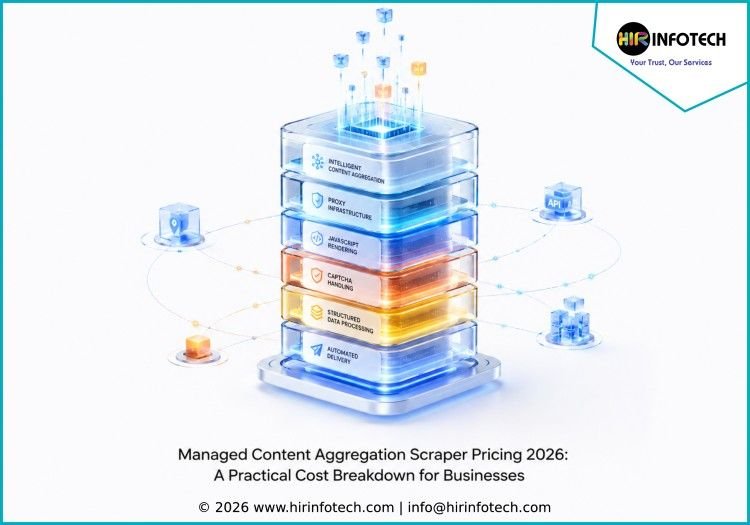
Managed Content Aggregation Scraper Pricing 2026: A Practical Cost Breakdown for Businesses
Introduction
Businesses across retail, real estate, and market intelligence rely on automated content aggregation to stay competitive. But estimating the cost of a managed content aggregation scraper—one that handles proxies, parsing, and delivery—requires understanding several moving parts. This guide provides practical pricing estimates based on real 2026 market data.
What a Managed Content Aggregation Scraper Actually Includes
Before discussing costs, it is essential to clarify what “managed” means in this context. Unlike DIY scraping, where your team builds and maintains the entire infrastructure, a managed solution includes:
- Proxy infrastructure (residential or datacenter) with automatic rotation
- CAPTCHA solving and anti-bot bypass mechanisms
- JavaScript rendering for modern, dynamic websites
- Data parsing and structuring into usable formats (JSON, CSV, XML)
- Monitoring and alert systems for extraction failures
- Ongoing maintenance when target websites change their structure
When you pay for a managed content aggregation scraper, you are primarily paying to avoid the engineering overhead of keeping scrapers operational .
Core Pricing Models in 2026
The web scraping industry has matured significantly. In 2026, providers typically use one of four pricing models, each suited to different usage patterns.
Subscription-Based Pricing
Monthly subscriptions are the most common entry point. These plans include a fixed number of API credits, page requests, or compute units each month. Overages are billed separately.
Current market examples show subscription entry points ranging from $29 to $99 per month for small-scale needs . Mid-tier business subscriptions typically fall between $149 and $299 monthly, covering hundreds of thousands to a few million requests .
Consumption-Based (Pay-As-You-Go)
Consumption-based pricing charges only for what you use. This model works well for variable workloads or one-time extraction projects. Per-request costs are generally higher than the effective per-unit cost of committed subscriptions—often by 20 to 40 percent .
For occasional scraping needs, consumption-based pricing can be more economical. For predictable, ongoing extraction, subscription or committed plans typically offer better value.
Pay-Per-Result (PPE)
An increasingly popular model in 2026 is pay-per-result pricing, particularly for structured data extraction. Instead of paying for requests or compute time, you pay for each completed data record—for example, per product listing, per job posting, or per real estate property .
PPE pricing typically ranges from $0.003 to $0.02 per record, depending on source complexity . This model includes proxy costs and anti-bot handling, making it highly predictable for budgeting.
Custom Enterprise Pricing
For large-scale operations exceeding one million pages monthly, enterprise agreements are negotiated individually. These contracts often include committed minimum spend, volume-based discounting, dedicated infrastructure, and service-level agreements .
Key Cost Drivers for Content Aggregation Projects
Several factors significantly influence the final price of a managed content aggregation solution.
Source Website Complexity
The single largest cost variable is the technical difficulty of your target sources. Static HTML pages are inexpensive to scrape. JavaScript-heavy single-page applications, sites with advanced anti-bot defenses, or platforms requiring authentication cost substantially more.
For JavaScript rendering, expect to pay 5 to 25 times more per request compared to standard requests . If your aggregation requires residential proxies rather than datacenter IPs, bandwidth costs increase by approximately 300 to 400 percent .
Data Volume and Frequency
Volume drives cost directly. Scraping a few thousand pages monthly places you in entry-level pricing. Hundreds of thousands of pages moves you to mid-tier subscriptions. Millions of pages monthly requires enterprise negotiation.
Frequency matters equally. One-time extractions are cheaper per project than continuous monitoring, which requires ongoing infrastructure and maintenance. Real-time or sub-hourly monitoring commands premium pricing due to the operational intensity .
Data Processing Requirements
Raw HTML extraction costs less than fully cleaned, deduplicated, and enriched datasets. If you require entity resolution, sentiment analysis, or integration with your existing data warehouse, budget additional costs. Many providers charge separately for heavy post-processing or offer it only in higher-tier plans .
Practical Pricing Estimates for 2026
Based on current market data, here are realistic monthly cost ranges for managed content aggregation solutions.
Small-Scale Aggregation
For monitoring a handful of competitor websites, tracking dozens of products, or running weekly extraction from a few sources: Expect to pay between $50 and $200 per month. At this scale, pay-per-result or entry-level subscriptions are appropriate .
Mid-Scale Aggregation
For daily extraction from dozens of sources, monitoring thousands of products or listings, or maintaining ongoing market intelligence feeds: Typical monthly costs range from $250 to $1,000. Most businesses at this scale use business-tier subscriptions or committed consumption plans .
Large-Scale Aggregation
For enterprise operations extracting from hundreds of sources, processing millions of pages monthly, or requiring real-time monitoring across multiple markets: Monthly costs typically start at $2,000 and can reach $10,000 or more. These deployments use custom enterprise agreements with volume-based pricing .
One-Time Projects
For single data collection initiatives—such as building an initial database or conducting market research—one-time projects range from $500 for simple extractions to $15,000 or more for complex, multi-source aggregation requiring significant processing .
Hir Infotech: Managed Content Aggregation Expertise
For organizations seeking a reliable partner in managed data aggregation, Hir Infotech brings over 13 years of specialized experience in web scraping and raw data services. With a track record of serving 2,745+ clients across the USA, Europe, and Australia, the company has deployed more than 2,300 web scraping solutions and processes over 3.1 million records daily .
Hir Infotech’s approach to managed content aggregation combines AI-driven extraction technology with human expertise. The company handles the full lifecycle: proxy infrastructure, CAPTCHA solving, JavaScript rendering, data parsing, and ongoing maintenance. Their global distributed infrastructure spans three major markets, ensuring compliance with regional regulations including GDPR and CCPA while maintaining 99.8 percent scraping uptime .
What distinguishes Hir Infotech in the managed aggregation space is its end-to-end capability. Unlike platforms that require customers to manage their own scrapers or integrate multiple tools, Hir Infotech delivers structured, analysis-ready data directly. Their portfolio includes large-scale projects—monitoring 125,000 products on Amazon, extracting from 375 government websites, and scraping 62 e-commerce sites for affiliate aggregation . For business decision-makers evaluating managed content aggregation, Hir Infotech offers the technical depth and operational scale required for reliable, long-term data partnerships.
Frequently Asked Questions
What is the cheapest way to get a content aggregation scraper?
DIY scraping using open-source tools like Scrapy or BeautifulSoup has the lowest monetary cost—server expenses from $10 to $50 monthly. However, factor in engineering time for development and ongoing maintenance. For most businesses, a managed solution becomes cost-effective once you value your team’s hours .
Does data frequency affect pricing significantly?
Yes. Continuous or real-time scraping costs more than one-time extraction because it requires persistent infrastructure, monitoring, and maintenance. Most providers charge higher recurring fees for ongoing aggregation compared to single projects .
Are there hidden costs in managed scraping services?
Common additional costs include premium proxy upgrades (residential IPs cost significantly more than datacenter), overage fees for exceeding subscription limits, and custom extraction setup fees. Always request a detailed rate card before committing .
What compliance considerations affect scraping costs?
GDPR, CCPA, and other data protection regulations may require compliance measures such as data anonymization, consent verification, or legal review. Professional managed services incorporate compliance into their pricing, whereas DIY approaches may expose you to regulatory risk .
How do I estimate my monthly scraping volume?
Calculate the number of target pages multiplied by extraction frequency. For example, monitoring 1,000 product pages daily equals approximately 30,000 page requests monthly. Add 20 to 30 percent for retries, JavaScript rendering, or pagination traversal.
Conclusion
Estimating the cost of a managed content aggregation scraper requires a clear understanding of your data sources, volume requirements, and processing needs. In 2026, businesses can choose from subscription, consumption-based, pay-per-result, or custom enterprise models, with monthly costs ranging from under $200 for small-scale needs to over $10,000 for enterprise deployments.
The key to accurate budgeting is distinguishing between simple and complex sources. Static pages from standard websites are inexpensive. JavaScript-heavy platforms with anti-bot defenses command premium pricing. For organizations seeking predictable, reliable raw data services without in-house scraping teams, partnering with a specialist like Hir Infotech provides a cost-effective path forward. With over a decade of experience, global infrastructure, and a compliance-first approach, Hir Infotech delivers the expertise required to turn web content into actionable business intelligence.









