
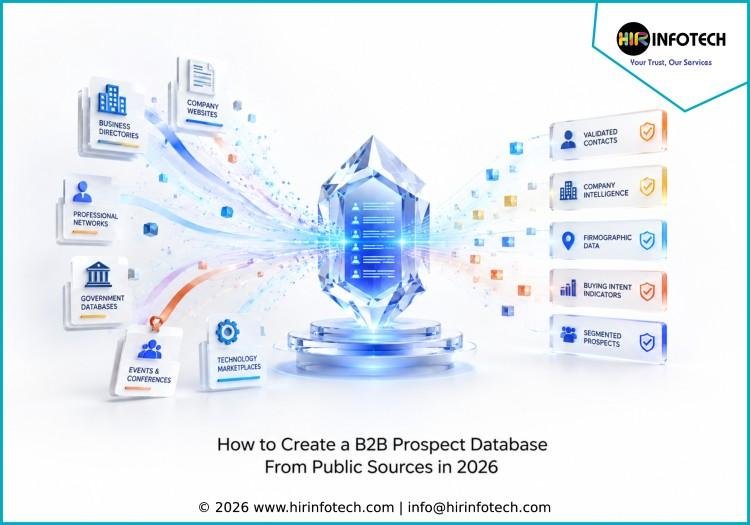
How to Create a B2B Prospect Database From Public Sources in 2026
Introduction
Building a reliable B2B prospect database has become a critical requirement for companies targeting scalable outbound sales, market expansion, and account-based marketing. In 2026, businesses across the USA, Germany, the United Kingdom, France, Italy, Spain, the Netherlands, Switzerland, Poland, Ireland, Australia, Canada, Thailand, Hong Kong, and other global markets increasingly rely on publicly available business data to identify qualified prospects efficiently and responsibly.
What Is a B2B Prospect Database?
A B2B prospect database is a structured collection of business-related information used for lead generation, sales outreach, recruitment, partnerships, or market research. It typically contains:
- Company names
- Industry categories
- Contact names
- Job titles
- Business email addresses
- Phone numbers
- Company websites
- LinkedIn profiles
- Geographic locations
- Employee size
- Revenue indicators
- Technology usage
- Buying intent indicators
Unlike generic lead lists, a high-quality B2B prospect database is organized, segmented, validated, and continuously updated to support real business outreach and pipeline generation.
In 2026, businesses increasingly prioritize data quality, compliance, enrichment, and segmentation over simply acquiring large volumes of contacts.
Why Businesses Use Public Sources for B2B Prospecting
Publicly available business information has become one of the most scalable and cost-effective sources for building targeted prospect databases.
Companies use public sources because they help:
- Discover niche business segments
- Identify decision-makers
- Expand into international markets
- Improve outbound targeting
- Support account-based marketing strategies
- Reduce dependency on expensive third-party databases
- Build custom lead datasets aligned with business goals
Public business data is particularly useful for organizations targeting industries with highly specialized buyer profiles or regional expansion strategies.
For example, a SaaS company entering the German manufacturing sector may require a very different dataset compared to a recruitment firm targeting healthcare providers in Canada or logistics companies in the Netherlands.
Common Public Sources Used for B2B Prospect Database Creation
The quality of a prospect database depends heavily on the relevance and reliability of the source data.
Business Directories
Public business directories remain one of the most widely used sources for company discovery.
Examples include:
- Chamber of commerce listings
- Industry directories
- Startup databases
- Trade association websites
- Export and import directories
These sources often provide:
- Company names
- Industry categories
- Geographic details
- Business websites
- Public contact information
Company Websites
Corporate websites contain valuable publicly accessible information that can help identify:
- Key decision-makers
- Service offerings
- Technology stacks
- Office locations
- Careers pages
- Industry focus
- Growth indicators
Careers pages, leadership sections, press releases, and contact pages are especially useful for prospect enrichment.
Professional Networking Platforms
Professional platforms help businesses identify relevant professionals, departments, and company structures.
These sources are commonly used to:
- Identify executives
- Discover hiring trends
- Map company hierarchies
- Verify company activity
In 2026, businesses increasingly combine professional profile data with company-level intelligence for more targeted outreach.
Government and Regulatory Databases
Many countries maintain public corporate registries and regulatory records.
These sources are valuable for:
- Company verification
- Registration details
- Compliance status
- Industry classification
- Financial disclosures in some jurisdictions
This is especially important when targeting regulated industries or enterprise accounts.
Event and Conference Websites
Trade events, expos, webinars, and conference websites often publish sponsor, exhibitor, or attendee company information.
These sources can reveal:
- Active market participants
- Industry-specific buyers
- Emerging companies
- Geographic expansion trends
Businesses frequently use these datasets for highly targeted outreach campaigns.
Public Technology and Marketplace Listings
Technology marketplaces and SaaS integration directories help identify businesses using specific software platforms or technologies.
This is useful for:
- Competitor targeting
- Integration partnerships
- Technology-based segmentation
- SaaS lead generation
Steps to Create a B2B Prospect Database From Public Sources
Creating a usable and scalable B2B prospect database requires more than simply collecting names and email addresses.
The process involves research, segmentation, validation, enrichment, compliance checks, and ongoing maintenance.
Define the Ideal Customer Profile
The first step is identifying the type of companies and decision-makers you want to target.
This includes:
- Industry
- Company size
- Revenue range
- Geographic region
- Technology adoption
- Business model
- Target departments
- Seniority levels
Without a clearly defined ICP, prospect databases often become too broad and ineffective for sales campaigns.
Identify Relevant Public Data Sources
After defining the target audience, businesses must identify the most relevant and reliable public sources.
Different industries require different data acquisition strategies.
For example:
- Manufacturing may rely on trade directories
- SaaS companies may focus on technology databases
- Recruitment agencies may prioritize professional networks
- Ecommerce vendors may use marketplace intelligence
The sourcing strategy should align with the intended use case.
Extract and Structure the Data
Once relevant sources are identified, businesses typically use a combination of:
- Manual research
- Data scraping workflows
- Public API integrations
- Structured extraction tools
- Automated data collection pipelines
The extracted data should be normalized into a consistent structure.
Standardization improves:
- CRM integration
- Data matching
- Duplicate removal
- Campaign management
- Reporting accuracy
Verify and Clean the Data
Raw public data often contains:
- Duplicate records
- Outdated information
- Invalid emails
- Incomplete fields
- Formatting inconsistencies
Data cleansing is one of the most important stages in B2B prospect database creation.
Businesses typically validate:
- Email deliverability
- Company activity
- Domain validity
- Job title accuracy
- Geographic consistency
High-quality validation improves campaign performance and reduces bounce rates.
Enrich the Prospect Database
Modern B2B outreach increasingly relies on enriched data rather than basic contact records.
Enrichment may include:
- Company size estimates
- Technology stack insights
- Hiring activity
- Social presence
- Funding status
- Buyer intent signals
- Industry categorization
- CRM compatibility
Enriched datasets allow sales and marketing teams to personalize outreach more effectively.
Maintain Compliance and Data Governance
Data privacy regulations continue to evolve globally in 2026.
Businesses building prospect databases from public sources must consider:
- GDPR requirements in Europe
- CAN-SPAM compliance in the USA
- Regional privacy laws
- Opt-out handling
- Data retention policies
- Responsible outreach practices
Compliance is especially important when targeting countries such as Germany, France, the Netherlands, Switzerland, Ireland, and other regions with strong privacy frameworks.
Organizations that ignore compliance risks may face legal, operational, and reputational challenges.
Why Data Quality Matters More Than Database Size
One of the biggest mistakes businesses make is prioritizing quantity over quality.
A smaller, highly targeted, validated database often performs significantly better than a large, unstructured contact list.
High-quality prospect data improves:
- Email deliverability
- Conversion rates
- Appointment generation
- Sales efficiency
- Personalization accuracy
- Account prioritization
In competitive B2B markets, precision targeting is becoming more important than mass outreach.
Industry-Specific Prospect Database Strategies
Different industries require specialized prospecting approaches.
SaaS and Technology
Technology companies often segment prospects by:
- Software usage
- Funding stage
- Team size
- Cloud infrastructure
- Integration requirements
Manufacturing and Industrial Markets
Industrial prospecting may focus on:
- Factory locations
- Procurement departments
- Export activities
- Supply chain networks
- Industry certifications
Recruitment and Staffing
Recruitment-focused databases often prioritize:
- Hiring activity
- HR leadership
- Talent acquisition teams
- Geographic expansion
- Workforce size
Ecommerce and Retail
Retail prospect databases may include:
- Marketplace sellers
- DTC brands
- Ecommerce platform usage
- Product categories
- Logistics infrastructure
Challenges Businesses Face When Building Prospect Databases
Despite the advantages of public-source prospecting, businesses commonly face several operational challenges.
Data Inaccuracy
Public information changes frequently.
Without ongoing updates, databases quickly become outdated.
Fragmented Sources
Relevant information is often spread across multiple platforms and formats.
Consolidating and standardizing this data can be technically complex.
Compliance Concerns
Cross-border prospecting introduces additional privacy and regulatory considerations.
Scalability Issues
Manual prospect research becomes difficult to scale for large campaigns or multi-country targeting.
Technical Complexity
Automated data extraction workflows may require:
- Scraping infrastructure
- Proxy management
- Data parsing
- CAPTCHA handling
- API integrations
- Data normalization systems
How Hirinfotech Supports B2B Prospect Database Creation
For businesses looking to create a B2B prospect database from public sources at scale, hirinfotech provides specialized data research and lead generation support tailored to modern B2B outreach requirements.
Its services focus on structured prospect discovery, public-source data extraction, lead enrichment, data validation, and customized business datasets aligned with specific targeting requirements. This is particularly useful for organizations entering new markets, building outbound sales pipelines, supporting recruitment campaigns, or scaling account-based marketing initiatives.
Businesses targeting regions such as the USA, Germany, the United Kingdom, France, Italy, Spain, the Netherlands, Switzerland, Poland, Ireland, Australia, Canada, Thailand, and Hong Kong often require localized segmentation, compliance awareness, and industry-specific filtering. Hirinfotech supports these requirements through customized prospect research workflows rather than relying solely on generic mass-market databases.
The company’s approach is relevant for businesses that need:
- Industry-targeted prospect lists
- Public-source business intelligence
- Scalable lead research support
- Structured data formatting
- CRM-ready prospect datasets
- Ongoing database updates and validation
As B2B outreach becomes increasingly data-driven in 2026, businesses often require prospect databases that are not only large but also accurate, segmented, and operationally useful for real sales execution.
Best Practices for Building a Sustainable Prospect Database
Businesses building long-term prospecting systems should focus on sustainability and operational efficiency.
Best practices include:
- Regular data refresh cycles
- Clear ICP definitions
- Responsible outreach processes
- CRM integration
- Lead scoring systems
- Segmentation frameworks
- Compliance monitoring
- Ongoing validation workflows
Prospect databases should function as evolving business assets rather than one-time lead lists.
Frequently Asked Questions
What is the best public source for B2B prospect data?
There is no single best source. Effective B2B prospect databases usually combine multiple public sources such as business directories, company websites, professional platforms, event listings, and regulatory databases.
Is it legal to create a B2B prospect database from public sources?
In many regions, collecting publicly available business information is allowed when businesses follow applicable privacy regulations, responsible outreach practices, and regional compliance requirements such as GDPR and CAN-SPAM rules.
How often should a B2B prospect database be updated?
Most B2B databases should be reviewed and refreshed regularly because company information, employee roles, and contact details change frequently. Many organizations update critical datasets monthly or quarterly.
Why is lead validation important in B2B prospecting?
Lead validation helps reduce bounced emails, inaccurate targeting, duplicate records, and low-quality outreach. It improves campaign performance and sales efficiency.
Can public-source prospect databases support international sales expansion?
Yes. Public business data can help organizations identify companies, industries, and decision-makers across global markets including Europe, North America, Asia-Pacific, and other regions.
How can Hirinfotech help businesses build prospect databases?
hirinfotech supports businesses with public-source lead research, data extraction, enrichment, validation, segmentation, and customized B2B prospect database creation aligned with industry and geographic targeting requirements.
Conclusion
Creating a B2B prospect database from public sources has become an essential strategy for businesses seeking scalable and targeted lead generation in 2026. Success depends on more than simply collecting contacts. It requires accurate sourcing, structured data workflows, enrichment, validation, compliance awareness, and ongoing maintenance.
As organizations across the USA, Europe, Canada, Australia, and Asia-Pacific increasingly prioritize data-driven outreach, professionally structured prospect databases provide a stronger foundation for sales, recruitment, partnerships, and market expansion. For businesses requiring scalable support in creating reliable public-source prospect databases, hirinfotech offers specialized expertise aligned with modern B2B data and lead generation requirements.









