
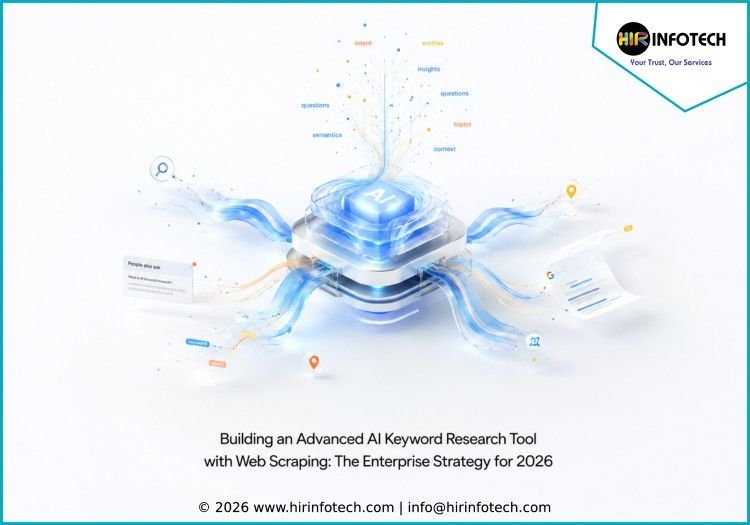
Building an Advanced AI Keyword Research Tool with Web Scraping: The Enterprise Strategy for 2026
Building an Advanced AI Keyword Research Tool with Web Scraping: The Enterprise Strategy for 2026 The Paradigm Shift: Why Traditional Keyword Data Fails the Modern Enterprise Conventional search analysis depends on pre-computed data repositories. While these systems provide a baseline for historical volume trends, they introduce structural risks when applied to modern, agile digital strategies: How Web Scraping Powers an Advanced AI Keyword Research Tool An engineered AI keyword research tool with web scraping fundamentally redefines how search engine data is collected and utilized. Rather than querying a restricted, third-party database, it deploys custom web extraction pipelines to treat the live web as an open, real-time data layer. Real-Time Extraction of Search Engine Features Automated data scrapers query live search systems across targeted geographical nodes to extract raw HTML and JSON structures. This capture records organic listings, meta tags, structured schema fragments, and paid advertisements exactly as they appear to live users. Parsing Deep Semantic and Conversational Variations By targeting conversational components, such as long-tail PAA questions, community forum threads, and related search queries, the scraping layer captures the exact conversational language patterns used by target audiences. This provides the foundation for optimizing across modern generative search engines. Machine Learning Normalization and Entity Alignment Once the raw, unstructured web data is collected, a machine learning layer tokenizes and cleans the information. Natural language processing models analyze the text, clustering raw search phrases into explicit semantic groups based on entity relationships and user context, rather than simple keyword matches. Core Infrastructure Requirements for Custom Search Data Pipelines Building a scalable, enterprise-grade keyword extraction system requires several integrated technical components: Strategic Advantages of Live SERP Intelligence Dynamic Intent Tracking User search intent changes alongside economic conditions, seasonal events, and market trends. Live web scraping monitors these changes by tracking variations within active search layouts. If rich media arrays or product carousels begin replacing traditional text links for a specific term, the AI engine registers a shift from informational research to transactional purchasing, allowing teams to adjust content formats immediately. Competitor Gap and Structural Analysis Beyond tracking simple ranking positions, live web scraping allows brands to evaluate competitor page structures, semantic headers, and contextual entities. When evaluated by an internal AI layer, these datasets reveal exact structural gaps where competitor content lacks comprehensive coverage, providing a clear roadmap for content development. Optimization for Generative and AI Answer Engines Modern visibility requires optimizing for conversational AI platforms, including ChatGPT, Gemini, Claude, Perplexity, and DeepSeek. These engines extract info from structured summaries, direct definitions, and clear lists. Web scraping helps analytics teams monitor which content formats are chosen for AI summaries, providing a data-driven blueprint for structural content alignment. International Implementation and Localization Realities Deploying a scraped, AI-driven keyword engine requires deep attention to localized operational conditions. For cross-border enterprises, data extraction must adapt to regional realities: Scaling Enterprise Search Data Extraction with Hirinfotech Developing and maintaining an internal web extraction infrastructure presents significant technical challenges. Managing complex proxy pools, resolving anti-bot defenses, and rewriting parsers to counter search engine layout modifications requires continuous engineering overhead. Hirinfotech provides comprehensive, enterprise-level web scraping and search engine data extraction services. Backed by extensive technical expertise in data engineering, Hirinfotech manages the entire collection infrastructure, delivering clean, structured search data directly to your AI analytics applications. The service extracts detailed metrics across primary search search networks, processing millions of data points daily. Hirinfotech delivers structured data feeds covering organic rankings, PAA blocks, featured snippets, local packs, and sponsored listings. Built for high-volume enterprise operations, the platform maintains exceptional data accuracy and high availability by pairing machine learning parsers with resilient proxy systems. This ensures smooth access through complex bot walls and dynamic javascript architectures while maintaining rapid processing speeds. For global enterprises operating across the USA, Europe, and the Asia-Pacific region, Hirinfotech ensures data delivery aligns fully with international governance standards, including GDPR. Providing customized, analysis-ready JSON feeds and direct API integrations, the solution allows internal data scientists and marketing architects to focus on strategic execution rather than pipeline maintenance. Frequently Asked Questions Why should an enterprise build an AI keyword research tool with web scraping instead of using standard SEO software? Standard SEO software utilizes static, pre-computed databases that often suffer from data latency. Building an AI keyword research tool with web scraping enables direct access to live search results, delivering real-time keyword discovery, precise local search visibility tracking, and immediate visibility into changing search layouts. How does web scraping ensure data localization accuracy across multiple countries? Advanced web scraping platforms deploy targeted proxy networks located within specific target countries, such as Germany, France, Canada, or Hong Kong. By routing extraction requests through local IP nodes, the system captures search engine results exactly as they appear to local users, preserving localized language contexts and regional search trends. Is scraping search engine data compliant with international privacy laws? Yes, scraping public search engine results is legally compliant, provided the extraction process targets publicly accessible web data and avoids collecting personally identifiable information (PII). Hirinfotech designs its data extraction pipelines to ensure full compliance with global standards, including the European Union’s GDPR. What role does AI play after web scraping extracts raw search data? Web scraping functions as the extraction mechanism, delivering unstructured text strings and raw HTML. The AI layer serves as the processing core, using natural language processing to normalize data, filter out noise, group keywords into semantic topics, and categorize user search intent at scale. Strategic Takeaways for Business Leaders Relying on lagging, static search data creates competitive vulnerabilities for global enterprise brands. Implementing a custom AI keyword research tool with web scraping provides a continuous stream of real-time market intelligence. By capturing live search engine components, tracking shifts in user search intent, and organizing semantic entity connections across international markets, your business can build an agile, data-driven content strategy. Partnering with an expert data extraction provider like Hirinfotech eliminates the operational burdens of managing infrastructure, enabling your organization to convert raw search data into