
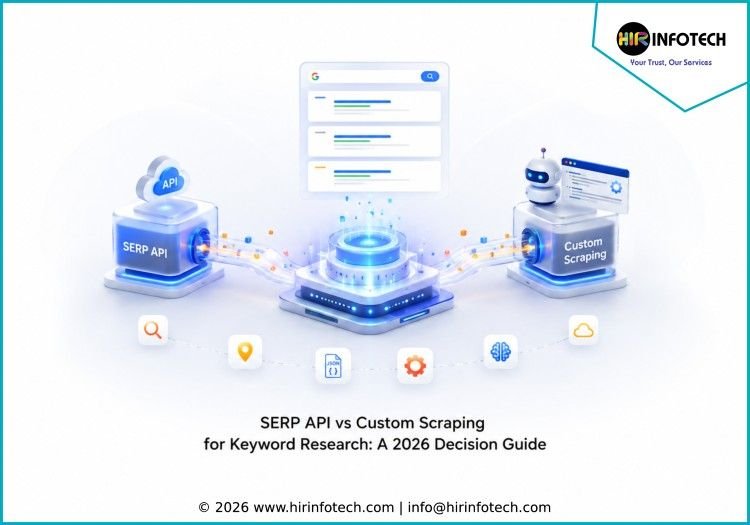
SERP API vs Custom Scraping for Keyword Research: A 2026 Decision Guide
SERP API vs Custom Scraping for Keyword Research: A 2026 Decision Guide Introduction Keyword research depends on accurate search engine data. But collecting that data at scale presents a fundamental choice: use a managed SERP API or build your own scraping infrastructure. Each path has distinct trade-offs in cost, control, and long-term maintenance. For B2B teams operating across multiple countries, this decision directly impacts data quality and operational overhead. What Is a SERP API and How Does It Work A SERP API is a managed service that retrieves, renders, and parses search engine results pages into structured JSON data your application can consume . You send query parameters including keyword, location, language, and device type. The API returns organized fields such as organic results, ads, knowledge panels, local packs, and featured snippets. Behind the API, the provider manages a full infrastructure stack. This includes proxy pools for IP rotation, headless browsers for JavaScript rendering, CAPTCHA solving systems, and parsing logic that adapts when search engines change their page layouts . The complexity of anti-bot detection, geo-targeting, and parser maintenance is abstracted behind the API layer . What Custom Scraping Entails Custom scraping means your team builds and maintains the entire data collection pipeline from scratch. You write code to send search requests, handle response parsing, manage proxy rotation, and store results. The workflow appears straightforward at first: send a request, retrieve HTML, extract fields, save output. In practice, this simple approach does not hold up well against search engines. Google is effective at detecting automated access, and search result layouts change without notice . To maintain reliable collection, you need rotating residential proxies, CAPTCHA solving integration, browser fingerprinting management, parser updates whenever layouts change, retry logic for failed requests, and ongoing monitoring of block rates. Cost Comparison: Beyond the Per-Query Price The most common mistake when comparing options is looking only at proxy prices versus API prices. The real comparison requires evaluating total operational cost across the entire infrastructure stack . For custom scraping, costs compound across several categories. Proxy infrastructure requires recurring residential or datacenter proxy fees. CAPTCHA solving needs third-party tools or manual intervention. Cloud servers and storage must handle request processing and data storage. Engineering time demands ongoing build and maintenance. Retry and failure handling must be implemented internally. Data normalization requires custom parsing logic. Maintenance overhead continues continuously as search engines update. For a managed SERP API, most of these costs are included. Proxy infrastructure is built into the service. CAPTCHA solving is handled automatically. Cloud server needs are minimal. Engineering effort is limited to initial integration. Retry handling is managed by the provider. Data normalization delivers structured JSON output. Maintenance overhead is provider-managed . At low volumes of a few hundred queries per day, custom scraping can be manageable. Block rates are lower, infrastructure needs are modest, and engineering effort is contained. As volume grows to thousands of queries per day, costs begin compounding rapidly. Higher proxy spending, increased CAPTCHA solving, more IP bans, retry spikes, and parser drift due to layout updates demand more engineering oversight . Reliability and Maintenance Realities Reliability is where the difference between approaches becomes most visible. Search engines continuously update their HTML structure, JavaScript rendering, anti-bot detection models, fingerprinting systems, and geo-targeting logic . Each change can break a custom scraping setup. A real-world example illustrates the challenge. One developer attempting to build a custom Google scraper spent weeks fighting Google’s risk control systems, burned thousands of dollars on proxy fees, and eventually abandoned the effort in favor of a managed SERP API . The specific obstacle was Google’s sg_ss parameter, a highly obfuscated dynamic encryption parameter generated through complex JavaScript virtual machine logic. Reversing this requires advanced de-obfuscation skills, and Google updates its risk control logic frequently. Performance differences are also substantial. A headless browser instance launching Chromium occupies 800MB to 1200MB of memory. Running ten concurrent scrapers demands 12GB or more of server RAM. Single search response times range from 8 to 15 seconds due to full resource loading . In comparison, managed SERP APIs using lightweight HTTP protocols achieve average response times as low as 1.4 seconds, delivering ten times higher throughput with the same resources. When Custom Scraping Makes Sense Custom scraping remains a viable choice for specific scenarios. If you only need occasional manual checks of a few keywords, a basic scraper may work without significant investment . One-time research projects that do not require ongoing monitoring can justify the manual effort. When localized accuracy is not important, the additional complexity of geo-targeting may be unnecessary. However, for production use cases with ongoing data needs, custom scraping typically becomes the more expensive option over time. The operational overhead of keeping the scraper working consistently across layout changes and anti-bot updates compounds continuously . When a SERP API Is the Better Choice A managed SERP API becomes the more practical option when your requirements include several factors. Tracking rankings across multiple cities or countries demands consistent geo-targeted results. Monitoring both desktop and mobile results requires device-specific rendering. Data accuracy affects revenue or client reporting, making reliability critical. Volume exceeds a few thousand queries per day, where proxy and engineering costs escalate. Engineering resources are limited and better focused on insights than infrastructure maintenance . Specific use cases where SERP APIs excel include keyword rank tracking across multiple markets, localized search result monitoring for different countries, competitor research at scale, AI search grounding for large language models, and e-commerce search intelligence for pricing and product monitoring . Multi-Market Considerations for Global Teams For businesses operating across the USA, Germany, United Kingdom, France, Italy, Russia, Spain, Netherlands, Switzerland, Poland, Ireland, Australia, Canada, Thailand, and Hong Kong, the choice between API and custom scraping has additional dimensions. Managed SERP APIs typically offer built-in geo-targeting through country parameters. You specify the location code, and the provider routes requests through appropriate infrastructure to return results relevant to that market. Custom scraping requires building your own geo-distributed proxy network and