
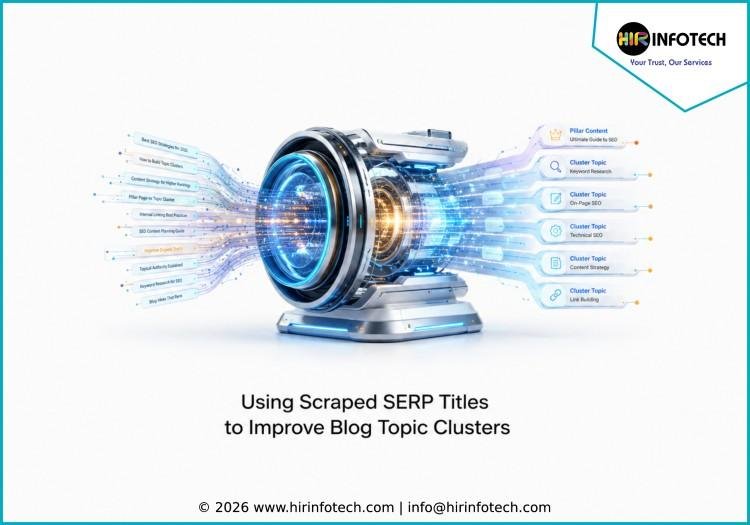
Using Scraped SERP Titles to Improve Blog Topic Clusters
Using Scraped SERP Titles to Improve Blog Topic Clusters Introduction Topic clusters only work when your pillar page and supporting content genuinely align with how Google groups related topics. But guessing which subtopics belong together leads to cannibalization and weak authority. Scraped SERP titles tell you exactly how Google structures topics — by revealing the pages that already rank for multiple related keywords and the title patterns that signal content completeness. Why SERP Titles Matter for Topic Clusters The pages that rank for multiple keywords in your cluster are telling you something important. When a single URL appears in the top results for two or more related keywords, Google considers that page authoritative for all those terms. That page is your model for cluster structure. SERP titles specifically reveal how Google interprets the relationship between broad topics and specific subtopics. The title of a ranking page is Google’s primary signal for understanding what the page covers. When you scrape titles across keywords in a candidate cluster, patterns emerge. For example, if your cluster includes the keywords “content strategy guide,” “content strategy framework,” and “content strategy examples,” scraping the SERP titles for each keyword might reveal that the same URL ranks for all three. That URL’s title — perhaps “The Complete Content Strategy Guide: Frameworks, Examples, and Templates” — tells you exactly how Google expects a pillar page to cover the topic. The title includes both the broad term and the subtopics. The Problem with Text-Based Topic Clustering Traditional keyword grouping tools match keywords by shared words or phrases. This approach merges keywords that should be separate and separates keywords that Google treats as related. Consider two keywords: “best running shoes” and “best running trails.” Text-based clustering merges these because both contain “best running.” But Google ranks completely different pages for each query. One maps to product pages. The other maps to location-based guides. Merging them creates a cluster that no single page can satisfy. SERP-based clustering solves this by reading the URLs Google returns. When two keywords share overlapping ranking URLs, they belong in the same cluster. When they share no URLs, they belong in separate clusters. Scraped SERP titles validate this further — the titles of overlapping URLs reveal the content format Google expects. Step 1: Scrape SERP Titles for Your Keyword List Start with a comprehensive keyword list around your primary topic. Export from Ahrefs, Semrush, Moz, or Google Search Console. For each keyword, scrape the top five to ten organic results. Extract the ranking URL, page title, meta description for optional context, and ranking position. For multi-market topic clusters covering the USA, Germany, United Kingdom, France, Italy, Russia, Spain, Netherlands, Switzerland, Poland, Ireland, Australia, Canada, Thailand, and Hong Kong, run separate SERP scrapes with country parameters. SERP titles vary by location due to localized intent and content preferences. Use a SERP API or managed scraper for consistent results. Tools like Apify’s Google Search Scraper return structured JSON with titles, URLs, descriptions, and positions. Step 2: Detect URL Overlap as the Primary Clustering Signal With SERP data collected, calculate URL overlap between every pair of keywords. Use Jaccard similarity, where the similarity score equals the number of shared ranking URLs divided by the total unique URLs across both keywords. This score ranges from zero, meaning no overlap, to one, meaning identical ranking sets. Apply agglomerative hierarchical clustering. This algorithm starts with each keyword as its own cluster, then merges based on overlap thresholds. A higher threshold creates finer, more specific clusters. A lower threshold creates broader, more general clusters. Step 3: Extract Title Patterns Within Each Cluster Once keywords are grouped into clusters, scrape SERP titles for the highest-volume keyword in each cluster. Look for patterns across the top five ranking pages. Ask these questions when analyzing titles. Do ranking titles consistently include specific words like “Guide,” “Checklist,” “Template,” or “Examples”? This indicates the content format Google expects. Do titles front-load the primary topic? Most effective titles place the main keyword within the first three to five words. What angle do ranking titles take? “Complete Guide” suggests exhaustive coverage. “Step-by-Step” suggests process documentation. “Best X” suggests comparison content. What word count range do ranking titles use? Matching the typical length prevents truncation in SERPs. For B2B topics, ranking titles often include commercial terms like “vs,” “review,” “top,” or “best.” For informational topics, titles lean toward “what is,” “how to,” or “guide.” Step 4: Map Title Patterns to Cluster Structure Title patterns inform two critical decisions for your topic cluster: pillar page format and supporting content scope. If ranking titles for your primary keyword consistently include subtopic modifiers — for example, “Content Strategy Guide: Frameworks, Tools, and Measurement” — your pillar page should cover multiple subtopics within a single, comprehensive guide. If ranking titles for subtopic keywords are held by distinct URLs that are different from the pillar URL, those subtopics need separate cluster articles. The title patterns of those separate URLs tell you the content format and angle for each supporting piece. Map title patterns to cluster roles. Pillar page titles are broad and comprehensive, following patterns like “Topic: The Complete Guide” or “Topic Explained (Everything You Need to Know).” Cluster article titles are specific and angled, following patterns like “How to Subtopic” or “Best Subtopic Tools” or “Subtopic vs Alternative.” Step 5: Build Intent-Based Sub-Clusters URL overlap tells you that keywords belong together. Title patterns tell you why. Add intent classification to your clusters by analyzing title language. Titles containing “What is,” “How to,” “Guide,” or “Explained” signal informational intent, which maps to blog posts or tutorials. Titles containing “Best,” “Top,” “Vs,” or “Review” signal commercial intent, which maps to comparison pages or roundups. Titles containing “Buy,” “Price,” “Cost,” or “Pricing” signal transactional intent, which maps to product pages or service landing pages. When keywords within the same URL-overlap cluster show different intent signals in their ranking titles, your cluster needs multiple content types. The cluster remains intact — Google still groups these keywords topically —