
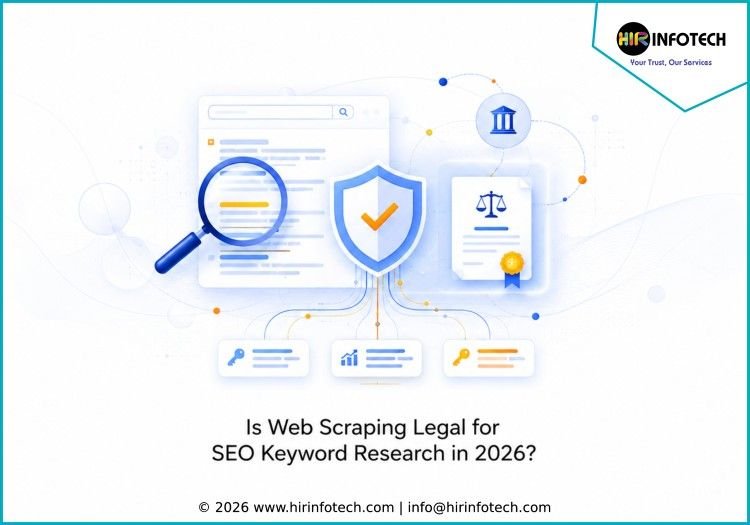
Is Web Scraping Legal for SEO Keyword Research in 2026?
Is Web Scraping Legal for SEO Keyword Research in 2026? Web scraping for SEO keyword research sits at the intersection of data intelligence, competitive strategy, and evolving legal frameworks. For businesses and agencies operating across markets including the USA, UK, Germany, France, Italy, Spain, the Netherlands, Switzerland, Poland, Ireland, Australia, Canada, Thailand, Hong Kong, and Russia, understanding the legal landscape is not optional — it is a fundamental requirement for building sustainable, defensible data programs. The good news is that scraping publicly available search data for keyword research is, in most major jurisdictions, legally sound when conducted responsibly. The nuances, however, matter significantly. The Core Legal Principle: Public Data vs. Protected Data The most important distinction in web scraping law is between publicly accessible data and data protected behind authentication, paywalls, or technical access controls. For SEO keyword research — which primarily involves extracting data from search engine results pages, autocomplete systems, competitor public pages, and publicly visible SERP features — this distinction consistently supports legality. Search engine results pages are publicly accessible to any user with a browser. Autocomplete suggestions, People Also Ask content, organic rankings, related searches, and Featured Snippet data are all visible without authentication, account creation, or any form of access control bypass. Scraping this category of data for keyword research purposes falls well within the boundaries that legal precedent and regulatory frameworks have established for legitimate data collection. The principle that publicly accessible data can be scraped without constituting unauthorised computer access has been affirmed across multiple significant legal rulings. In the USA, the Ninth Circuit Court of Appeals established in the hiQ Labs v. LinkedIn case that accessing publicly available data does not violate the Computer Fraud and Abuse Act — the primary US federal law governing unauthorised computer access. This ruling has since been cited in over 50 subsequent cases and represents the dominant legal position across US federal courts on public data scraping. A 2024 federal ruling in Meta v. Bright Data further reinforced that scraping public web data without bypassing authentication does not constitute a CFAA violation. For SEO keyword research programs extracting SERP data, autocomplete suggestions, and public competitor page content, this legal foundation is directly applicable and well established. The GDPR Dimension: What European Markets Require For businesses operating in or collecting data related to users in Germany, France, Italy, Spain, the Netherlands, Switzerland, Poland, Ireland, and other EU and EEA markets, the General Data Protection Regulation is the most significant legal framework to understand — and it is frequently misapplied to scraping for keyword research. GDPR governs the collection, processing, and storage of personal data — information that identifies or can identify an individual. Search engine results pages, autocomplete suggestions, keyword rankings, and SERP feature content are not personal data. They are publicly available information about search query patterns and content visibility, with no connection to identifiable individuals. Scraping this data for SEO keyword research does not involve personal data processing as defined under GDPR. Where GDPR becomes relevant is when scraping activities extend beyond SERP and keyword data into content that contains personally identifiable information — names, contact details, user-generated profiles, or behavioural data tied to individuals. For a focused keyword research scraping program that collects search result data, SERP features, and public competitor page structures, GDPR compliance requirements do not create a barrier. They simply require that the scraping activity does not capture personal data as a byproduct of broader collection. Responsible scraping services operating across European markets document their data collection purposes, apply data minimisation principles, and maintain audit trails that satisfy enterprise legal and procurement review — not because keyword data itself is regulated under GDPR, but because operating within a documented compliance framework is the professional standard for enterprise data programs in European jurisdictions. The UK, Canada, Australia and Other Key Markets The UK’s post-Brexit data protection framework mirrors GDPR closely. The UK Data Protection Act applies the same principles — personal data protection, lawful processing grounds, and data minimisation — making the same analysis applicable. Scraping public SERP and keyword data for SEO purposes does not engage UK data protection law in a way that creates compliance risk when conducted responsibly. Canada’s PIPEDA framework similarly governs personal data collection, not publicly available search engine data. Australia’s Privacy Act applies to personal information, with the same distinction between publicly accessible search data and protected personal data holding equally. In each of these markets, scraping SERP and keyword data for legitimate business research purposes is legally sound under current frameworks. For Thailand and Hong Kong, where data protection frameworks are developing alongside international standards, the same fundamental principle applies: publicly accessible search data scraped for keyword research does not engage personal data protection obligations under current legislation in either jurisdiction. Russia’s Federal Law 152-FZ on Personal Data governs personal information processing for Russian citizens. As with GDPR and its equivalents, the law applies to personal data, not to publicly accessible SERP data from Yandex or other Russian search engines. Keyword research scraping from public Russian search results is not within the scope of this legislation. Terms of Service: The Practical Boundary While public data scraping is legally defensible in most jurisdictions, website terms of service introduce a separate and practically important consideration. Most major search engines and websites include terms that restrict or prohibit automated access or data collection. Violating terms of service does not automatically create criminal liability under laws like the CFAA — the hiQ ruling and subsequent cases have established this clearly for US law — but it does create potential civil liability through breach of contract claims and can result in IP blocking, rate limiting, or cease-and-desist notices. For SEO keyword research programs, the practical implication is that responsible scraping should acknowledge terms of service even while operating within established legal parameters. Using managed scraping infrastructure with appropriate request pacing, respecting robots.txt directives as a statement of good faith, and avoiding technical circumvention of access controls are the professional