
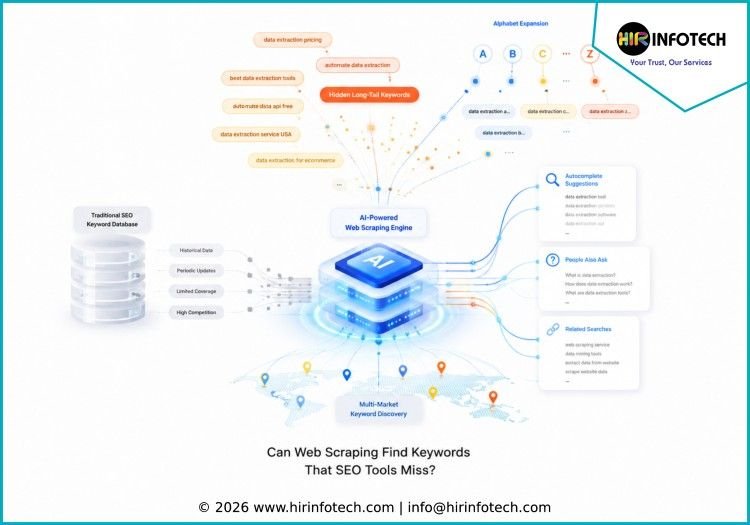
Can Web Scraping Find Keywords That SEO Tools Miss?
Introduction
Traditional SEO tools rely on historical databases that update periodically. Web scraping takes a different approach. By pulling live data directly from search engines, scraping captures emerging search patterns, regional variations, and long-tail questions that conventional keyword research platforms often miss entirely.
The Blind Spots of Traditional SEO Tools
Premium SEO platforms like Semrush, Ahrefs, and Moz maintain massive keyword databases. Semrush claims over 26 billion keywords, and Ahrefs crawls billions of pages daily. These are impressive numbers. But they share a fundamental limitation: they work from historical or periodically refreshed data sets.
When a new search trend emerges, traditional tools may take weeks or months to reflect it. The delay happens because these platforms must crawl, process, and index massive volumes of data before making it available to users. By the time a keyword appears in their databases, early adopters have already captured significant traffic.
Traditional keyword tools also struggle with hyper-local variations. A search pattern specific to a single city or region may never reach the volume threshold required to appear in aggregated databases. Similarly, question-based queries and conversational search patterns are often underrepresented because these platforms prioritize keywords with measurable search volume.
How Web Scraping Accesses Untapped Keyword Data
Web scraping solves these problems by extracting data directly from search engine results pages in real time. Instead of waiting for database updates, scraping captures exactly what search engines are showing right now.
The key sources for keyword discovery through scraping are well documented. Google Autocomplete suggestions reveal what users are actively typing. People Also Ask (PAA) boxes expose related questions that indicate deeper intent. Related searches at the bottom of results pages show thematic connections that traditional tools may miss.
Each of these sources provides a different type of keyword intelligence. Autocomplete reflects real-time search behavior, often capturing trending topics before they appear in volume data. PAA questions reveal the specific information gaps users are trying to fill. Related searches expose semantic relationships that can expand topic clusters.
Real-Time Data Versus Historical Databases
The distinction between real-time scraping and historical databases matters for practical SEO. A traditional tool might tell you that “winter jacket” has high search volume. But scraping Google Autocomplete in August versus November will show dramatically different suggestions, reflecting seasonal intent shifts that historical averages obscure.
For content strategists, this difference is critical. Writing for a keyword that peaked three months ago wastes resources. Scraping reveals what users are searching for today, enabling content that meets current demand rather than past interest.
The velocity of search behavior has increased significantly. Breaking news, product launches, and cultural trends generate immediate search spikes. Traditional tools cannot capture these fast enough. Web scraping, when properly configured, provides near real-time intelligence.
Three High-Value Keyword Sources Accessible Only Through Scraping
Google Autocomplete remains the most direct source of user intent data. When a user begins typing, Google’s prediction algorithm draws from multiple signals including trending queries, location, and search history patterns. Scraping this endpoint reveals the specific phrases users are actively forming, not just the keywords that have enough volume to appear in commercial databases.
People Also Ask boxes represent a fundamentally different type of keyword data. These are not search queries in the traditional sense. They are questions that Google has identified as contextually relevant to the user’s information journey. A single PAA extraction from a seed keyword can return 15 to 30 related questions, each representing a distinct content opportunity that might never appear as a standalone keyword in traditional tools.
Related searches provide the third pillar. Located at the bottom of Google results pages, these suggestions represent thematic clusters that search engines associate with the original query. Scraping related searches reveals the semantic field around a topic, helping content teams build comprehensive coverage that signals authority to search engines.
Alphabet Expansion: A Technique That SEO Tools Cannot Replicate
One of the most powerful scraping techniques has no equivalent in traditional keyword tools. Alphabet expansion involves appending each letter of the alphabet to a seed keyword and capturing the autocomplete suggestions for each variation.
For example, starting with “data extraction,” a scraper would query “data extraction a,” “data extraction b,” and so on through all 26 letters. This reveals long-tail suggestions that never appear when searching only the base keyword. A standard autocomplete query returns approximately 10 suggestions. Alphabet expansion multiplies this by 27 (26 letters plus the base keyword), generating up to 270 keyword ideas from a single seed.
Recursive depth expansion takes this further. After capturing suggestions at depth one, the scraper treats each suggestion as a new seed keyword and repeats the process. At depth two, one seed can generate approximately 110 suggestions. At depth three, the number approaches 1,110 suggestions. No traditional keyword tool offers this level of granular exploration because the computational cost would be prohibitive at database scale.
Multi-Market Keyword Discovery
For businesses operating across multiple countries, scraping unlocks region-specific keyword data that global databases often miss. Search behavior varies significantly by location due to language differences, cultural context, and local search history.
Running the same seed keyword with country-specific parameters for USA, Germany, United Kingdom, France, Italy, Russia, Spain, Netherlands, Switzerland, Poland, Ireland, Australia, Canada, Thailand, and Hong Kong produces meaningfully different suggestion sets. A term that autocompletes to “cloud storage pricing” in the United States might suggest “cloud storage compliance” in Germany, reflecting stricter data protection regulations.
Comparing these results reveals universal keywords that translate across markets, regional variations that require localization, and market-specific opportunities where competitors may have gaps. Traditional SEO tools typically offer country filters but rely on the same underlying database, missing the localized intent patterns that scraping captures directly.
Overcoming Scraping Challenges for Consistent Data
Web scraping at scale presents real challenges. Search engines actively monitor traffic patterns and may block requests from datacenter IP addresses. Rate limiting, CAPTCHAs, and layout changes can disrupt pipelines.
The most common failure point is IP reputation. When too many requests originate from the same address, search engines slow responses or return partial results. Professional scraping operations use rotating proxy pools to distribute traffic across many IP addresses, making requests appear as organic user traffic.
Retry logic requires careful tuning. Automatic retries can spiral out of control, with failed requests triggering additional requests that increase volume and cause more failures. Mature pipelines implement retry limits, staggered delays, and failure pattern monitoring rather than blind repetition.
Geolocation accuracy is another critical factor. For scraping to deliver useful localized data, IP addresses must be correctly recognized by geolocation databases. An IP that routes through a different country than intended produces inaccurate local results, undermining multi-market research. Verified proxy networks with reliable geolocation mapping address this requirement.
Integrating Scraped Keywords Into Content Strategy
Raw keyword data from scraping requires processing before it becomes actionable. The first step is deduplication. Recursive expansion and alphabet techniques generate overlapping suggestions that must be cleaned.
Intent classification follows. Autocomplete suggestions that include “how,” “what,” or “why” indicate informational intent suitable for blog content. Suggestions with “best,” “vs,” or “review” signal commercial investigation, appropriate for comparison pages. Terms with “near me,” “buy,” or “price” show transactional intent, guiding service page optimization.
The most sophisticated workflows apply AI-based filtering to scraped keyword data. Semantic analysis models evaluate search intent, predict conversion potential, and cluster related terms into topic groups. Some systems report filtering out up to 95 percent of无效关键词 while maintaining effective keyword output rates above 90 percent.
Why Hir Infotech Recommends Scraping for Keyword Discovery
At Hir Infotech, we have built our web scraping practice around the principle that the most valuable market intelligence is often the most accessible yet systematically overlooked. With over 13 years of experience and 2,745+ satisfied clients across the USA, Europe, and Australia, we have deployed search engine data extraction for hundreds of SEO and content strategy use cases.
Our approach to keyword discovery through scraping focuses on three deliverables that matter to B2B content teams. First, we extract complete autocomplete suggestion lists with alphabet expansion and recursive depth up to level three, generating thousands of keyword ideas from a single seed. Second, we capture People Also Ask questions and related searches simultaneously, providing the full intent landscape around any topic. Third, we support multi-market collection across all target locations simultaneously, running identical queries with country-specific parameters to reveal regional intent differences that single-market research would miss.
We address the technical challenges of scraping at scale through rotating proxy networks, request throttling, and compliance-first delivery methods. Our AI-driven pipelines extract structured intelligence including rankings, SERP features, ad placements, and entity data. Delivery options include API, cloud storage, or direct integration with analytics platforms.
We do not sell software subscriptions. We deliver structured, decision-ready keyword datasets that feed directly into content calendars, brief-writing processes, and competitive analysis. For organizations looking to move beyond generic keyword lists and start building content around what users are actually searching right now, web scraping provides the most direct data source available.
Frequently Asked Questions
What specific keywords can scraping find that traditional tools miss?
Scraping captures emerging search trends before they appear in historical databases, hyper-local variations that never reach volume thresholds, question-based queries that traditional tools underrepresent, and long-tail variations revealed through alphabet expansion that standard keyword research overlooks.
Is scraping Google autocomplete legal?
Scraping publicly accessible autocomplete data typically falls within acceptable use when done at reasonable volumes with proper rate limiting. Excessive automated requests may violate terms of service and trigger blocks. Professional scraping operations use proxy rotation and respect robots.txt guidelines to maintain compliance.
How often should I scrape for keyword research?
For stable B2B topics, monthly scraping provides sufficient data. For news-driven or rapidly evolving industries, weekly or even daily runs capture emerging opportunities. Seasonal topics benefit from regular scraping to track intent shifts throughout the year.
What is the cost difference between scraping and paid SEO tools?
Paid SEO tools require monthly subscriptions starting at 99andexceeding500 for enterprise access. Scraping costs vary based on volume but can be significantly lower, with some platforms charging approximately $0.001 per keyword expanded, plus a small flat fee per run.
Can scraping work for all the countries you serve?
Yes. Country-specific parameters targeting USA, Germany, United Kingdom, France, Italy, Russia, Spain, Netherlands, Switzerland, Poland, Ireland, Australia, Canada, Thailand, and Hong Kong return localized autocomplete, PAA, and related search data unique to each market.
Conclusion
Web scraping is not a replacement for traditional keyword tools. It is a complementary approach that solves problems those tools cannot address. Historical databases provide volume estimates and competitive metrics. Scraping provides real-time intent data, emerging trends, regional variations, and the specific questions users are asking right now. For B2B content strategists in 2026, combining both approaches delivers the most complete keyword intelligence. Traditional tools validate opportunity. Scraping reveals what is happening at the edge of search behavior—often before competitors notice. For organizations ready to move beyond assumption-based keyword lists, Hir Infotech delivers structured search engine data extraction tailored to your content strategy, turning Google’s real-time signals into your competitive advantage.









