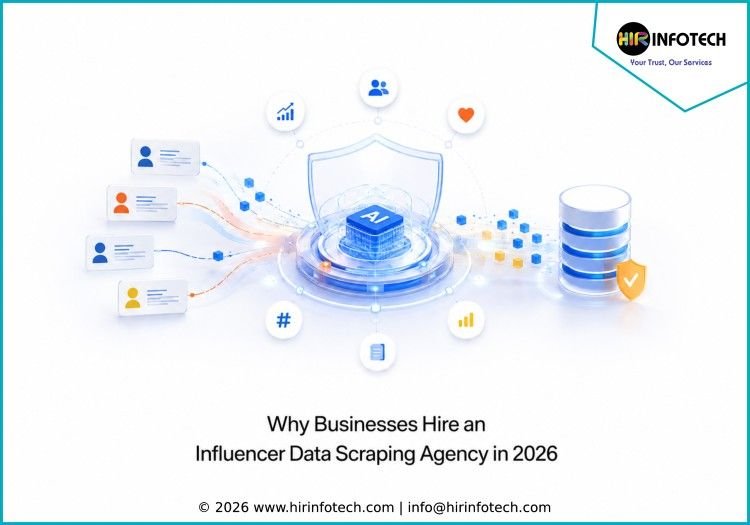
Why Businesses Hire an Influencer Data Scraping Agency in 2026
Why Businesses Hire an Influencer Data Scraping Agency in 2026 The Case for Getting Specialist Help With Influencer Data Influencer marketing decisions backed by accurate, structured data consistently outperform those made on instinct or surface-level metrics. Yet sourcing that data reliably — at the scale and consistency modern campaigns demand — requires infrastructure, technical expertise, and ongoing maintenance that most internal teams are not set up to provide. That is why more businesses are choosing to hire a dedicated influencer data scraping agency rather than attempting to build or manage extraction pipelines in-house. What an Influencer Data Scraping Agency Actually Does An influencer data scraping agency specializes in extracting structured, actionable social media data from public profiles, posts, and engagement signals across platforms like Instagram, TikTok, YouTube, X, LinkedIn, and Facebook. The agency manages the full extraction workflow — from configuring and maintaining the scrapers to delivering clean, formatted datasets ready for analysis. The data delivered typically includes follower counts, engagement rates, comment volumes, posting frequency, content performance metrics, hashtag usage, sponsored content patterns, audience growth trends, and profile metadata. Depending on the scope of the engagement, agencies can also layer in sentiment analysis, content categorization, and competitor tracking. What distinguishes an agency from a self-serve tool or a freelance developer is the combination of dedicated infrastructure, technical depth, ongoing maintenance, compliance awareness, and structured data delivery — factors that become increasingly important as data requirements scale. Why In-House Scraping Has Real Limitations Building an internal social media data scraping capability sounds straightforward until the reality of platform defenses sets in. Instagram, TikTok, and other major platforms actively deploy IP detection, rate limiting, CAPTCHA challenges, browser fingerprinting, and frequent endpoint changes specifically to disrupt automated data collection. A scraper that functions reliably today can fail within days as a platform updates its blocking logic. Maintaining effective extraction across multiple platforms simultaneously — while keeping data quality consistent — requires dedicated engineering time, residential proxy infrastructure, rotating IP management, and adaptive crawling logic. For most businesses, that overhead is a distraction from core operations, not a sensible use of internal resources. An experienced agency absorbs all of that complexity. It has already solved the infrastructure challenges, built the maintenance processes, and developed the platform-specific expertise needed to keep data flowing accurately and consistently. The Business Value of Outsourcing Influencer Data Extraction Speed to Insight An agency with existing infrastructure can begin delivering structured influencer datasets significantly faster than building an in-house capability from scratch. For teams with active campaign timelines or competitive research needs, time-to-data is a practical business advantage. Scalability Without Overhead Campaign data requirements fluctuate. An agency can scale extraction volume up or down based on current needs — covering a broader creator pool during active discovery phases and pulling back during quieter periods — without the fixed cost of maintaining internal infrastructure year-round. Data Quality and Consistency Raw scraped data is only as useful as the cleaning and structuring applied to it. Specialist agencies build data pipelines that normalize, deduplicate, and validate output before delivery, ensuring the datasets marketing teams receive are actually ready for analysis rather than requiring significant cleaning work downstream. Multi-Platform Coverage Influencer research rarely stays on one platform. Agencies with multi-platform extraction capabilities allow businesses to run coordinated research across Instagram, TikTok, YouTube, and X simultaneously — giving a more complete picture of creator performance and audience reach than single-platform analysis provides. Compliance and Responsible Data Handling In 2026, data collection practices face greater regulatory scrutiny. Agencies operating responsibly work exclusively with publicly visible data, align their practices with applicable data protection frameworks, and apply appropriate security controls to data handling and storage. Businesses that hire a compliant, professionally operated agency reduce the legal and reputational exposure associated with poorly managed data collection. What to Evaluate When Hiring an Influencer Data Scraping Agency Not all agencies operate with the same depth of capability. Before committing to a provider, businesses should assess several practical dimensions: Platform Coverage — Does the agency extract data from the platforms most relevant to your influencer strategy? Confirm coverage for your priority channels rather than assuming breadth. Data Freshness and Delivery Cadence — Understand how often data is refreshed and in what format it is delivered. For active campaign management, near-real-time or weekly data updates matter more than quarterly snapshots. Output Format and Integration Compatibility — Clean data delivered in formats incompatible with your analytics stack creates unnecessary friction. Confirm that output formats — JSON, CSV, structured feeds, or API delivery — align with your existing tools and workflows. Infrastructure Reliability — Ask how the agency handles platform blocking, data gaps, and scraper maintenance. An agency that cannot clearly explain its approach to reliability and error handling is one that will likely deliver inconsistent results. Security and Compliance Standards — Assess whether the agency applies enterprise-grade security to data storage and transmission, and whether its collection practices respect public-only data boundaries and relevant privacy regulations. Customization Capability — Generic influencer datasets may not match the specific creator profiles, niches, content types, or engagement signals your campaigns require. Evaluate whether the agency can tailor extraction scope to your actual research requirements. How Hir Infotech Delivers Specialist Influencer Data Extraction Hir Infotech is an AI-driven social media data and web scraping specialist with over 13 years of experience delivering structured data extraction services to businesses globally. Its social media data scraping capabilities cover Instagram, TikTok, YouTube, X, Facebook, LinkedIn, and other major platforms — making it a practical choice for businesses that need comprehensive, multi-platform influencer datasets. For teams focused on influencer intelligence, Hir Infotech extracts the data points most relevant to discovery, vetting, and performance analysis: follower metrics, engagement rates, content signals, posting patterns, hashtag activity, and profile metadata. Its AI-powered extraction pipelines go beyond raw collection — applying natural language processing for sentiment classification and content categorization to deliver datasets with analytical depth, not just volume. Hir Infotech’s infrastructure operates at enterprise scale, with AI and machine learning algorithms