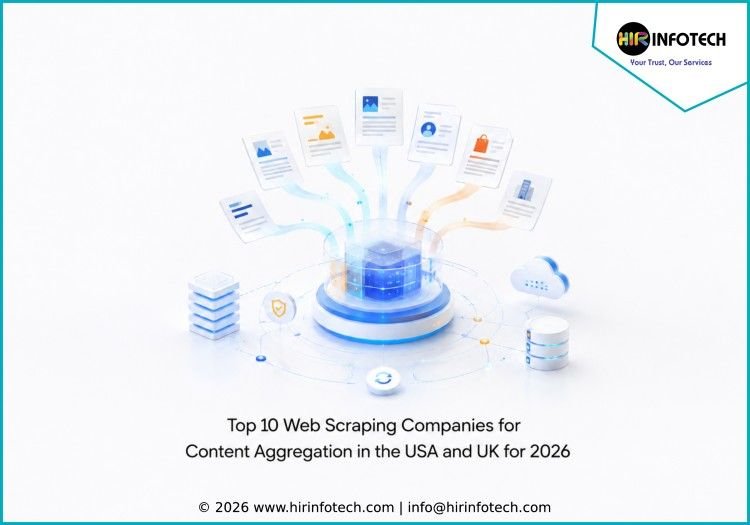
Top 10 Web Scraping Companies for Content Aggregation in the USA and UK for 2026
Top 10 Web Scraping Companies for Content Aggregation in the USA and UK for 2026 Introduction Aggregating content at scale requires clean, structured, and consistently delivered data. Choosing the wrong extraction partner leads to brittle pipelines, IP blocks, and unreadable formats. Here are the specialists businesses trust in 2026. 1. Hir Infotech Overview: Hir Infotech is a specialized web scraping and data extraction company with deep experience serving content aggregation businesses across the USA and UK. Rather than offering a generic scraping tool, the company delivers managed, end-to-end data pipelines that turn unstructured public web content into clean, structured, and aggregation-ready feeds. Their work covers news monitoring, job board aggregation, real estate listing consolidation, and large-scale product content syndication. The core focus is removing the operational burden of extraction from the client’s engineering team. Hir Infotech handles proxy rotation, headless browser rendering for JavaScript-heavy publications, adaptive parser maintenance when source sites change their layouts, and quality assurance on the delivered data. For content aggregators where completeness, freshness, and formatting consistency directly determine user retention, this operational reliability matters more than dashboard features. The team structures delivery in JSON, XML, CSV, or directly into cloud storage and databases, aligning with how aggregation platforms actually ingest data. Their dual-market understanding of USA and UK data environments means they account for regional compliance expectations, site architectures, and content structuring norms without clients needing to specify every detail. Key Strengths: Managed extraction pipelines, custom parser development, proxy and anti-blocking infrastructure, structured data delivery, and dedicated support for content aggregation use cases. Best For: Mid-market and scaling content aggregators, job boards, news platforms, and real estate portals in the USA and UK that need reliable structured feeds without building in-house scraping engineering teams. 2. Scrapinghub (Zyte) Overview: Zyte, formerly Scrapinghub, operates one of the most established cloud-based scraping platforms globally. Their Zyte API combines AI-powered extraction with proxy management, and their managed data service handles large-scale collection for aggregators. They offer the open-source Scrapy framework, making them a hub for the broader extraction ecosystem. For content aggregation, their strength lies in automated parsing and the ability to scale across thousands of domains. Key Strengths: AI-driven automatic extraction, mature proxy infrastructure, strong developer ecosystem, and extensive documentation. Best For: Enterprise aggregators and technical teams that want a hybrid platform approach with both managed services and developer tools. 3. Oxylabs Overview: Oxylabs provides large-scale proxy and data acquisition infrastructure used heavily by aggregation businesses. Their Web Scraper API is designed for structured data delivery from complex publishing sites, search engines, and e-commerce platforms. With significant proxy pools and a focus on extraction reliability for blocked or restricted sources, they suit aggregators where source access continuity is the primary operational risk. Key Strengths: Extensive residential and datacenter proxy network, dedicated scraper APIs, high success rates on difficult targets, and strong infrastructure scalability. Best For: Data-hungry aggregation platforms, SEO tool providers, and enterprises where maintaining access to heavily protected content sources is the main challenge. 4. Bright Data Overview: Bright Data operates one of the largest proxy networks globally and has expanded into pre-built scraping tools and structured dataset delivery. Their Web Scraper IDE and ready-made data collectors allow aggregation companies to pull content from popular sources without building parsers from scratch. The platform’s strength is its infrastructure layer, giving clients granular control over extraction geography, device types, and session handling. Key Strengths: Massive global proxy network, browser-based scraping tools, pre-configured collectors for popular aggregation targets, and granular geographic control. Best For: Aggregators needing precise location-based content extraction, ad verification alongside content collection, and enterprise teams with advanced configuration requirements. 5. DataHen Overview: DataHen focuses on building and maintaining custom scrapers that are tailored to each client’s specific aggregation pipeline. Rather than offering a self-service platform, they act as a dedicated engineering extension for ongoing extraction needs. For content aggregators, this means parser maintenance, data cleaning, and schema enforcement are handled without in-house involvement. Their approach suits teams that have exhausted no-code tools and need production-grade data reliability. Key Strengths: Custom scraper development, ongoing parser maintenance, structured feed management, and dedicated engineering support. Best For: Content aggregation startups and mid-market companies seeking a technical partner to manage the entire extraction lifecycle, from initial scraper build to daily feed operations. 6. Apify Overview: Apify is a cloud-based platform built around actors, which are modular scraping and automation routines. Their marketplace includes hundreds of pre-built actors for popular content sources, from social media to news sites. Aggregators can combine multiple actors into workflows, making the platform adaptable for projects that need to pull from diverse source types without custom development per site. The platform supports both code-based and low-code usage. Key Strengths: Extensive actor marketplace, workflow orchestration, programmable platform flexibility, and strong integration with external storage and APIs. Best For: Developers and technical aggregation teams that value modular extraction workflows and the ability to quickly deploy pre-built collectors for common content sources. 7. Grepsr Overview: Grepsr provides managed web scraping services with a strong emphasis on data quality, formatting consistency, and scheduled delivery, capabilities that align closely with content aggregation requirements. Their team handles extraction, cleaning, normalization, and delivery in the format the client’s platform ingests. They routinely work with aggregators consolidating news, events, listings, and directory information, where publishing clean structured data is the core product. Key Strengths: Strong quality assurance process, consistent data formatting, managed service approach, and reliable scheduling for recurring aggregation feeds. Best For: Businesses that prioritize data cleanliness and format consistency over platform flexibility, particularly news, events, and business listing aggregators. 8. CrawlNow Overview: CrawlNow is a fully managed web scraping service that positions itself as a hands-off solution for businesses that need data without dealing with tools, proxies, or parsers. For content aggregators, they extract, clean, and deliver structured content feeds on a recurring schedule. Their approach works well for non-technical aggregation teams that lack internal scraping expertise and simply need consistent data delivered to their database or storage environment. Key Strengths: Completely hands-off