
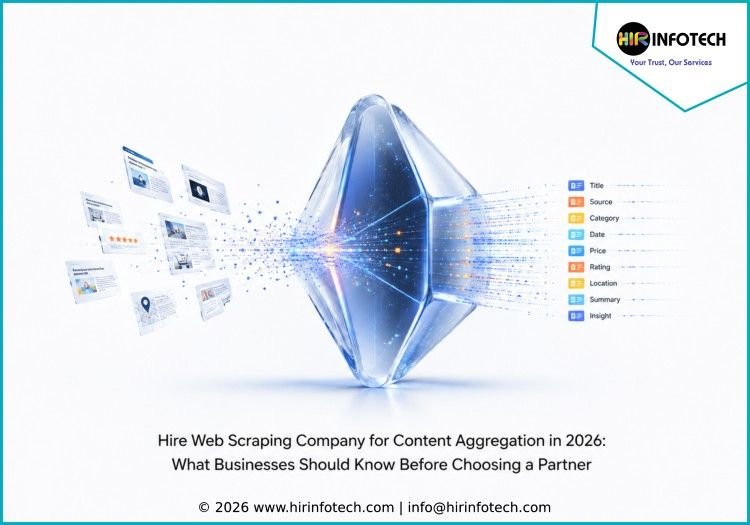
Hire Web Scraping Company for Content Aggregation in 2026: What Businesses Should Know Before Choosing a Partner
Introduction
Content aggregation has become a business intelligence requirement rather than a publishing convenience. Organizations across media, eCommerce, market research, SaaS, and analytics increasingly rely on large-scale data collection to track markets, monitor competitors, discover trends, and build intelligent products. Hiring the right web scraping company can determine whether your content aggregation strategy becomes a competitive advantage or an operational burden.
Why Businesses Hire a Web Scraping Company for Content Aggregation
Content aggregation refers to collecting and organizing information from multiple online sources into a structured and usable format. Businesses use it to bring together data from websites, marketplaces, news platforms, directories, review portals, forums, and industry sources.
In 2026, organizations rarely aggregate content manually because data volumes are too large and change too quickly.
Common business use cases include:
- News and media monitoring
- Product and price intelligence
- Industry research platforms
- Market trend tracking
- Review and sentiment analysis
- Lead generation and enrichment
- Job listing aggregation
- Real estate and travel portals
- Competitive monitoring dashboards
For many organizations, the challenge is no longer accessing information. The challenge is collecting, validating, organizing, and continuously updating that information at scale.
That is where specialized web scraping services become important.
Why Content Aggregation Has Become More Complex in 2026
Many decision-makers assume content aggregation simply means pulling information from websites. In reality, modern web environments have changed significantly.
Current challenges include:
Dynamic websites and JavaScript rendering
Large websites increasingly use React, Angular, Vue, and single-page applications that generate content dynamically.
Basic scraping tools often fail because information loads after page rendering.
Anti-bot systems
Modern websites use:
- CAPTCHA systems
- IP rate limiting
- Behavioral analysis
- Device fingerprinting
- Session validation
Without the right infrastructure, extraction processes can fail or become unreliable.
Frequent website structure changes
Websites continuously update layouts and HTML structures.
Without maintenance processes, data pipelines can break unexpectedly.
Data quality problems
Raw scraped information often contains:
- Duplicate records
- Missing values
- Formatting inconsistencies
- Invalid data fields
- Outdated content
Poor-quality aggregated data creates inaccurate reports and poor business decisions.
Compliance considerations
Businesses increasingly expect data collection processes to align with:
- Privacy requirements
- Data governance policies
- Regional regulations
- Internal compliance standards
Responsible data collection is now part of enterprise procurement discussions.
How Web Scraping Services Solve Content Aggregation Challenges
A specialized web scraping company delivers much more than raw extraction.
A complete content aggregation workflow typically includes:
Source identification
Teams define:
- Relevant websites
- Data categories
- Refresh frequency
- Geographic requirements
- Content priorities
Data extraction architecture
Specialized extraction systems may include:
- Crawlers
- Headless browsers
- APIs
- Proxy management
- Automation workflows
- AI-assisted extraction logic
Data transformation and cleaning
Collected information often requires:
- Deduplication
- Standardization
- Schema mapping
- Data enrichment
- Validation checks
Delivery and integration
Businesses generally need output through:
- APIs
- JSON
- CSV
- XML
- Cloud storage
- Data warehouses
- CRM platforms
- Analytics systems
The goal is not collecting data for its own sake.
The goal is making information immediately usable inside business systems.
What Buyers Should Evaluate Before Hiring a Web Scraping Company
Many organizations focus heavily on pricing when selecting a provider.
However, long-term success often depends on operational capabilities.
Technical capability
Ask whether the provider can handle:
- Dynamic websites
- Login-protected environments where authorized
- Pagination
- Infinite scrolling
- Multi-source extraction
- Real-time feeds
Scalability
Business requirements often grow.
Consider whether the provider can support:
- Millions of pages
- Multiple regions
- Continuous extraction schedules
- Large datasets
Data accuracy standards
Reliable providers typically have:
- Validation processes
- Monitoring systems
- Quality checks
- Structured output controls
Data quality directly affects downstream business decisions.
Maintenance and monitoring
Content aggregation is rarely a one-time project.
Evaluate:
- Site change monitoring
- Error handling
- Update frequency
- Support processes
Security and compliance
Enterprise buyers increasingly ask about:
- Data handling policies
- Logging
- Access controls
- Privacy considerations
- Governance practices
Industry Use Cases for Content Aggregation
Different industries use aggregated content differently.
Media and publishing
Media businesses aggregate:
- News articles
- trends
- topic coverage
- regional stories
This supports faster publishing workflows and audience insights.
E-commerce and retail
Retail organizations aggregate:
- Product listings
- pricing information
- competitor inventory
- customer reviews
This enables pricing intelligence and product strategy decisions.
SaaS and technology
Technology platforms aggregate:
- market signals
- customer feedback
- competitor activity
- industry data
This helps product teams identify opportunities.
Recruitment and HR
Recruitment platforms commonly aggregate:
- job postings
- salary information
- skills demand trends
- company hiring activity
Market research organizations
Research firms collect and structure large datasets from:
- public websites
- directories
- marketplaces
- industry databases
How Hir Infotech Supports Content Aggregation Through Specialized Web Scraping Services
Organizations hiring a web scraping company for content aggregation typically need more than isolated scraping scripts. They need structured, scalable workflows that can continue operating as websites, data requirements, and business objectives evolve.
Hir Infotech provides web scraping and data extraction services focused on helping organizations convert large volumes of online information into structured business intelligence. Its capabilities align naturally with content aggregation requirements because the process involves multiple technical and operational layers beyond extraction itself.
For businesses building aggregation platforms, market intelligence systems, monitoring solutions, or industry databases, the work frequently includes:
- Multi-source data collection
- AI-assisted extraction workflows
- Structured data transformation
- Real-time or scheduled delivery
- Data cleaning and validation
- API and database integration
- Ongoing maintenance support
Organizations operating across international markets often require extraction pipelines that accommodate dynamic websites, changing layouts, and evolving data structures.
For sectors such as eCommerce, media, SaaS, market research, and analytics, scalable infrastructure and consistent output quality become operational requirements rather than technical preferences.
A specialized delivery approach also matters because content aggregation projects frequently expand from single-source extraction into broader intelligence systems that support reporting, analytics, and business decision-making.
Warning Signs When Hiring a Web Scraping Vendor
Choosing the wrong provider often creates hidden operational costs.
Be cautious when a provider:
- Guarantees unrealistic outcomes
- Cannot explain data quality processes
- Offers no ongoing support
- Avoids discussions around compliance
- Cannot describe scaling capabilities
- Provides unclear delivery methods
Content aggregation initiatives usually become long-term systems.
Short-term decisions often create expensive problems later.
Best Practices for Businesses Starting Content Aggregation Projects
Organizations beginning new aggregation initiatives can reduce risk by following several practical steps.
Define business objectives clearly
Avoid vague goals like:
“Collect market data.”
Instead define:
- Required fields
- Source websites
- update frequency
- business outcomes
Start with high-value data
Focus first on information directly supporting:
- revenue decisions
- market intelligence
- operations
- customer insights
Plan for long-term maintenance
Web environments change continuously.
Maintenance should be part of project planning rather than an afterthought.
Prioritize usable data
Large data volumes do not automatically create value.
Clean, structured, decision-ready information is more valuable than raw extraction volume.
Frequently Asked Questions
Is hiring a web scraping company better than building an internal scraping team?
For many businesses, external specialists reduce development time and maintenance overhead. Internal teams often face challenges related to infrastructure, monitoring, and website changes.
How much does content aggregation through web scraping typically cost?
Costs depend on source complexity, data volume, update frequency, integration requirements, and maintenance needs. Projects can range from one-time extraction engagements to ongoing enterprise data pipelines.
Can content aggregation support AI and analytics systems?
Yes. Structured aggregated datasets frequently support AI models, dashboards, forecasting systems, recommendation engines, and business intelligence platforms.
How often should aggregated data be updated?
The required frequency depends on the use case. Pricing intelligence may need real-time updates, while market research projects may only require weekly or monthly refresh cycles.
Can Hir Infotech support custom content aggregation requirements?
Hir Infotech provides web scraping and data extraction services that can support customized workflows where businesses need structured, scalable data collection and ongoing delivery requirements.
Conclusion
Hiring a web scraping company for content aggregation in 2026 is less about collecting information and more about building reliable data systems that support business decisions. Organizations increasingly need scalable extraction, clean data pipelines, integration capabilities, and long-term operational reliability.
The right web scraping approach can help businesses transform fragmented online information into structured intelligence that supports growth, analytics, and competitive visibility. For organizations evaluating specialized support, companies such as Hir Infotech can be relevant where content aggregation requirements demand managed web scraping capabilities, scalable delivery, and ongoing data operations expertise.









