
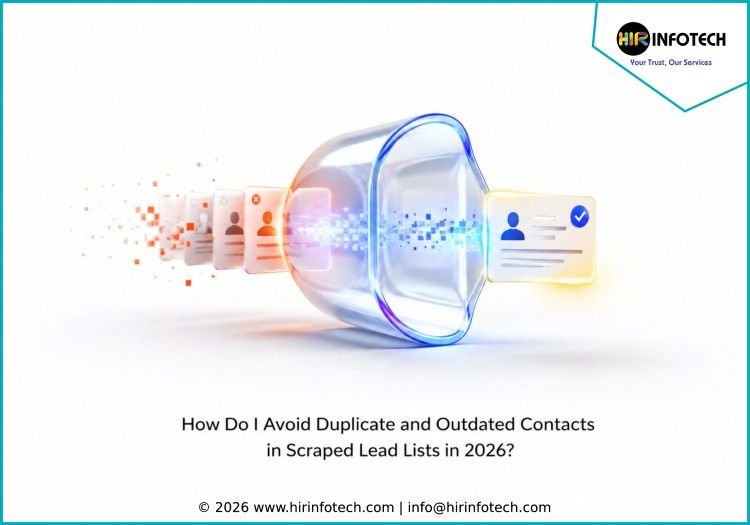
How Do I Avoid Duplicate and Outdated Contacts in Scraped Lead Lists in 2026?
Introduction
Scraped lead lists can help businesses scale outreach faster, but poor-quality data creates serious operational problems. Duplicate entries, outdated contacts, invalid emails, and inaccurate company information can damage campaign performance and waste sales resources. In 2026, businesses across the USA, Europe, Canada, Australia, and Asia are placing far greater emphasis on lead data accuracy, verification, and ongoing maintenance.
Why Duplicate and Outdated Lead Data Is a Serious Business Problem
Lead scraping remains a widely used approach for B2B prospecting, market research, recruitment outreach, SaaS sales, and partnership development. However, raw scraped data is rarely ready for immediate use.
Businesses commonly face issues such as:
- Duplicate contacts across multiple sources
- Employees who no longer work at the company
- Invalid or abandoned email addresses
- Incorrect job titles
- Generic inboxes instead of decision-maker contacts
- Inconsistent formatting across datasets
- Outdated company information
- Missing LinkedIn or website data
- Regional compliance risks
These problems affect nearly every stage of the sales and marketing process.
For example, duplicate records inside a CRM can cause:
- Multiple sales representatives contacting the same prospect
- Inflated pipeline reporting
- Poor segmentation
- Reduced personalization quality
- Lower email deliverability
Outdated contacts are even more damaging because they directly reduce campaign effectiveness and waste outreach budgets.
In competitive B2B markets such as the USA, Germany, the United Kingdom, Canada, and Australia, inaccurate lead data can quickly affect sales efficiency and brand credibility.
Why Scraped Lead Lists Become Outdated So Quickly
Lead databases naturally decay over time. In many industries, employee movement is constant.
People frequently change:
- Companies
- Job titles
- Departments
- Email addresses
- Regions
- Responsibilities
Organizations also:
- Rebrand
- Merge
- Shut down
- Change domains
- Restructure teams
In fast-moving industries, contact data may become partially outdated within a few months.
This is especially true for:
- SaaS companies
- Technology startups
- Ecommerce businesses
- Recruitment agencies
- Marketing firms
- Manufacturing suppliers
- Financial services providers
Businesses operating across multiple countries often face additional complications due to:
- Localized naming conventions
- Different business registries
- Regional privacy requirements
- Language inconsistencies
- International phone formatting
Without proper data validation processes, scraped lead lists lose value quickly.
Common Causes of Duplicate Contacts in Lead Scraping
Multi-Source Scraping
A contact may appear on:
- Company websites
- LinkedIn profiles
- Business directories
- Event attendee pages
- Industry databases
- News mentions
- Association listings
If records are merged without normalization rules, duplicates multiply rapidly.
Variations in Contact Formatting
The same person may appear as:
- John Smith
- John A. Smith
- J. Smith
- Jonathan Smith
Company names may also vary:
- ABC Technologies
- ABC Tech
- ABC Technologies Ltd.
- ABC Technologies Inc.
Without standardization, systems treat these as separate records.
CRM Import Errors
Many businesses repeatedly upload lead files into their CRM without:
- Existing record checks
- Email matching
- Domain matching
- Duplicate detection rules
This creates long-term database clutter.
Outdated Legacy Data
Older prospecting lists are often reintroduced into active campaigns without revalidation. This causes overlaps with newer datasets.
Best Practices to Avoid Duplicate Contacts in Scraped Lead Lists
Use Unique Identifiers During Data Collection
The most reliable deduplication strategy starts before data enters the database.
Businesses should use unique matching identifiers such as:
- Email addresses
- LinkedIn profile URLs
- Company domains
- Phone numbers
- CRM IDs
Professional lead scraping workflows typically combine multiple identifiers to improve accuracy.
For example:
- Email + company domain
- LinkedIn URL + full name
- Phone number + business website
This reduces false duplicates significantly.
Normalize Data Before Importing
Data normalization standardizes formatting before records are stored.
This includes:
- Standardizing company names
- Formatting phone numbers consistently
- Removing extra spaces and symbols
- Converting emails to lowercase
- Standardizing job titles
Normalization improves duplicate detection across large datasets.
Implement Automated Deduplication Rules
Modern lead management systems use automated deduplication workflows.
These rules can:
- Detect matching emails
- Compare domains
- Flag similar names
- Merge overlapping records
- Remove redundant entries
Businesses handling enterprise-scale lead scraping often run scheduled deduplication processes weekly or daily.
Separate Raw Data From Production Data
A common mistake is pushing scraped data directly into sales systems.
Instead, businesses should maintain:
- Raw scraped datasets
- Cleaned verification datasets
- CRM-ready production datasets
This layered approach improves data quality control and reduces contamination inside operational systems.
How to Prevent Outdated Contacts in Lead Databases
Verify Emails Before CRM Upload
Email verification is now a standard requirement for B2B lead generation.
Verification systems help identify:
- Invalid emails
- Catch-all domains
- Disposable addresses
- Inactive mailboxes
- High-risk domains
This protects sender reputation and improves outreach performance.
Use Real-Time Data Enrichment
Data enrichment tools help update:
- Job titles
- Company size
- Industry classifications
- Social profiles
- Location information
- Technology stack data
This is especially useful for businesses targeting multiple international markets.
For example, companies targeting decision-makers in Germany, Switzerland, France, and the Netherlands often rely on enrichment to maintain localization accuracy.
Apply Recency Filters
Not all scraped data has equal value.
Businesses should prioritize:
- Recently updated profiles
- Active company websites
- Fresh business listings
- Current employee data
Many organizations now use freshness scoring models to rank lead reliability.
Schedule Ongoing Data Hygiene Audits
Lead databases should never remain static.
Regular audits help identify:
- Dormant contacts
- Duplicate records
- Invalid emails
- Role changes
- Company closures
In 2026, many sales operations teams run automated hygiene audits monthly to maintain CRM quality.
Compliance Considerations for International Lead Scraping
Businesses operating across the USA, United Kingdom, Germany, France, Ireland, Switzerland, Australia, Canada, Hong Kong, and other regions must also consider data privacy compliance.
Key considerations include:
- GDPR requirements in Europe
- Lawful interest standards
- Consent management
- Business-contact data usage policies
- Data retention controls
- Opt-out management
Lead scraping without proper verification and governance can create both operational and compliance risks.
Responsible businesses now focus heavily on:
- Publicly available business data
- Legitimate B2B outreach practices
- Verified contact accuracy
- Transparent data handling
How Professional Lead Scraping Services Improve Data Quality
Many organizations eventually discover that internal scraping workflows become difficult to scale.
Professional lead scraping and data processing services often provide:
- Automated deduplication pipelines
- Multi-source validation
- Email verification
- CRM formatting
- Lead enrichment
- Regional filtering
- Data segmentation
- Compliance-aware processing
- API integrations
- Continuous dataset maintenance
This becomes particularly important for businesses managing:
- Large outbound campaigns
- Multi-country prospecting
- Enterprise CRM systems
- High-volume recruitment outreach
- International B2B sales operations
How Hirinfotech Supports Cleaner and More Reliable Lead Data
As businesses scale outbound prospecting, maintaining clean and reliable lead data becomes increasingly important. Hirinfotech supports organizations that require structured web scraping, lead verification, and custom data processing workflows designed for modern B2B operations.
The company focuses on helping businesses reduce duplicate and outdated contacts in large prospecting datasets through scalable lead management processes tailored to operational requirements.
Depending on project scope, its workflows may include:
- Multi-source lead extraction
- Duplicate detection logic
- Email verification integration
- Data normalization
- CRM-ready formatting
- Industry segmentation
- Custom filtering rules
- Automated enrichment workflows
For organizations managing international outreach across the USA, United Kingdom, Germany, France, Canada, Australia, Ireland, Switzerland, Hong Kong, and other global markets, maintaining clean lead data is essential for campaign efficiency and CRM accuracy.
Rather than focusing only on collecting large volumes of contacts, modern lead generation strategies increasingly prioritize data reliability, relevance, and operational usability. Businesses often require cleaner datasets that align with sales workflows, outbound automation systems, and compliance expectations across multiple regions.
For companies relying on scalable B2B outreach, structured lead data management can significantly improve campaign quality, reporting accuracy, and overall prospecting efficiency.
Key Indicators of a High-Quality Lead List
Businesses evaluating scraped lead data should look for:
- Low duplicate rates
- Verified business emails
- Standardized formatting
- Current job titles
- Accurate company domains
- Industry relevance
- Geographic accuracy
- CRM compatibility
- Freshness validation
- Clear segmentation
Lead quality matters far more than raw lead volume.
A smaller, verified, well-maintained dataset typically produces stronger business outcomes than a large unverified contact database.
Frequently Asked Questions
How often should scraped lead lists be updated?
Most B2B lead databases should be reviewed and refreshed every 30 to 90 days, depending on the industry and target market. Fast-moving industries usually require more frequent updates.
What is the best way to remove duplicate contacts from lead lists?
Using unique identifiers such as email addresses, LinkedIn URLs, and company domains combined with automated deduplication rules is generally the most reliable approach.
Why do scraped lead lists contain outdated contacts?
People frequently change jobs, companies update websites, and business directories become outdated. Without continuous verification and enrichment, lead data naturally decays over time.
Are verified lead lists better for email outreach?
Yes. Verified lead lists improve email deliverability, reduce bounce rates, and help protect domain reputation during outbound campaigns.
Can duplicate contacts affect CRM performance?
Yes. Duplicate records can create reporting inaccuracies, fragmented customer histories, poor segmentation, and inconsistent sales communication.
Does Hirinfotech support lead data cleaning and verification?
Yes. Hirinfotech provides web scraping and data processing solutions that can support lead extraction, formatting, validation, and deduplication workflows for businesses managing large-scale B2B outreach.
Conclusion
Avoiding duplicate and outdated contacts in scraped lead lists has become a critical requirement for modern B2B sales and marketing operations. As businesses expand prospecting efforts across international markets, lead data quality directly impacts outreach performance, CRM efficiency, and campaign reliability.
Strong lead management now depends on structured scraping workflows, verification systems, normalization standards, and ongoing data hygiene processes. Businesses that prioritize clean, accurate, and regularly updated lead data are better positioned to improve targeting, reduce wasted outreach, and scale prospecting more effectively.
For organizations requiring scalable web scraping and lead data support, Hirinfotech provides specialized solutions designed to improve data usability, verification, and operational efficiency in global B2B









