
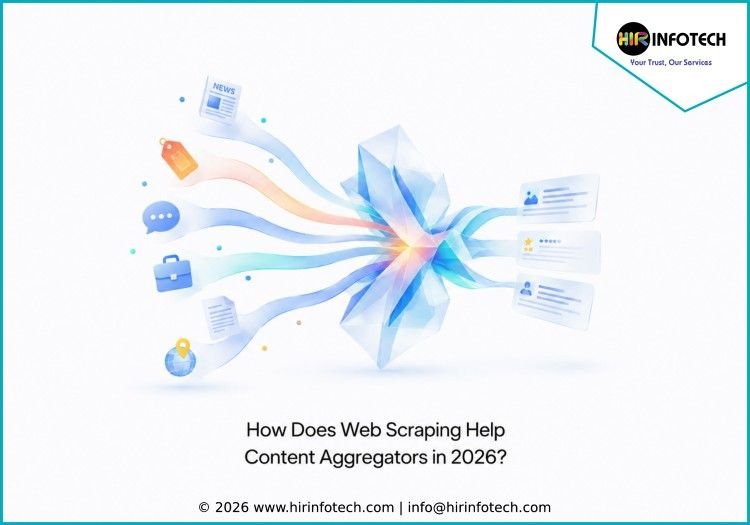
How Does Web Scraping Help Content Aggregators in 2026?
Introduction
As digital content continues to grow across websites, marketplaces, news portals, and public platforms, content aggregators need reliable ways to collect and organize information at scale. Web scraping has become a critical technology for automating large-scale data collection, helping businesses maintain accurate, timely, and structured aggregated content in 2026.
What Are Content Aggregators?
Content aggregators are systems or platforms that gather information from multiple online sources and present it in a centralized format for users, businesses, or internal operations.
These aggregators may collect:
- News articles
- Product listings
- Pricing information
- Customer reviews
- Research data
- Social discussions
- Job postings
- Public records
- Marketplace updates
- Media content
The goal is to simplify access to fragmented online information while improving discoverability, analytics, and operational efficiency.
As online content volumes increase, manual collection methods become difficult to manage. This is why automated web scraping has become essential for modern aggregation systems.
What Is Web Scraping?
Web scraping is the automated process of extracting information from websites and converting it into structured datasets for further use.
Instead of copying data manually, scraping systems automatically collect:
- Text
- Metadata
- Product details
- Images
- Reviews
- Tables
- URLs
- Ratings
- Pricing data
- Contact information
Modern scraping systems are far more advanced than simple bots. In 2026, web scraping often includes:
- AI-assisted extraction
- Browser automation
- Dynamic rendering support
- Real-time monitoring
- Structured normalization
- API integrations
- Multi-language processing
For content aggregators, web scraping forms the foundation of scalable and continuously updated data pipelines.
Why Web Scraping Is Important for Content Aggregators
Automating Large-Scale Content Collection
Content aggregators typically monitor hundreds or thousands of online sources.
Without automation, manually collecting and updating information becomes:
- Slow
- Expensive
- Error-prone
- Difficult to scale
Web scraping allows aggregators to automatically gather data continuously without relying on manual workflows.
This significantly improves operational efficiency.
Supporting Real-Time Data Updates
Many aggregation platforms depend on current information.
Examples include:
- News feeds
- Product pricing
- Stock availability
- Market updates
- Trend tracking
Web scraping enables real-time or scheduled updates that help aggregators maintain fresh datasets and improve user trust.
Consolidating Fragmented Online Information
Online data is scattered across multiple websites with different formats and structures.
Web scraping helps aggregators:
- Collect data from various sources
- Standardize formats
- Organize records
- Remove duplicates
- Structure outputs consistently
This creates usable datasets for analytics, search systems, and customer-facing platforms.
Improving Scalability
As aggregation requirements grow, businesses need infrastructure capable of handling:
- High-volume extraction
- Concurrent crawling
- Multi-source monitoring
- Distributed data collection
Modern web scraping systems support scalable operations that can process large volumes of online content efficiently.
How Web Scraping Helps Different Types of Content Aggregators
News and Media Aggregators
News aggregation platforms use web scraping to collect:
- Headlines
- Articles
- Publication metadata
- Topic categories
- Trending stories
Automated scraping allows faster indexing and continuous news monitoring.
E-Commerce and Product Aggregators
Retail-focused aggregators often scrape:
- Product details
- Pricing changes
- Availability data
- Customer reviews
- Marketplace listings
This helps businesses compare products, track competitors, and monitor market trends.
Review Aggregators
Review platforms collect customer feedback from multiple websites to analyze:
- Consumer sentiment
- Product satisfaction
- Brand reputation
- Service quality trends
Web scraping simplifies large-scale review collection and analysis.
Job Aggregators
Recruitment platforms use scraping workflows to aggregate:
- Job postings
- Salary information
- Hiring patterns
- Skill demand trends
This improves job discovery and labor market visibility.
Research and Analytics Platforms
Research-driven organizations aggregate public information for:
- Industry analysis
- Competitive intelligence
- Trend forecasting
- Market research
- AI model training
Web scraping supports large-scale data acquisition for these analytical workflows.
Key Benefits of Web Scraping for Content Aggregation
Faster Data Acquisition
Automated extraction significantly reduces the time required to collect large datasets from multiple websites.
Scraping systems can process thousands of records much faster than manual research teams.
Better Data Accuracy
Structured extraction workflows reduce manual entry errors and improve consistency across aggregated datasets.
Enhanced Competitive Intelligence
Content aggregators can monitor:
- Competitor pricing
- Market trends
- Product launches
- Customer sentiment
- Industry developments
This improves strategic decision-making.
Stronger Search and Discovery Systems
Aggregated content often powers:
- Search engines
- Recommendation systems
- Internal databases
- AI-driven search platforms
Well-structured scraped data improves search quality and discoverability.
Improved AI and Analytics Capabilities
Many modern AI systems rely on aggregated online data.
Web scraping supports:
- Machine learning datasets
- Sentiment analysis
- Semantic search
- Recommendation engines
- Predictive analytics
- Large language model training
Reliable data pipelines improve the effectiveness of these systems.
Challenges Content Aggregators Face Without Proper Scraping Systems
Dynamic Website Structures
Modern websites frequently change layouts, rendering methods, and content delivery mechanisms.
Basic scraping scripts often fail in these environments.
Anti-Bot Protection
Many websites implement:
- CAPTCHA systems
- IP blocking
- Rate limiting
- Bot detection technologies
Content aggregators need stable infrastructure and responsible extraction strategies to manage these limitations.
Data Quality Issues
Poorly designed scraping systems may generate:
- Duplicate records
- Missing fields
- Incorrect formatting
- Broken datasets
Data validation and normalization become essential at scale.
Multi-Language and Regional Variations
Global aggregation projects often require handling:
- Multiple languages
- Regional website structures
- Localized terminology
- Different currencies
- Country-specific layouts
Modern aggregation workflows increasingly use AI-assisted processing to manage multilingual content effectively.
Maintenance Overhead
Websites evolve constantly. Aggregators require ongoing maintenance and monitoring to ensure extraction systems continue functioning reliably.
The Role of AI in Modern Web Scraping
AI is transforming how content aggregation systems operate in 2026.
Traditional scraping workflows relied heavily on static extraction rules. Modern AI-assisted systems can adapt more effectively to changing web environments.
AI-driven scraping supports:
- Intelligent content recognition
- Layout adaptation
- Semantic categorization
- Language detection
- Duplicate detection
- Automated normalization
- Smart parsing workflows
This improves extraction stability and reduces long-term maintenance complexity.
Best Practices for Content Aggregators Using Web Scraping
Focus on Structured Data Quality
Reliable aggregation systems require:
- Deduplication workflows
- Validation rules
- Schema consistency
- Monitoring systems
- Normalization pipelines
Clean datasets improve downstream analytics and operational reliability.
Use Scalable Infrastructure
Large-scale aggregation often requires:
- Distributed crawling systems
- Cloud-based orchestration
- Proxy infrastructure
- Queue management
- Real-time monitoring
Scalable architecture improves operational continuity.
Maintain Responsible Data Collection Practices
Businesses should follow ethical and compliance-aware scraping practices, including:
- Respectful crawl frequency
- Proper governance policies
- Privacy-conscious handling
- Controlled infrastructure usage
Continuously Monitor Pipelines
Monitoring systems help detect:
- Extraction failures
- Layout changes
- Missing records
- Performance bottlenecks
- Data anomalies
Ongoing monitoring improves long-term system stability.
How Hir Infotech Supports Content Aggregators With Data Extraction Services
Hir Infotech provides data extraction services designed to support scalable content aggregation and automated digital data collection workflows.
Modern aggregation projects often require more than simple scraping scripts. Businesses increasingly need systems capable of handling:
- Dynamic websites
- Real-time updates
- Large-scale extraction
- Structured data transformation
- Multi-source aggregation
- AI-assisted processing
- Long-term maintenance
Hir Infotech develops customized extraction workflows that help businesses automate content collection while improving operational scalability and data reliability.
Their capabilities include:
- Automated web scraping systems
- Content aggregation workflows
- Structured data extraction
- Dynamic website handling
- Multi-language processing
- API-ready data delivery
- Monitoring and maintenance support
For businesses managing analytics platforms, research systems, AI applications, or large-scale digital intelligence operations, reliable data extraction services play an important role in maintaining continuously updated and structured content ecosystems.
Frequently Asked Questions
How does web scraping help content aggregators?
Web scraping helps content aggregators automatically collect, organize, and update information from multiple online sources efficiently and at scale.
What types of data can content aggregators collect?
Aggregators commonly collect news articles, product listings, customer reviews, pricing data, job postings, social content, and public information.
Why is automation important in content aggregation?
Automation improves scalability, reduces manual work, increases update frequency, and helps maintain accurate and current datasets.
What are the biggest challenges in aggregation scraping projects?
Common challenges include dynamic websites, anti-bot systems, data quality issues, multilingual content handling, and ongoing infrastructure maintenance.
How is AI improving modern web scraping?
AI improves extraction accuracy, layout adaptation, language processing, semantic classification, and automated normalization in scraping workflows.
Does Hir Infotech provide scalable data extraction services?
Yes. Hir Infotech provides scalable data extraction services that support content aggregation, structured scraping workflows, and automated digital data collection systems.
Conclusion
Web scraping has become a core technology for content aggregators in 2026, helping businesses collect, organize, and process large volumes of online information efficiently. From news monitoring and pricing intelligence to AI training and analytics platforms, automated data extraction enables aggregators to maintain scalable and continuously updated digital ecosystems.
However, successful content aggregation requires more than basic extraction scripts. Businesses increasingly need scalable infrastructure, intelligent automation, structured data workflows, and ongoing maintenance capabilities. Companies such as Hir Infotech help organizations build reliable data extraction systems that support modern aggregation operations and long-term digital intelligence strategies.









