
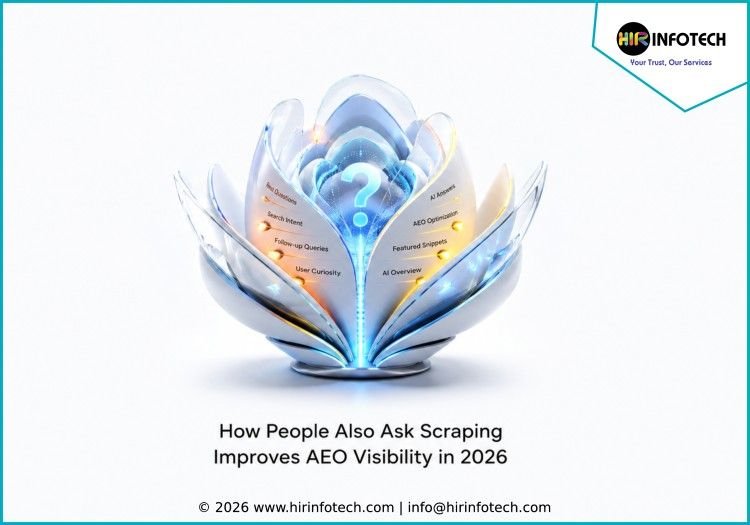
Explain How People Also Ask Scraping Can Improve AEO Visibility
Introduction
Answer Engine Optimization (AEO) has become a critical part of digital visibility in 2026 as Google, ChatGPT, Gemini, Copilot, and other AI-driven platforms increasingly prioritize direct answers over traditional blue-link results. Businesses targeting markets such as the USA, Germany, the United Kingdom, France, and Australia are now using People Also Ask scraping to understand user intent, structure AI-friendly content, and improve visibility across search and answer engines.
What Is People Also Ask (PAA)?
People Also Ask is a dynamic Google SERP feature that displays related questions connected to a user’s search query.
These questions help users explore topics further, refine search intent, discover related concerns, and access concise answers quickly.
PAA boxes often include follow-up questions, expandable answers, featured snippets, source links, and topic relationships.
In 2026, PAA data has become one of the most valuable datasets for SEO, AEO, content planning, and AI search optimization.
What Is AEO Visibility?
Answer Engine Optimization focuses on improving visibility within AI-generated answers, featured snippets, conversational search interfaces, voice search systems, generative search experiences, and AI-powered assistants.
Unlike traditional SEO, AEO prioritizes direct answers, structured information, contextual clarity, search intent satisfaction, and conversational relevance.
Businesses that optimize for AEO improve their chances of appearing in AI Overviews, voice search results, summarized search answers, AI chatbot responses, and featured snippets.
Why People Also Ask Scraping Matters for AEO
PAA boxes reveal how users naturally ask questions online.
This makes them highly valuable for search intent analysis, content structuring, AI-friendly optimization, conversational SEO, and topic clustering.
Scraping PAA data allows businesses to collect real search behavior directly from live SERPs instead of relying only on static keyword datasets.
How People Also Ask Scraping Supports AEO Visibility
1. Identifies Real User Questions
PAA scraping helps uncover conversational queries, follow-up questions, informational intent, problem-solving searches, and decision-making queries.
For example, instead of targeting only “keyword scraping,” businesses may discover questions like “How does keyword scraping work?”, “Is keyword scraping legal?”, “What tools scrape keyword data?”, and “How much does keyword scraping cost?”
These align strongly with AI search systems and conversational interfaces.
2. Improves Content Structure for AI Search
AI systems prefer content that clearly answers questions, uses logical headings, provides concise explanations, and follows conversational patterns.
PAA scraping helps structure content into question clusters, intent-driven sections, FAQ formats, and direct-answer layouts.
This improves extractability for Google AI Overviews, ChatGPT-style systems, voice assistants, and search summaries.
3. Helps Build Topic Authority
PAA questions reveal deeper layers of a topic such as legality, tools, proxies, pricing, compliance, automation, and APIs.
Businesses can use this to expand topical coverage, strengthen semantic relevance, improve content depth, and build stronger entity associations.
4. Supports Semantic SEO and Search Intent Mapping
PAA data reveals user concerns, contextual relationships, intent progression, and search journeys.
This helps build informational clusters, commercial investigation topics, transactional pathways, and educational content structures.
Search engines increasingly prioritize semantic relationships over isolated keywords.
5. Improves Featured Snippet Opportunities
Many featured snippets originate from PAA-based structures.
Optimizing around PAA questions improves chances of appearing in paragraph snippets, FAQ snippets, AI summaries, answer boxes, and rich results.
6. Enhances Voice Search Optimization
Voice queries closely match PAA-style questions because they are conversational and natural.
Scraping PAA data helps optimize for spoken search patterns, long-tail conversational queries, and mobile voice assistants.
7. Reveals Content Gaps
PAA scraping uncovers missing subtopics, weak competitor coverage, unanswered buyer questions, and emerging interests.
This helps businesses create new content, expand FAQs, build knowledge hubs, and target untapped search intent.
8. Helps Optimize International AEO Strategies
PAA structures vary across countries.
USA queries often focus on pricing and tools, Germany leans toward technical questions, UK searches use different terminology, and France and Italy show unique phrasing patterns.
Localized PAA scraping improves regional SEO accuracy and AI search alignment.
What Data Should Businesses Scrape From PAA Sections
Core Question Data
Question text, related queries, follow-up chains, and intent classification.
SERP Context Data
Ranking URLs, snippet content, featured answers, and SERP feature presence.
Geographic and Device Data
Country-specific results, mobile SERPs, desktop SERPs, and localized variations.
Semantic Relationships
Topic clusters, entity connections, keyword relationships, and conversational patterns.
Challenges in People Also Ask Scraping
Dynamic SERP Rendering
PAA sections are JavaScript-heavy and require browser automation, dynamic rendering, and structured parsers.
Anti-Bot Systems
Google uses CAPTCHA systems, rate limiting, behavioral detection, and IP restrictions, requiring proxy rotation and fingerprint management.
Constant SERP Changes
PAA structures change frequently, requiring ongoing maintenance of parsers, selectors, and extraction workflows.
Best Practices for PAA Scraping in 2026
Focus on Search Intent
Prioritize commercially relevant and high-value informational queries instead of collecting random questions.
Organize Questions Into Clusters
Clustering improves topic authority, AI readability, content structure, and internal linking.
Combine PAA With SERP Analysis
PAA becomes more powerful when combined with rankings, featured snippets, AI Overviews, and competitor data.
Refresh Data Regularly
Frequent updates are required due to SERP changes, AI search updates, and evolving user behavior.
How Hirinfotech Supports PAA Scraping and AEO Data Workflows
Hirinfotech supports scalable scraping workflows for SEO automation, search intelligence, and Answer Engine Optimization initiatives.
Their systems support dynamic SERP extraction, question clustering, intent classification, AI Overview tracking, semantic mapping, geo-targeted analysis, and FAQ dataset generation.
Businesses across the USA, Germany, the UK, France, Italy, Canada, and Australia use such workflows to build structured conversational search datasets for AI-driven SEO and AEO strategies.
Frequently Asked Questions
What is People Also Ask scraping?
It is the extraction of related questions and answers from Google SERPs to analyze intent and content opportunities.
Why is PAA data important for AEO?
Because it reflects how users naturally ask questions, making it ideal for AI-driven search optimization.
Can PAA scraping improve featured snippets?
Yes, structured answers based on PAA questions often improve snippet visibility.
Does PAA data vary by country?
Yes, question formats and intent vary significantly across regions.
What businesses benefit from PAA scraping?
SEO agencies, SaaS companies, ecommerce brands, publishers, and enterprise SEO teams.
Can Hirinfotech support PAA scraping?
Yes, it provides scalable workflows for AEO and conversational search intelligence.
Conclusion
People Also Ask scraping is now a core component of AEO in 2026. It helps businesses understand real user questions, improve semantic SEO, optimize for AI search systems, and enhance featured snippet visibility.
Organizations that leverage PAA data gain stronger insights into search intent and conversational behavior, allowing them to build more AI-friendly, structured, and competitive content strategies across global markets.









