
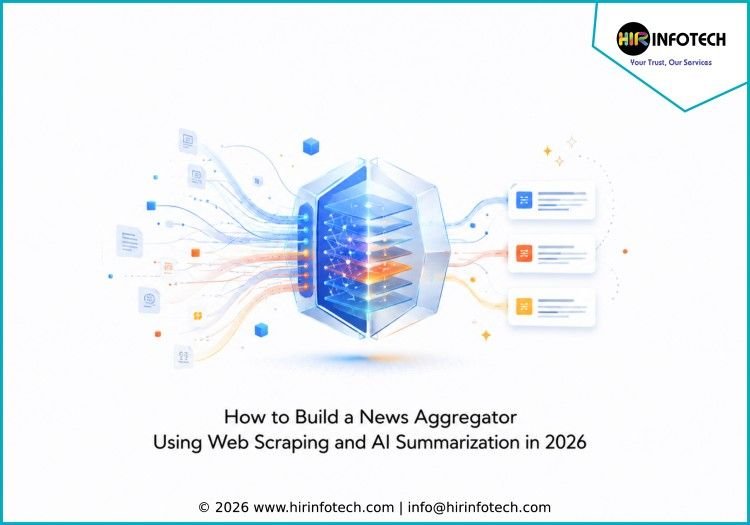
How to Build a News Aggregator Using Web Scraping and AI Summarization in 2026
In an information-dense corporate landscape, timing is everything. Whether monitoring market volatility, tracking geopolitical shifts, or managing brand reputation, business leaders require instantaneous access to global events. However, manually tracking hundreds of industry publications, regional outlets, and regulatory feeds is structurally impossible.
To bridge this gap, organizations are shifting toward automated internal intelligence. Building an enterprise-grade news aggregator that pairs precision data extraction with advanced Large Language Model (LLM) processing allows teams to consolidate fragmented data into structured, real-time insights.
This guide maps out the architecture, engineering workflows, and compliance guardrails required to design and build a resilient news aggregator using web scraping and AI summarization in 2026.
Why Automated News Aggregation Matters in 2026
Relying on off-the-shelf news feeds or manual curation creates immediate blind spots. Standard syndication networks often omit niche industry journals, local foreign-language reports, and localized regulatory updates.
Furthermore, simply gathering thousands of raw articles introduces an overwhelming amount of noise. Without intelligence at the collection layer, business units waste critical hours sorting through duplicate press releases, syndicated wire copies, and irrelevant content.
Integrating intelligent web scraping with natural language processing (NLP) solves both sides of the equation. It allows an enterprise to control its information pipelines entirely—determining exactly what sources are monitored, filtering out structural noise, and distilling thousands of words of dense reporting into concise, actionable executive summaries.
The Core Technical Architecture of an AI-Powered Aggregator
A robust news aggregation system consists of three distinct infrastructure layers: collection, transformation, and distribution. Each layer must run independently within a decoupled microservices architecture to ensure structural stability and handle sudden traffic spikes during major breaking news events.
1. The Collection Layer (AI-First Web Data Extraction)
The collection framework utilizes intelligent scrapers and enterprise web crawlers to monitor target destinations continuously. Rather than relying purely on static RSS feeds—which frequently omit the full body text of articles—the infrastructure actively interacts with live HTML layouts and document objects to extract complete textual data.
2. The Transformation Layer (Deduplication, Cleaning, and AI Processing)
Once data is extracted, it enters a processing pipeline where raw HTML markup is stripped away. The text is normalized, standardized to a uniform timezone, and deduplicated using hashing algorithms. The cleaned text is then fed into an AI summarization pipeline powered by specialized LLMs to extract key entities, analyze sentiment, and compile summaries.
3. The Distribution Layer (Storage and Delivery)
The final outputs—consisting of structured JSON objects containing metadata, full text, semantic vector embeddings, and condensed summaries—are pushed into enterprise databases. From there, the data feeds into internal business applications, specialized portals, or direct executive alert systems via REST APIs.
Step-by-Step Implementation Workflow
Building a reliable system requires a precise engineering sequence. Skipping foundational steps or failing to account for website structural changes will quickly lead to broken pipelines and corrupted datasets.
Step 1: Source Discovery and Inventory Mapping
Before writing a single line of code, data architecture teams must map the target data ecosystem. This involves auditing the required publications, identifying structural commonalities, and verifying how content is rendered. Engineers must classify sources into distinct buckets based on whether they are static HTML portals, dynamic JavaScript-heavy single-page applications, or sites guarded by sophisticated anti-bot walls.
Step 2: Designing the Web Scraping Pipeline
Traditional scraping relies on fragile CSS selectors or XPath expressions. When a publisher modifies their layout, these selectors instantly break, resulting in dropped fields or missing text. Modern architectures utilize vision-based extraction and LLM-guided parsing models to identify content elements like headers, authors, publishing dates, and main bodies based on context and visual hierarchy rather than rigid code tags. This ensures extraction stability even when a website undergoes a full front-end redesign.
Step 3: Managing Proxy Infrastructure and Bot Detection
News networks and large publishing groups implement strict rate limits and web application firewalls (WAFs) to protect their bandwidth. To extract data responsibly and avoid IP blocks, the collection layer must deploy a distributed proxy network. The infrastructure should feature automated proxy rotation, smart session retention, adaptive request delays, and machine learning models capable of solving CAPTCHAs and bypassing anti-bot systems in real time.
Step 4: Normalization and Content Deduplication
The same news story is frequently republished across dozens of syndication networks and regional affiliates. To prevent corporate users from reading identical updates repeatedly, the transformation pipeline must feature text deduplication. Using techniques like MinHash or Locality-Sensitive Hashing (LSH), the pipeline calculates textual similarity scores. If a newly scraped article matches an existing record above a specific threshold, it is flagged as a duplicate, linked to the primary piece, and filtered out of the primary summarization queue.
Step 5: Engineering the AI Summarization Engine
Feeding an entire 3,000-word investigative report into a generic public AI prompt often yields wordy, unfocused overviews. To produce enterprise-ready intelligence, companies must engineer structured summarization prompts and utilize fine-tuned LLMs. The model must be explicitly instructed to output data within clear constraints, enforcing structured categories such as core facts, executive takeaways, entities mentioned, and market sentiment. This structural enforcement allows internal business systems to parse the summary programmatically and display it cleanly within corporate dashboards.
Operational Challenges and Risk Mitigation
Operating a data infrastructure of this scale introduces distinct engineering, legal, and operational vulnerabilities that must be actively managed.
One primary challenge is data quality and the risk of AI hallucinations, where summaries might misinterpret complex data points and lead to inaccurate internal reporting. To mitigate this risk, teams must implement strict deterministic validation filters and anchor-text verification loops to ensure summaries only reference facts present in the raw source text.
Anti-bot countermeasures present another significant bottleneck as target domains frequently update firewall policies to block extraction pipelines. This requires the use of adaptive browser fingerprinting and AI-driven proxy rotation that closely mimics human browsing patterns.
Finally, legal and regulatory compliance is paramount. Aggregating copyrighted material can expose organizations to copyright or terms-of-service violations. To operate safely, businesses must restrict aggregation to publicly accessible data, respect robots.txt directives, enforce reasonable crawl rates, and use generated summaries strictly for internal decision support.
Powering Your Aggregator with Hir Infotech
Developing, scaling, and maintaining an internal web scraping and AI summarization framework demands immense engineering hours, complex proxy management, and constant maintenance. For global mid-market and enterprise organizations, outsourcing these technical complexities to a dedicated data partner ensures reliable execution with zero internal infrastructure overhead.
Hir Infotech specializes in enterprise-grade AI-Powered Content Aggregation Services, delivering structured, ready-to-use information streams tailored directly to your operational needs. With more than 13 years of specialized expertise in data extraction and advanced machine learning pipelines, Hir Infotech manages the entire data collection lifecycle for over 200 global enterprises across the USA, Europe, and Australia.
Our Specialized Capabilities Include:
- Intelligent AI-Driven Scraping: Our proprietary data pipelines use LLM-guided field extraction and multimodal computer vision to process millions of web pages simultaneously, achieving a proven 99.5% data accuracy rate regardless of changes to source website layouts.
- Advanced Anti-Bot Defenses: Built-in machine learning models dynamically bypass complex proxy blockages and WAF protections, ensuring a 99.9% adaptive crawling uptime.
- End-to-End Enterprise Compliance: All data collection pipelines are built around strict compliance frameworks, aligning fully with GDPR, the EU AI Act, and enterprise security standards.
- Custom NLP and Delivery Formats: Extracted data is cleaned, enriched, and structured into seamless delivery formats—including real-time REST APIs, webhooks, and secure database integrations—allowing your data science and strategy teams to focus entirely on analysis rather than data cleaning.
By partnering with Hir Infotech, your organization eliminates the friction of building, monitoring, and repairing broken scraping code, replacing manual processes with an automated, scalable market intelligence platform.
Frequently Asked Questions
Can an aggregation pipeline extract data from sites hidden behind login walls?
Yes, but extracting data behind user authentication requires explicit technical setup and compliance verification. Automated browsers must be programmed to handle authentication handshakes, manage session tokens, and securely store credential data. Organizations must ensure that bypassing login walls complies with the source platform’s terms of service and local data protection regulations.
How does the system handle foreign language news sources?
Advanced AI transformation pipelines handle translation naturally. Once a foreign language article is scraped, it passes through a neural translation layer or directly into a multilingual LLM. The system can be configured to summarize the article directly into English while preserving the original entities, regional context, and names, allowing global teams to monitor international markets seamlessly.
How often should the web scraping crawlers run?
The crawl frequency depends entirely on the volatility of the source and your specific operational requirements. Real-time market monitoring lines may require sub-minute checking frequencies or live scraping API integration. Conversely, general industry trends, policy changes, or regulatory updates typically use hourly or daily scheduled cron cycles to balance system performance and data freshness.
What is the advantage of using Hir Infotech over an in-house development team?
Building an in-house scraping operation requires continuous engineering attention to fix broken scripts, manage expensive rotating proxy networks, and build complex deduplication models. Hir Infotech provides a fully managed, enterprise-grade data feed with a guaranteed 99.9% uptime and 99.5% accuracy. This eliminates internal engineering overhead, proxy costs, and maintenance headaches, allowing your business to receive clean, decision-ready data from day one.
Driving Business Value Through Intelligent Automation
Building a custom news aggregator is no longer just a project for engineering teams—it is a core strategic asset for data-driven companies. By combining adaptive web scraping with fine-tuned AI summarization, organizations can turn the massive, unmanageable noise of the web into a clean, curated stream of business intelligence.
Success requires moving past fragile, legacy code and adopting modern, layout-agnostic data pipelines that scale effortlessly without breaking. Whether your company chooses to construct these advanced data systems internally or leverage the managed expertise of a dedicated partner like Hir Infotech, automating your information streams is the definitive way to secure a real-time competitive advantage.









