
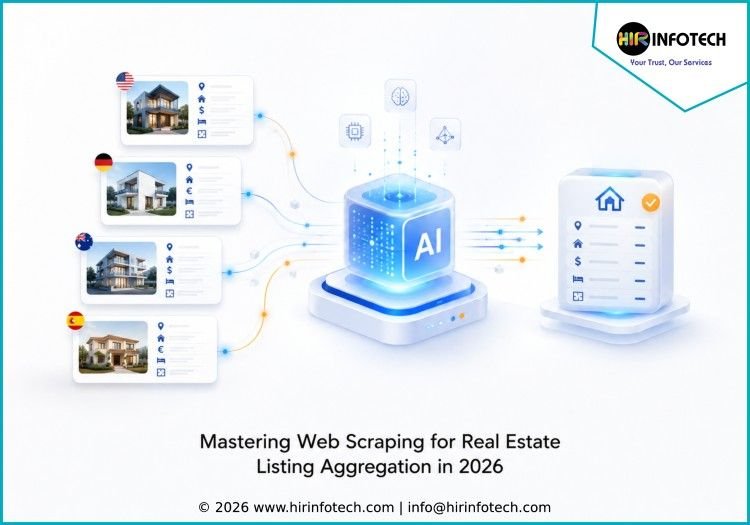
Mastering Web Scraping for Real Estate Listing Aggregation in 2026
The Operational Reality of Real Estate Aggregation in 2026
Aggregating real estate listings at scale involves compiling heterogeneous data from hundreds of disparate sources into a singular, normalized database. A functional data feed must capture a deep taxonomy of attributes for every property, including:
- Transactional Metrics: Current listing price, historical price revisions, tax assessments, and historical sales data.
- Physical Specifications: Square footage, room configurations, structural amenities, plot boundaries, and geographic coordinates.
- Market Context: Days on market (DOM), listing status updates (active, pending, contingent, or sold), and listing agent credentials.
- Visual Assets: High-resolution property imagery, floor plans, and metadata associated with virtual tours.
When executing this process across multiple countries or regional jurisdictions, companies run into immediate technical hurdles. Real estate portals do not follow a standardized architecture. A platform in the United States structures its data differently than a portal in Germany or Australia. Without an adaptive approach to extraction, data engineering teams spend more time fixing broken scripts than delivering business value.
Core Challenges in Enterprise-Scale Real Estate Data Extraction
To build a high-performance aggregation engine, technical leaders must overcome several structural and architectural barriers embedded in modern web ecosystems.
Advanced Anti-Bot Remediation and Captcha Walls
Major real estate portals protect their proprietary data using advanced Web Application Firewalls (WAFs) and behavioral AI detection mechanisms. These defensive systems analyze inbound traffic for non-human indicators, such as rigid request cadences, lack of browser fingerprinting, and inconsistent header telemetry. Traditional scraping configurations trigger immediate IP blocks or encounter sophisticated CAPTCHA challenges that stop data flows entirely.
Brittle DOM Architectures and Dynamic Layout Changes
Legacy web scrapers rely on Cascading Style Sheets (CSS) selectors and XML Path Language (XPath) expressions to locate data points within a web page’s Document Object Model (DOM). Real estate platforms frequently run continuous deployment pipelines, altering class names, modifying nesting structures, or running A/B tests on listing layouts. When a platform changes its front-end code, traditional scrapers fail to locate the target fields, resulting in missed updates or corrupted datasets.
Dynamic Single-Page Applications (SPAs)
Modern real estate portals are built as highly interactive Single-Page Applications utilizing frameworks like React, Angular, or Vue. These sites do not deliver fully formed HTML upon the initial server request. Instead, they stream content dynamically via background API endpoints or execute JavaScript locally in the user’s browser. Scraping these sources requires heavy browser rendering infrastructure that can rapidly inflate computational overhead if not optimized correctly.
Data Normalization and Schema Fragmentation
Even when data is successfully extracted, formatting inconsistencies present a severe downstream challenge. One portal may express listing prices in a single text string containing currency symbols (e.g., “$1,200,000”), while another splits the currency and numerical values into distinct elements. Properties may have amenities listed as unstructured text tags, requiring sophisticated parsing to convert raw text into a clean, queryable schema.
How AI-Driven Web Scraping Solves the Aggregation Bottleneck
To establish a resilient data pipeline, enterprises are replacing rigid extraction workflows with AI-driven web scraping. By integrating machine learning models, natural language processing (NLP), and computer vision into the extraction core, companies can build self-healing pipelines that adapt to structural changes autonomously.
Self-Healing Layout Adaptation
Instead of relying on fragile CSS selectors, AI-powered scrapers employ Large Language Model (LLM) components and vision-based parsing to interpret web pages much like a human analyst would. The system identifies a property’s price, bedroom count, or geographic location based on visual context and semantic meaning rather than its exact position in the underlying source code. If a portal updates its layout or shifts its data tables, the AI engine recognizes the target fields seamlessly, eliminating script downtime.
Behavioral Browser Evasion
Overcoming enterprise-grade anti-bot defenses requires an adaptive proxy management and fingerprinting framework. AI-driven scraping solutions utilize machine learning algorithms to orchestrate proxy rotation dynamically, distributing requests across diverse residential and mobile IP networks. Furthermore, these platforms emulate authentic user behavior by varying navigation paths, adjusting request pacing, and spoofing complete browser fingerprints, ensuring uninterrupted access to vital market listings.
Automated Multimodal Extraction
Real estate listings are deeply visual. Valuable property insights are often embedded directly within images, floor plans, or scanned PDF documents rather than plaintext HTML. Advanced AI extraction combines computer vision with multimodal processing to analyze images, scan architectural documents, and extract structured metadata from non-textual assets, providing a more comprehensive view of the property profile.
Driving PropTech and Investment Outcomes with High-Fidelity Feeds
Implementing a scalable aggregation infrastructure delivers measurable strategic advantages to data-centric real estate enterprises:
- Precision Automated Valuation Models (AVMs): Machine learning pricing engines require continuous inputs of comparable sales data, listing reductions, and hyper-local inventory trends. Clean, low-latency data feeds directly translate to tighter valuation tolerances and minimized risk profiles for institutional buyers and iBuyers.
- Compressed Time-to-Market for PropTech Platforms: Building real estate technology platforms requires substantial engineering focus on product features and user experiences. Offloading the data collection layer to an enterprise-grade ingestion infrastructure allows product teams to accelerate launch timelines without accumulating technical debt.
- Granular Market Velocity Tracking: By capturing real-time inventory adjustments and calculating precise days-on-market metrics, investment analysts can monitor hyper-local demand shifts, optimize rental yields, and deploy capital into high-velocity zip codes before broader market trends materialize.
Advanced Real Estate Data Ingestion with Hir Infotech
Enterprise Property Intelligence Fueled by Precision Engineering
As a specialized pioneer in AI-driven web scraping and data intelligence, Hir Infotech delivers robust, enterprise-grade real estate data extraction architectures designed for global scale. Backed by over 13 years of technical expertise, Hir Infotech manages complex ingestion pipelines that extract, clean, and structure more than 50 million property listings monthly across the United States, Europe, and Australia.
Hir Infotech’s extraction ecosystem replaces fragile, legacy parsing methods with a multi-layered, AI-native infrastructure. By blending LLM-guided field mapping with advanced computer vision, their platforms intelligently capture deep property attributes—including transaction history, zoning classifications, granular amenity matrices, and visual media assets—with an industry-leading 98.7% data accuracy rate.
Designed to eliminate internal engineering overhead, Hir Infotech handles the entire extraction lifecycle end-to-end. Their platform features adaptive anti-bot evasion mechanics, automated JavaScript rendering, and continuous proxy synchronization to bypass complex firewall constraints seamlessly. Whether fueling sophisticated PropTech AVM engines, equipping REIT portfolio managers with predictive market analytics, or providing localized brokerages with clean market intelligence, Hir Infotech converts raw, unstructured web listings into compliant, schema-consistent, and decision-ready datasets delivered via high-frequency APIs or secure cloud storage.
Architectural Compliance and Ethical Data Extraction
When executing large-scale data harvesting operations across global real estate portals, engineering and legal teams must adhere strictly to established data compliance frameworks.
Frequently Asked Questions
How does AI-driven web scraping handle real estate portals that frequently update their user interface layout?
AI-driven web scraping systems utilize machine learning models and semantic parsing rather than relying on fixed CSS or XPath selectors. By analyzing the visual hierarchy and contextual layout of a page, the AI can correctly identify and extract fields like “Price” or “Square Footage” even if the website’s underlying code structure changes completely.
Can your platforms extract real estate listing data hidden behind JavaScript or single-page applications?
Yes. Modern real estate scraping frameworks employ headless browser automation and execution layers that fully render JavaScript, mimic human scrolling patterns, and interact with complex page elements. This ensures complete data extraction from dynamic Single-Page Applications (SPAs) without missing lazy-loaded content.
What is the typical accuracy rate for data normalized through automated AI pipelines?
Enterprise data solutions, such as those provided by Hir Infotech, deliver a 98.7% to 99.5% accuracy rate. This high precision is achieved by combining machine learning extraction engines with automated data validation layers that automatically flag anomalies, filter out duplicate records, and standardize unstructured text strings before final delivery.
How do data ingestion pipelines manage property listings across different countries with varying formats?
Advanced aggregation engines deploy localized transformation schemas. The data pipelines ingest localized terminology (e.g., “plots” vs. “lots” or “square meters” vs. “square feet”), run them through an automated normalization layer, and output a standardized, unified schema optimized for cross-border analysis.
Conclusion
Sourcing high-fidelity property records via web scraping for real estate listing aggregation requires shifting away from brittle, manual script maintenance toward resilient, AI-driven web scraping architectures. By integrating machine learning models that autonomously navigate layout shifts, bypass anti-bot perimeters, and deliver normalized datasets, enterprises can build a reliable foundation for their core applications. Partnering with a dedicated enterprise data specialist like Hir Infotech enables PropTech platforms, investment firms, and brokerages to eliminate complex technical overhead, secure a sustainable data advantage, and focus internal resources entirely on extracting actionable market intelligence.









