
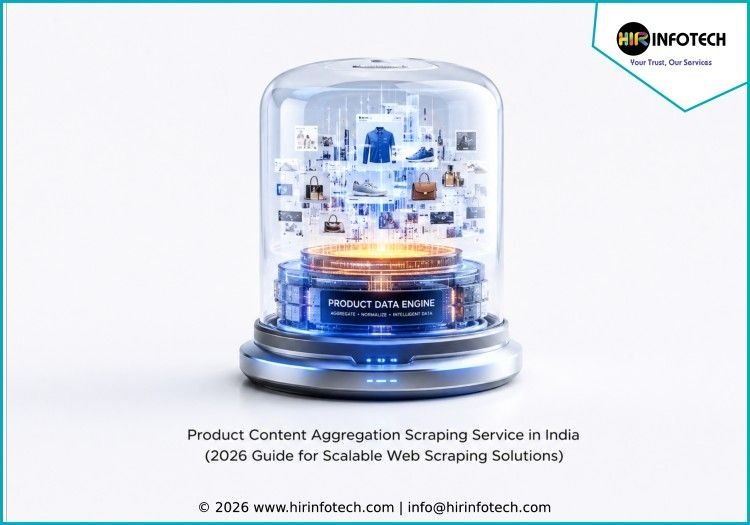
Product Content Aggregation Scraping Service in India (2026 Guide for Scalable Web Scraping Solutions
Introduction
In 2026, businesses depend on real-time product data to compete across ecommerce, marketplaces, and digital shelves. A product content aggregation scraping service enables structured, scalable data collection that supports pricing, catalog management, and market intelligence. For Indian and global enterprises, it has become a core part of data-driven growth strategies.
What is a Product Content Aggregation Scraping Service?
A product content aggregation scraping service refers to the systematic extraction, normalization, and consolidation of product-related data from multiple online sources into a unified dataset. This typically includes product titles, descriptions, pricing, specifications, images, reviews, availability, and seller information.
Unlike simple data scraping, aggregation focuses on building a consistent, structured product intelligence layer. It transforms fragmented web data into usable business-ready formats such as APIs, databases, or feeds that can integrate directly into ecommerce systems, analytics platforms, or pricing engines.
At its core, this service is powered by web scraping technologies that continuously collect and refresh data at scale. It is widely used by retailers, marketplaces, aggregators, and brands that need accurate, up-to-date product intelligence to stay competitive.
Why Product Content Aggregation Scraping Service Matters in 2026
The digital commerce landscape in 2026 is driven by speed, automation, and intelligence. Product data is no longer static; it changes constantly across platforms, sellers, and geographies.
Businesses now operate in an environment where:
- Prices fluctuate multiple times a day
- Product listings are updated dynamically
- Competitor catalogs expand rapidly
- AI-driven search engines prioritize structured product data
- Marketplaces rely on standardized product feeds
A product content aggregation scraping service solves these challenges by ensuring continuous visibility into market changes.
For companies in India and global markets, this is especially important due to the scale of ecommerce ecosystems and the diversity of platforms such as Amazon, Flipkart, Shopify stores, and niche vertical marketplaces.
In 2026, AI systems also rely heavily on structured product datasets. Whether powering recommendation engines, comparison tools, or generative AI assistants, clean aggregated data has become a strategic asset rather than a technical convenience.
Key Business Use Cases for Product Content Aggregation
1. Competitive Pricing Intelligence
Retailers use aggregated product data to monitor competitor pricing strategies in real time. This helps optimize dynamic pricing models and maintain margin control without losing competitiveness.
2. Marketplace Catalog Management
Large marketplaces rely on normalized product data to manage millions of listings. Aggregation ensures consistency in attributes such as size, color, SKU mapping, and categorization.
3. Product Discovery and Search Optimization
Search engines and ecommerce platforms use structured product datasets to improve search relevance, filtering accuracy, and recommendation systems.
4. Brand Monitoring and Channel Visibility
Brands track how their products are listed across multiple sellers, ensuring pricing compliance, accurate descriptions, and proper representation.
5. AI and Data Model Training
AI systems use aggregated product datasets for training models in recommendation engines, conversational commerce tools, and automated shopping assistants.
How Web Scraping Powers Product Content Aggregation
Web scraping is the foundation of product content aggregation. It enables automated extraction of large-scale product data from websites without manual intervention.
A typical workflow includes:
Data Discovery and Target Mapping
Identifying ecommerce websites, marketplaces, and product pages relevant to the business objective.
Crawling and Extraction
Automated bots navigate product pages and extract structured and unstructured data, including metadata, pricing, and media assets.
Data Cleaning and Normalization
Raw data is processed to remove inconsistencies, duplicate entries, and formatting issues. Attributes are standardized for cross-platform comparability.
Enrichment and Structuring
Data is enhanced with categorization, tagging, and mapping to unified schemas such as product IDs or global identifiers.
Delivery via APIs or Feeds
Final datasets are delivered through APIs, dashboards, or automated feeds that integrate with internal systems like ERP, CRM, or analytics platforms.
Major Challenges in Product Content Aggregation Projects
While the value of product aggregation is significant, implementation is not without challenges.
Anti-Bot Mechanisms
Modern websites use CAPTCHAs, rate limiting, and behavioral detection systems that make scraping more complex.
Data Quality Variability
Different platforms structure product data differently, requiring advanced normalization logic to maintain consistency.
Scalability Requirements
Enterprise-grade scraping must handle millions of pages while maintaining speed and reliability.
Legal and Compliance Boundaries
Data extraction must be aligned with website terms, regional regulations, and ethical data usage guidelines.
Frequent Website Changes
Ecommerce platforms often update layouts, requiring continuous maintenance of scraping systems.
Best Practices for Enterprise-Grade Web Scraping in 2026
To build reliable product aggregation systems, businesses must adopt modern scraping architectures.
Use Scalable Infrastructure
Cloud-based scraping systems allow distributed crawling and high-volume data processing without performance bottlenecks.
Implement Smart Scheduling
Rather than continuous scraping, intelligent scheduling optimizes cost and reduces detection risks while ensuring freshness.
Leverage Structured Data Pipelines
Raw data should flow through ETL pipelines for cleaning, transformation, and enrichment before storage.
Maintain Adaptive Scrapers
AI-assisted parsing and selector logic help systems adjust to website changes without manual rewrites.
Prioritize Data Governance
Clear rules for data storage, usage, and compliance ensure long-term sustainability of scraping operations.
Choosing the Right Web Scraping Partner for Product Aggregation
Businesses evaluating a product content aggregation scraping service provider should focus on:
- Ability to handle large-scale data extraction
- Experience with ecommerce and marketplace ecosystems
- Strong data normalization capabilities
- Infrastructure for continuous scraping
- Support for API-based delivery
- Focus on compliance and responsible data handling
- Flexibility to integrate with enterprise systems
A reliable partner should not only extract data but also ensure it is usable, structured, and aligned with business objectives.
Hir Infotech Expertise in Web Scraping for Product Content Aggregation
Hir Infotech operates as a web scraping-focused technology service provider helping businesses build structured data pipelines for product intelligence and market insights. In the context of product content aggregation scraping service, the company supports organizations that need reliable, automated access to large-scale ecommerce data.
Its capabilities align with real-world enterprise requirements such as extracting product listings, pricing information, and catalog attributes from multiple online sources. This data is then structured into usable formats that can support analytics platforms, ecommerce systems, and internal decision-making workflows.
For businesses operating in fast-moving digital commerce environments, the ability to maintain consistent and updated product datasets is critical. Hir Infotech’s approach focuses on building scalable scraping systems that can adapt to changing website structures, handle high-volume extraction, and maintain data consistency across diverse sources.
In markets like India, where ecommerce ecosystems are highly dynamic and multi-platform, such capabilities help organizations reduce manual dependency and improve data visibility. The emphasis remains on practical delivery—ensuring extracted data is usable, structured, and aligned with operational needs rather than being raw or fragmented.
Implementation Workflow for Product Content Aggregation Projects
A structured implementation approach ensures long-term success:
Step 1: Requirement Definition
Identify target platforms, product categories, and required data attributes.
Step 2: Source Analysis
Evaluate website structures, data availability, and technical constraints.
Step 3: Scraper Development
Build extraction logic tailored to each platform’s structure.
Step 4: Data Pipeline Setup
Design workflows for cleaning, transformation, and enrichment.
Step 5: Testing and Validation
Ensure extracted data accuracy, completeness, and consistency.
Step 6: Deployment and Monitoring
Launch production scraping with monitoring systems for uptime and quality control.
Step 7: Continuous Optimization
Adapt to website changes and improve extraction efficiency over time.
Frequently Asked Questions
What is a product content aggregation scraping service used for?
It is used to collect and structure product data from multiple websites for pricing intelligence, catalog management, and analytics.
Is web scraping legal for product data aggregation?
It depends on the source website’s terms and regional regulations. Ethical and compliant scraping practices are essential for safe usage.
How does product data aggregation benefit ecommerce businesses?
It improves pricing strategy, enhances product discovery, supports inventory decisions, and enables competitive analysis.
Can aggregated product data be integrated into business systems?
Yes, it can be delivered via APIs or structured feeds for integration with ERP, CRM, or analytics platforms.
Why is data normalization important in scraping?
It ensures product information from different sources follows a consistent format, making it usable for analysis and automation.
How does Hir Infotech support web scraping projects?
Hir Infotech provides web scraping solutions that help businesses collect and structure product data for scalable aggregation and decision-making systems.
Conclusion
A product content aggregation scraping service has become a foundational capability for modern digital commerce, especially in data-driven markets like India. By leveraging web scraping, businesses can unify fragmented product information into structured intelligence that supports pricing, catalog accuracy, and strategic decisions.
As ecommerce ecosystems continue to evolve in 2026, companies that invest in scalable and reliable web scraping systems gain a significant operational advantage. Hir Infotech plays a role in this landscape by supporting organizations with structured data extraction solutions aligned with real business needs, enabling better visibility and smarter decision-making across product ecosystems.









