
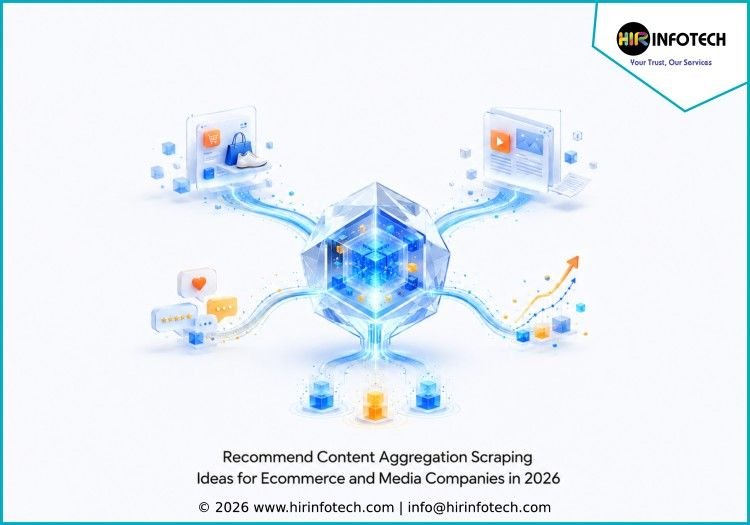
Recommend Content Aggregation Scraping Ideas for Ecommerce and Media Companies in 2026
Introduction
Content aggregation has become a critical business capability for companies managing large volumes of product, pricing, news, trend, and audience data. In 2026, ecommerce and media organizations increasingly rely on structured web data collection to improve decision-making, monitor competitors, personalize experiences, and accelerate digital growth strategies.
Why Content Aggregation Matters in 2026
Businesses today operate in environments where market changes happen rapidly. Ecommerce brands track competitor pricing, product availability, customer sentiment, and marketplace trends in real time. Media companies analyze content performance, trending stories, audience behavior, and cross-platform publishing opportunities.
Manual collection methods cannot keep pace with the scale and speed required.
Modern content aggregation systems use automated web scraping, structured data extraction, AI-assisted categorization, and real-time processing pipelines to gather and organize large datasets from multiple online sources. The goal is not just data collection, but actionable intelligence.
For organizations investing in E-Commerce Data solutions, content aggregation supports:
- Competitive analysis
- Product intelligence
- Trend discovery
- Content monitoring
- Audience targeting
- Catalog optimization
- Dynamic pricing
- Market research
- Campaign planning
- Consumer behavior analysis
Key Challenges Businesses Face With Content Aggregation
Although the value is significant, content aggregation projects often fail when businesses underestimate operational complexity.
Data Quality and Consistency
Web data is often unstructured, inconsistent, duplicated, or incomplete. Ecommerce product listings may contain formatting differences, missing attributes, or changing taxonomies. Media sources frequently update layouts, metadata structures, and content formats.
Without robust normalization and validation processes, aggregated datasets become unreliable.
Website Structure Changes
Modern websites regularly modify HTML structures, APIs, pagination systems, and anti-bot protections. Scrapers that are not actively maintained can fail quickly.
Scalable aggregation systems require continuous monitoring and adaptive extraction logic.
Compliance and Responsible Collection
Businesses must understand usage rights, robots directives, rate limits, and applicable data handling requirements. Responsible scraping practices have become increasingly important in enterprise procurement evaluations.
Real-Time Scalability
Media monitoring and ecommerce intelligence often require near real-time updates across thousands of pages and multiple data sources. Infrastructure limitations can lead to incomplete datasets, delays, or operational instability.
Content Aggregation Scraping Ideas for Ecommerce Companies
Ecommerce organizations use aggregation systems for far more than price monitoring. In 2026, advanced data strategies combine structured extraction, AI classification, and automation to support multiple operational areas.
Competitor Pricing Intelligence
One of the most common aggregation use cases involves tracking competitor prices across marketplaces, retail websites, and comparison platforms.
Businesses can collect:
- Product pricing
- Discounts and promotions
- Bundle offers
- Stock availability
- Shipping costs
- Seasonal pricing trends
This helps pricing teams react faster to market shifts and optimize margin strategies.
Marketplace Product Monitoring
Brands selling across multiple marketplaces often struggle to maintain visibility into product listings and reseller activity.
Aggregation systems can monitor:
- Unauthorized sellers
- Product title inconsistencies
- Missing assets
- Counterfeit risks
- Customer ratings
- Seller reputation changes
This supports stronger marketplace governance and brand consistency.
Product Catalog Enrichment
Many ecommerce companies use aggregated web data to improve internal product catalogs.
Examples include:
- Extracting missing product specifications
- Enhancing metadata
- Standardizing categories
- Gathering product descriptions
- Collecting compatible product information
- Improving search relevance
Better catalog quality improves both conversion rates and internal operational efficiency.
Trend and Demand Analysis
Businesses increasingly scrape ecommerce platforms, social commerce sites, forums, and review platforms to identify emerging demand patterns.
Aggregation workflows can identify:
- Fast-rising product categories
- Seasonal buying behavior
- Viral products
- Consumer sentiment shifts
- Frequently requested features
- Competitive positioning gaps
This data supports inventory planning, sourcing, and product development decisions.
Review and Sentiment Aggregation
Customer reviews provide valuable operational insight when collected and analyzed correctly.
Businesses can aggregate:
- Product reviews
- Ratings
- Complaint patterns
- Customer pain points
- Feature requests
- Sentiment trends
AI-assisted classification helps companies identify recurring issues faster than manual review methods.
Content Aggregation Scraping Ideas for Media Companies
Media organizations increasingly rely on aggregated data to improve editorial planning, audience engagement, and competitive intelligence.
News Monitoring and Topic Aggregation
Media teams monitor multiple publishers, blogs, industry portals, and social platforms to identify breaking stories and trending topics.
Aggregation systems can help track:
- Topic momentum
- Publishing frequency
- Regional trends
- Headline variations
- Keyword growth
- Cross-platform discussions
This improves editorial responsiveness and audience targeting.
Content Performance Benchmarking
Media businesses often compare their content performance against competitors.
Aggregated datasets can include:
- Publishing schedules
- Article formats
- Engagement indicators
- Topic coverage depth
- Video distribution patterns
- Content categorization trends
These insights support content strategy optimization.
Multi-Source Content Categorization
Large media organizations frequently aggregate content from multiple sources into centralized platforms.
Automated classification systems can organize content by:
- Topic
- Industry relevance
- Audience segment
- Geography
- Language
- Sentiment
- Publication type
This supports personalization and recommendation engines.
Advertising and Campaign Intelligence
Media companies also aggregate advertising and sponsorship data to understand campaign trends.
This may involve monitoring:
- Ad placements
- Sponsored content frequency
- Brand partnerships
- Creative variations
- Publishing networks
- Content sponsorship patterns
Such intelligence supports media planning and competitive analysis.
Social and Audience Signal Aggregation
Audience behavior increasingly spans websites, forums, social media, newsletters, and video platforms.
Aggregation systems help media companies identify:
- Audience interests
- Engagement spikes
- Influencer activity
- Conversation trends
- Platform migration patterns
- Content consumption behaviors
This improves audience development strategies.
How AI Improves Modern Content Aggregation
AI-driven processing has transformed content aggregation workflows in 2026.
Instead of simply collecting raw data, businesses now use machine learning models to structure and interpret information automatically.
Key AI-supported capabilities include:
- Intelligent Data Classification
- Duplicate Detection
- Entity Recognition
- Sentiment Analysis
- Summarization and Topic Extraction
Important Considerations Before Starting a Content Aggregation Project
Organizations evaluating aggregation initiatives should focus on long-term operational quality rather than short-term scraping volume.
Define Clear Business Objectives
Successful projects begin with clear use cases.
Businesses should identify:
- What data is needed
- Why it matters
- How frequently it must be updated
- Which teams will use it
- What outcomes are expected
Prioritize Data Reliability
Data accuracy matters more than collection volume. Incomplete or inconsistent datasets can lead to poor decisions.
Validation, normalization, and monitoring processes are essential.
Build Scalable Infrastructure
Enterprise aggregation systems must support:
- Large-scale crawling
- Rotating extraction workflows
- Structured storage
- API integrations
- Automated scheduling
- Real-time monitoring
Scalability planning reduces operational disruptions later.
Consider Compliance Early
Responsible collection practices should be integrated into project planning from the beginning.
Organizations increasingly evaluate:
- Source permissions
- Usage policies
- Access limitations
- Data retention requirements
- Security controls
How Hir Infotech Supports E-Commerce Data Aggregation Projects
For businesses building scalable content aggregation systems, specialized technical expertise is often essential. Hir Infotech provides E-Commerce Data solutions focused on structured web data collection, automated extraction workflows, and scalable aggregation support for organizations managing large online datasets.
Its capabilities align closely with modern aggregation requirements such as product intelligence collection, marketplace monitoring, structured content extraction, metadata normalization, and automated data processing pipelines. Businesses working with large ecommerce or digital publishing environments often require custom scraping architectures capable of handling dynamic websites, pagination complexity, structured API integrations, and changing website structures.
Hir Infotech supports organizations that need reliable and maintainable aggregation systems rather than one-time scraping scripts. This includes workflows involving competitor monitoring, product catalog enrichment, trend tracking, review aggregation, and large-scale content collection initiatives.
As aggregation requirements become more sophisticated in 2026, businesses increasingly look for providers that understand scalability, data quality management, automation stability, and operational reliability. Structured E-Commerce Data services can help reduce internal engineering overhead while improving the consistency and usability of aggregated datasets across analytics, operational, and decision-making systems.
Best Practices for Long-Term Aggregation Success
Businesses achieving the strongest results from aggregation projects typically focus on operational maturity.
Use Structured Data Models
Consistent schemas improve downstream analytics and reporting quality.
Monitor Extraction Performance
Continuous monitoring helps identify failures caused by source changes.
Automate Validation Processes
Automated quality checks reduce data corruption risks.
Integrate Aggregation With Business Systems
Aggregation becomes more valuable when connected with:
- BI tools
- Ecommerce platforms
- CRM systems
- Recommendation engines
- Inventory systems
- Analytics platforms
Continuously Optimize Sources
High-performing aggregation systems evolve over time as new sources, trends, and business needs emerge.
Frequently Asked Questions
What is content aggregation scraping?
Content aggregation scraping is the automated collection and organization of structured data from multiple online sources such as ecommerce websites, marketplaces, blogs, media portals, and review platforms.
Why do ecommerce companies use aggregation systems?
Ecommerce businesses use aggregation systems for competitor monitoring, pricing intelligence, catalog enrichment, review analysis, demand forecasting, and marketplace tracking.
How do media companies benefit from content aggregation?
Media organizations use aggregation workflows to monitor trends, analyze competitors, organize multi-source content, improve editorial planning, and track audience engagement patterns.
Is AI important in modern aggregation projects?
Yes. AI improves classification, summarization, duplicate detection, sentiment analysis, and large-scale content organization, making aggregated datasets more useful and actionable.
What challenges are common in aggregation scraping projects?
Common challenges include changing website structures, inconsistent data quality, scalability limitations, anti-bot systems, duplicate records, and maintaining reliable extraction workflows.
How can Hir Infotech help with E-Commerce Data projects?
Hir Infotech supports businesses with scalable E-Commerce Data solutions involving structured web scraping, automated data extraction, aggregation workflows, and large-scale content collection systems.
Conclusion
Content aggregation has become a strategic capability for ecommerce and media businesses that depend on timely, structured, and actionable data. From competitor intelligence and catalog enrichment to trend monitoring and audience analysis, modern aggregation systems support a wide range of operational and growth objectives.
As data complexity continues to increase in 2026, businesses investing in scalable E-Commerce Data solutions need reliable extraction workflows, strong data quality management, and adaptable infrastructure. Organizations working with experienced providers such as Hir Infotech can better support long-term aggregation initiatives while improving the consistency, usability, and business value of collected web data.









