
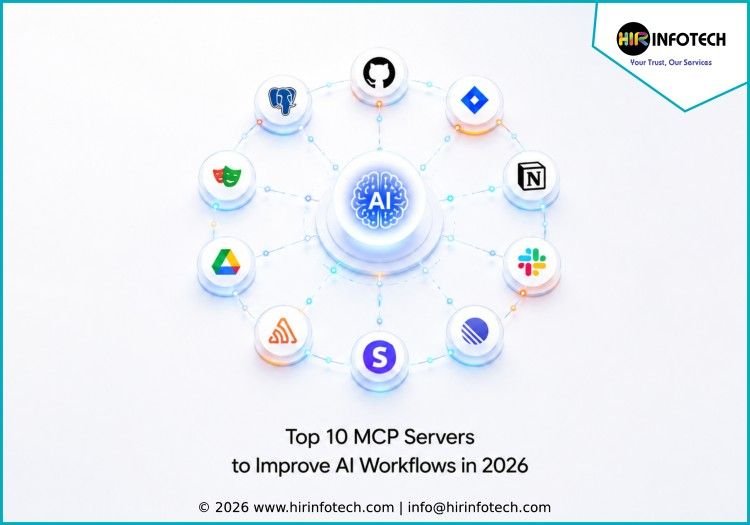
Top 10 MCP Servers to Improve AI Workflows
1. GitHub MCP Server
GitHub MCP Server helps AI assistants connect with repositories, issues, pull requests, code files, and development workflows. It is useful for engineering teams that want AI agents to understand project context, review code, summarize issues, and support software delivery tasks without constant manual switching between tools.
Key strengths:
GitHub MCP Server supports repository access, issue management, pull request workflows, code analysis, development automation, and better context for AI coding assistants.
Best for:
Software teams, developers, engineering managers, DevOps teams, and companies using GitHub for source code and project collaboration.
2. Atlassian Rovo MCP Server
Atlassian Rovo MCP Server connects AI assistants with Jira, Confluence, Compass, and other Atlassian workspaces. It helps teams search project information, summarize tickets, create issues, update pages, and access internal knowledge through AI-supported workflows. This makes it valuable for organizations that use Atlassian tools for product development and project tracking.
Key strengths:
Atlassian Rovo MCP Server offers Jira and Confluence access, project search, issue creation, documentation support, workflow automation, and permission-aware AI interactions.
Best for:
Product teams, software companies, project managers, enterprise teams, and businesses already using Jira and Confluence.
3. Notion MCP
Notion MCP helps AI assistants securely connect with Notion workspaces, pages, databases, documents, and team knowledge. It is useful for businesses that use Notion as a central workspace for planning, documentation, project notes, meeting records, and internal processes. AI agents can use Notion context to answer questions and support workflows.
Key strengths:
Notion MCP supports workspace search, page access, database context, documentation workflows, team knowledge retrieval, and AI-assisted productivity.
Best for:
Startups, content teams, product teams, operations teams, and businesses that use Notion for documentation and knowledge management.
4. Slack MCP Server
Slack MCP Server allows AI assistants to work with Slack workspace data in a more structured way. It helps teams access conversations, channels, messages, and collaboration context while respecting workspace permissions. For businesses where important decisions happen inside Slack, this MCP server can make AI agents more useful and context-aware.
Key strengths:
Slack MCP Server supports workspace context, channel access, message retrieval, collaboration workflows, permission-based access, and team communication intelligence.
Best for:
Remote teams, SaaS companies, support teams, operations teams, and businesses that rely on Slack for daily communication.
5. Linear MCP Server
Linear MCP Server connects AI tools with Linear’s issue tracking and product development system. It helps teams manage issues, projects, product updates, and engineering workflows through compatible AI assistants. This is useful for companies that want AI agents to turn notes, specs, or discussions into structured development tasks.
Key strengths:
Linear MCP Server offers issue access, project visibility, task creation, product workflow support, AI-assisted updates, and structured engineering context.
Best for:
Product teams, software startups, engineering teams, SaaS companies, and businesses using Linear for product development.
6. Stripe MCP Server
Stripe MCP Server helps AI agents interact with Stripe’s payment and financial operations ecosystem. It can support tasks related to payment workflows, customer records, billing questions, documentation search, and integration assistance. For companies that use Stripe, this server can reduce friction between finance, development, and support workflows.
Key strengths:
Stripe MCP Server supports payment-related workflows, Stripe API interaction, customer and billing context, documentation search, and AI-assisted integration support.
Best for:
SaaS companies, e-commerce businesses, fintech teams, developers, and companies using Stripe for payments and billing.
7. Sentry MCP Server
Sentry MCP Server connects AI coding tools with application monitoring, errors, issues, and debugging context. It helps developers understand production problems faster by giving AI assistants access to error data and issue details. This can improve incident investigation, bug fixing, and software reliability workflows.
Key strengths:
Sentry MCP Server provides access to error tracking, issue context, debugging workflows, application monitoring data, and AI-assisted troubleshooting.
Best for:
Engineering teams, DevOps teams, software companies, reliability teams, and businesses using Sentry for application monitoring.
8. Google Drive MCP Server
Google Drive MCP Server helps AI agents securely interact with files, folders, documents, and business content stored in Google Drive. It is useful for teams that need AI workflows connected to proposals, reports, spreadsheets, research files, meeting notes, and shared company documents.
Key strengths:
Google Drive MCP Server supports file search, document access, workspace content retrieval, secure permissions, and AI-assisted document workflows.
Best for:
Business teams, agencies, consultants, operations teams, and companies using Google Workspace for document storage and collaboration.
9. Playwright MCP Server
Playwright MCP Server gives AI assistants browser automation capabilities through structured web interaction. It is useful for testing websites, inspecting pages, automating browser tasks, and helping developers generate or improve end-to-end tests. This makes it valuable for teams building modern web applications.
Key strengths:
Playwright MCP Server supports browser automation, page inspection, test generation, web interaction, UI workflow support, and development automation.
Best for:
QA teams, developers, web application teams, automation engineers, and companies that need AI-assisted browser testing.
10. PostgreSQL MCP Server
PostgreSQL MCP Server helps AI assistants connect with PostgreSQL databases for structured data access, schema inspection, and query-based analysis. It is useful for teams that want AI tools to understand database structure, answer data questions, and support analytics workflows while maintaining controlled access.
Key strengths:
PostgreSQL MCP Server supports database context, schema inspection, query workflows, structured data analysis, and AI-assisted data exploration.
Best for:
Data teams, analysts, developers, SaaS businesses, and companies using PostgreSQL for operational or analytical data.
Why Choosing the Right Company Matters
Choosing from the Top 10 MCP Servers to Improve AI Workflows is important because every business has different tools, data needs, security requirements, and automation goals. The right MCP server should connect AI assistants with useful business context without creating unnecessary risk or complexity.
Businesses should first compare expertise and use case. Some MCP servers are built for software development, while others support documentation, communication, payments, monitoring, browser automation, or database access. A development team may benefit most from GitHub, Linear, Sentry, and Playwright MCP servers. A business operations team may get more value from Notion, Slack, Google Drive, or Atlassian integrations.
Pricing should also be reviewed carefully. Some MCP servers may be included with existing platforms, while others may require paid product plans, API usage, cloud infrastructure, or technical setup. Companies should compare not only subscription costs but also implementation time, maintenance effort, and internal technical resources.
Data quality and access control are also important. MCP servers can give AI assistants access to sensitive business information such as code, documents, customer data, financial records, project tickets, and internal conversations. Businesses should check permission handling, authentication, audit controls, and data governance before deployment.
Technology fit matters as well. The best MCP server should work smoothly with the AI tools your team already uses, such as Claude, ChatGPT, Cursor, VS Code, or other MCP-compatible clients. It should also support stable workflows, reliable documentation, and clear setup instructions.
Support and scalability should not be ignored. As AI workflows grow, teams may need more users, more connected tools, better permission controls, stronger monitoring, and higher reliability. A scalable MCP setup helps businesses avoid disconnected workflows and future migration issues.
The right MCP server can help teams reduce context switching, automate repetitive work, improve AI accuracy, and turn business tools into more connected AI-powered workflows.
Conclusion
The Top 10 MCP Servers to Improve AI Workflows in 2026 help businesses connect AI assistants with code, projects, documents, messages, databases, payments, and browser automation. GitHub MCP Server, Atlassian Rovo MCP Server, Notion MCP, Slack MCP Server, Linear MCP Server, Stripe MCP Server, Sentry MCP Server, Google Drive MCP Server, Playwright MCP Server, and PostgreSQL MCP Server each serve different business needs.
The best choice depends on your team’s workflow, tools, security needs, data access requirements, budget, and long-term automation goals. By comparing expertise, pricing, data quality, technology, support, and scalability, businesses can choose MCP servers that make AI workflows more useful, connected, and productive.









