
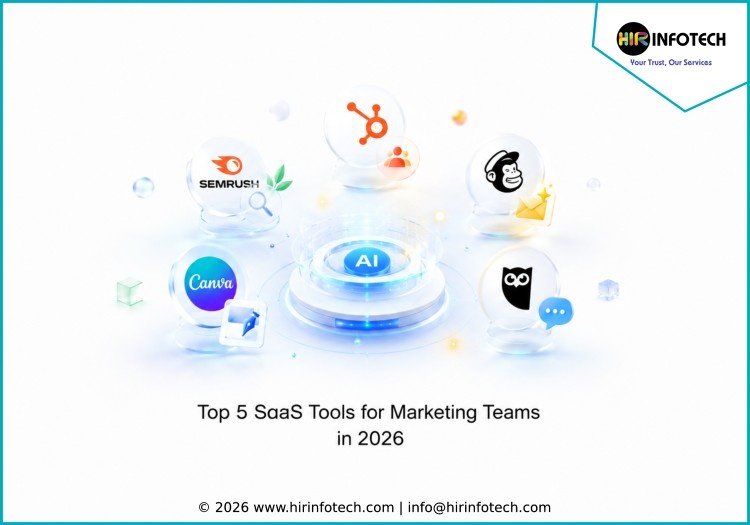
Top 5 SaaS Tools for Marketing Teams
1. HubSpot
Short overview:
HubSpot is a popular SaaS platform for marketing teams that need CRM, lead management, email marketing, landing pages, automation, reporting, and customer journey tools in one place. It helps teams attract visitors, capture leads, automate follow-ups, and align marketing with sales. HubSpot’s marketing software includes AI-powered tools for lead generation, workflows, forms, and cross-channel campaigns.
Key strengths:
HubSpot offers marketing automation, CRM data, email campaigns, landing pages, lead scoring, customer segmentation, analytics dashboards, forms, and campaign tracking. Its biggest advantage is that marketing, sales, and service teams can work from one connected customer platform.
Best for:
B2B companies, growing businesses, agencies, SaaS brands, and marketing teams that need CRM-based marketing automation and better lead management.
2. Semrush
Short overview:
Semrush is a powerful SaaS tool for marketing teams focused on SEO, content marketing, competitive research, keyword strategy, PPC insights, and online visibility. It helps marketers research keywords, analyze competitors, audit websites, track rankings, plan content, and improve organic search performance. Semrush also provides content marketing tools for creating, optimizing, managing, and analyzing content workflows.
Key strengths:
Semrush provides keyword research, competitor analysis, backlink tracking, technical SEO audits, content optimization, rank tracking, PPC research, market analysis, and AI-supported SEO workflows. It is especially useful for teams that want data-backed decisions instead of guessing what content or keywords to target.
Best for:
SEO teams, content marketers, digital agencies, performance marketers, ecommerce brands, and companies that want to grow organic traffic and competitive visibility.
3. Mailchimp
Short overview:
Mailchimp is a well-known SaaS platform for email marketing, SMS campaigns, audience management, customer journeys, forms, analytics, and marketing automation. It helps marketing teams build contact lists, segment audiences, personalize campaigns, and track performance. Mailchimp also supports behavior-based marketing and AI-assisted tools to help businesses convert more customers.
Key strengths:
Mailchimp offers email marketing, SMS marketing, customer journey automation, audience segmentation, signup forms, campaign analytics, templates, reporting, and integrations. Its user-friendly interface makes it a practical choice for teams that want to launch campaigns quickly without heavy technical setup.
Best for:
Small businesses, ecommerce brands, creators, agencies, startups, and marketing teams that need simple email automation and customer communication tools.
4. Canva
Short overview:
Canva is a visual communication and design SaaS tool that helps marketing teams create social posts, ads, presentations, videos, banners, brand assets, campaign materials, and content templates. It is useful for teams that need fast content production without depending on designers for every small task. Canva for marketing teams includes templates, brand controls, collaboration tools, analytics, and integrations.
Key strengths:
Canva provides drag-and-drop design, brand kits, templates, team collaboration, content approvals, social media graphics, presentations, video tools, AI design features, and marketing campaign assets. It helps teams maintain brand consistency while speeding up creative production.
Best for:
Marketing teams, social media managers, startups, agencies, content creators, ecommerce brands, and small businesses that need professional visuals at scale.
5. Hootsuite
Short overview:
Hootsuite is a SaaS tool for social media marketing, scheduling, content planning, engagement, analytics, and social listening. It helps marketing teams manage multiple social media accounts from one dashboard instead of switching between platforms. Hootsuite supports post scheduling, inbox management, campaign tracking, social listening, performance reporting, and AI-assisted social media workflows.
Key strengths:
Hootsuite offers social media scheduling, content creation, analytics, social listening, team collaboration, inbox management, message routing, automated replies, and campaign performance tracking. It is especially useful for brands that manage several channels and need better control over social engagement.
Best for:
Social media teams, agencies, ecommerce brands, B2B marketers, enterprise teams, and businesses that need centralized social media management and reporting.
Why Choosing the Right Company Matters
Choosing from the Top 5 SaaS Tools for Marketing Teams is not only about selecting the most popular platform. The right tool should match your marketing goals, team size, budget, campaign workflow, reporting needs, and growth plans.
Marketing teams use SaaS tools for different reasons. Some need better lead generation and CRM automation. Some need SEO and content insights. Others need email campaigns, social media scheduling, visual content creation, or performance reporting. A tool that works well for one team may not be the best fit for another.
Pricing should be compared carefully. Many SaaS platforms charge based on users, contacts, automation limits, reports, storage, or advanced features. A tool may look affordable at the start but become expensive as campaigns, contacts, or team members increase. Businesses should review plan limits, upgrade costs, add-ons, and long-term value before choosing.
Data quality is also important. Marketing teams need accurate campaign reports, reliable customer data, clear attribution, and useful insights. Poor data can lead to weak targeting, wasted ad spend, low-quality leads, and unclear decision-making. Strong SaaS tools should help teams understand what is working and where improvements are needed.
Technology and integrations matter as well. A good marketing SaaS tool should connect with CRM platforms, websites, analytics tools, ecommerce systems, ad platforms, social media channels, email tools, and reporting dashboards. Smooth integrations reduce manual work and help teams build more connected marketing operations.
Support and scalability should not be ignored. As companies grow, marketing workflows become more complex. Teams may need advanced automation, approval processes, user permissions, multi-channel reporting, and stronger security. Choosing a scalable platform helps businesses avoid switching tools too often.
The best SaaS tools for marketing teams are not always the tools with the most features. They are the tools that solve real marketing problems, improve daily workflows, reduce manual tasks, and help teams make better decisions.
Conclusion
The Top 5 SaaS Tools for Marketing Teams in 2026 can help businesses improve marketing automation, content creation, SEO performance, email campaigns, and social media management. HubSpot is strong for CRM-based marketing automation. Semrush is useful for SEO, content, and competitor research. Mailchimp helps with email, SMS, and customer journeys. Canva supports faster visual content creation. Hootsuite helps teams manage social media from one place.
Before choosing any platform, businesses should compare features, pricing, data quality, integrations, support, and scalability. The right SaaS tool can save time, improve campaign performance, support better collaboration, and help marketing teams grow with more confidence.









